
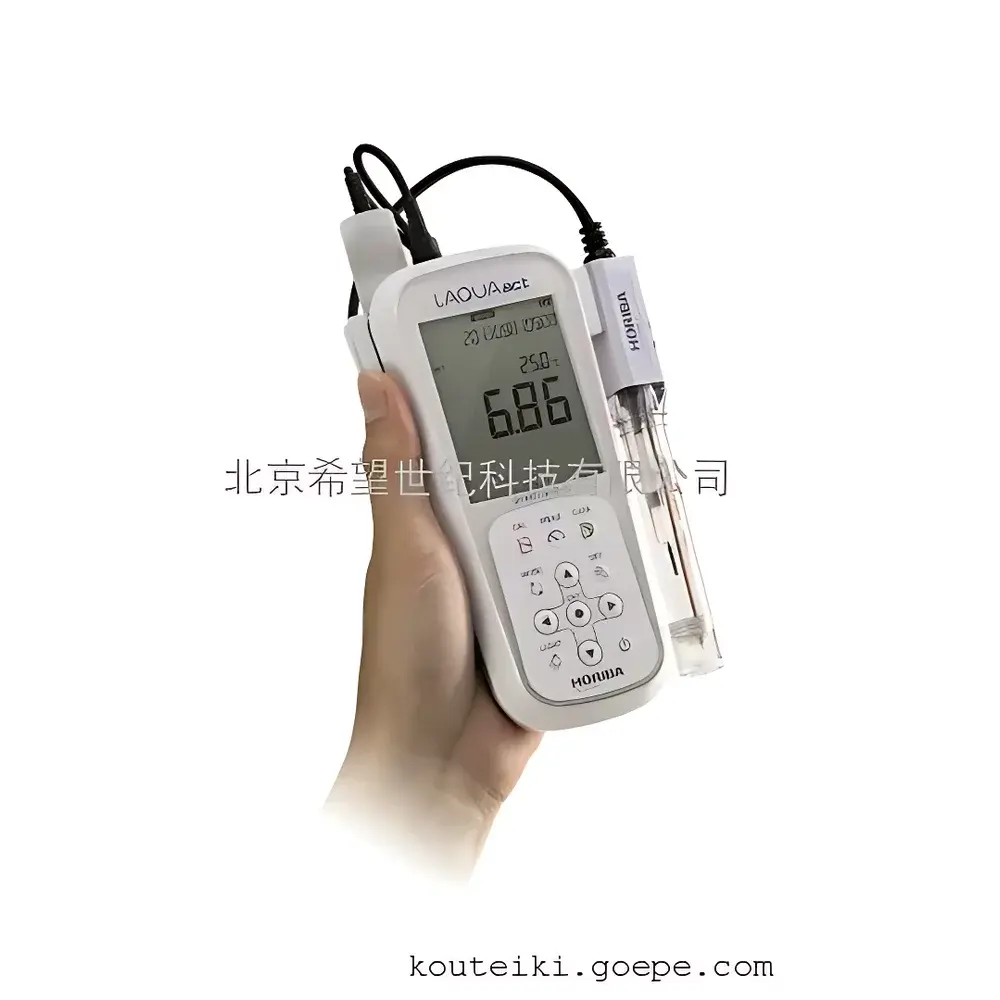
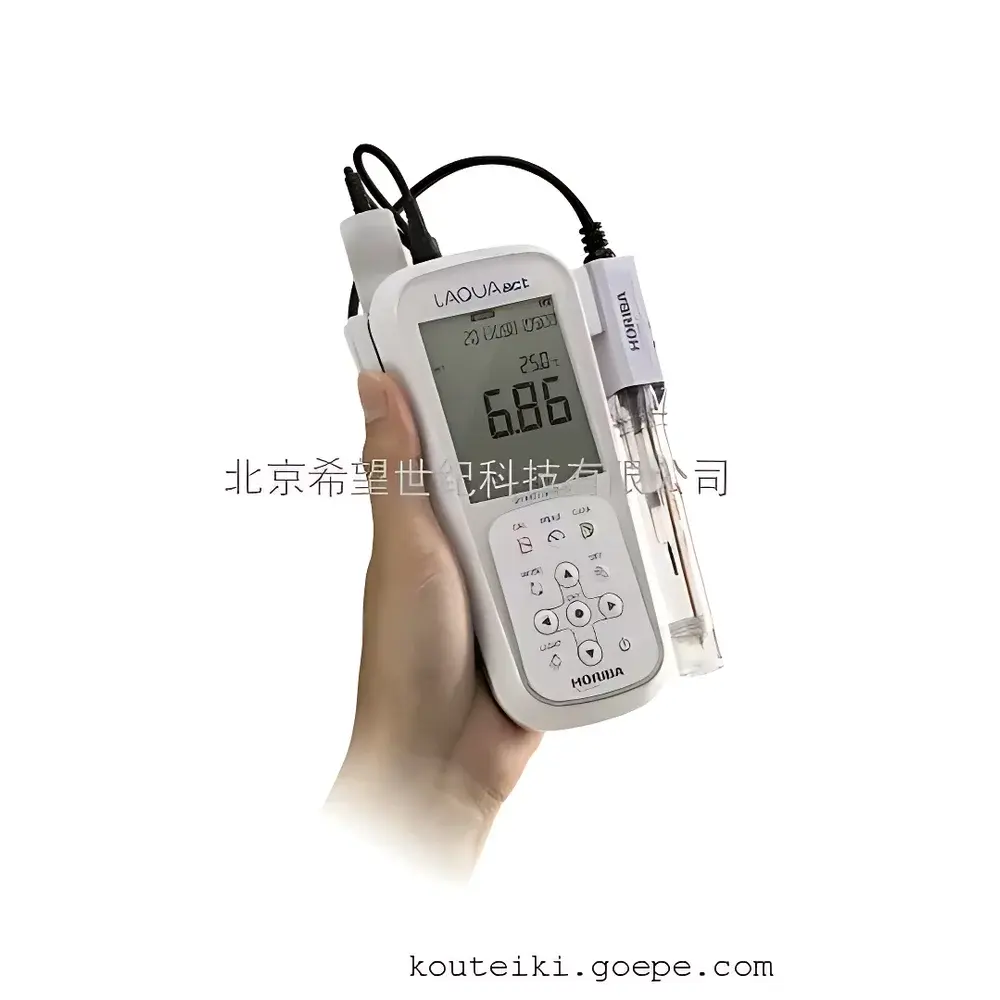
HORIBA OM-71 Portable Dissolved Oxygen Meter
| Brand | HORIBA |
|---|---|
| Origin | Japan |
| Model | OM-71 |
| Instrument Type | Portable/Handheld Water Quality Analyzer |
| Measured Parameter | Dissolved Oxygen (DO) |
| Measurement Principle | Membrane-Type Galvanic Cell |
| DO Range | 0.00–20.00 mg/L |
| Saturation Range | 0.0–200.0 % |
| Oxygen Concentration Range | 0.0–50.0 % |
| Resolution | 0.01 mg/L / 0.1 % |
| Temperature Compensation | 0–40 °C |
| Salinity Compensation | 0–40 ppt |
| Atmospheric Pressure Compensation | Yes |
| Accuracy | ±0.1 mg/L ±1 digit (DO), ±0.1 % (saturation), ±0.1 °C (temperature) |
| Repeatability | ±0.1 mg/L ±1 digit |
| Operating Environment | 0–45 °C, RH 0–80 % (non-condensing) |
| Protection Rating | IP67 |
| Display | Backlit monochrome LCD |
| Data Storage | 1,000 measurements with timestamp, ID, and temperature |
| Interface | USB for PC connectivity |
| Power | 2× AAA alkaline or Ni-MH batteries (≈500 h operation) |
| Dimensions | 67 × 28 × 170 mm (W×D×H, thickest point) |
| Weight | ≈270 g (without batteries) |
Overview
The HORIBA OM-71 Portable Dissolved Oxygen Meter is a field-deployable, ruggedized instrument engineered for precise, on-site measurement of dissolved oxygen (DO) concentration in natural waters, wastewater, aquaculture systems, and process streams. It employs a membrane-type galvanic cell sensor — a self-powered electrochemical transducer that generates a current proportional to the partial pressure of molecular oxygen diffusing through a gas-permeable Teflon membrane. This principle ensures stable zero-point performance, minimal polarization drift, and no requirement for external polarization voltage — critical advantages for long-duration field monitoring and battery-operated use. The OM-71 operates within a calibrated DO range of 0.00–20.00 mg/L, with simultaneous display of saturation (%DO) and oxygen concentration (%O₂), all automatically compensated for temperature (0–40 °C), atmospheric pressure, and salinity (0–40 ppt). Its IP67-rated housing enables reliable operation in rain, splashing, dust-laden environments, and brief submersion — meeting the durability expectations of environmental field technicians, regulatory inspectors, and water utility personnel.
Key Features
- Rugged IP67-rated enclosure constructed from impact-resistant, alcohol-resistant polymer — certified for immersion up to 1 m for 30 minutes and complete dust ingress protection.
- Backlit monochrome LCD with high-contrast characters optimized for outdoor readability under direct sunlight or low-light conditions.
- Integrated temperature sensor (0.0–100.0 °C display range; ±0.1 °C accuracy) enabling real-time automatic temperature compensation during DO measurement.
- Onboard atmospheric pressure correction using built-in barometric sensing — essential for accurate DO reporting across elevation gradients (e.g., mountain lakes, high-altitude treatment plants).
- Salinity compensation algorithm compliant with Winkler-derived standard curves, supporting accurate DO quantification in estuarine, brackish, and coastal applications.
- AutoHold function freezes stabilized readings for documentation; AutoPowerOff conserves battery life with user-configurable timeout and real-time battery-level indicator.
- GLP/GMP-compliant data logging: stores 1,000 measurement records with timestamp, sample ID, temperature, DO value, % saturation, % O₂, and sensor status flags.
Sample Compatibility & Compliance
The OM-71 is validated for use with freshwater, seawater, wastewater effluents, groundwater, and recirculating aquaculture system (RAS) water. Its galvanic DO probe is compatible with turbid, low-flow, and biofouling-prone matrices when used with recommended maintenance protocols (e.g., membrane replacement every 6–12 months, electrolyte refill per manufacturer schedule). The instrument complies with ISO 5814:2012 (Water quality — Determination of dissolved oxygen — Electrochemical probe method) and supports adherence to EPA Method 360.1 and ASTM D888-12 for field DO analysis. Its data structure and audit trail capabilities align with basic GLP requirements; when paired with HORIBA’s optional LAQUA software and USB interface, full 21 CFR Part 11 compliance (electronic signatures, secure audit logs, user access control) can be implemented in regulated laboratory settings.
Software & Data Management
Data export is supported via USB connection to Windows-based PCs using HORIBA’s LAQUA Software Suite (v3.x or later). The software enables batch download, time-series visualization, statistical summary (mean, SD, min/max), customizable report generation (PDF/CSV), and calibration history tracking. All logged entries include immutable metadata: date/time stamp, operator ID, instrument serial number, probe ID, temperature, pressure, salinity, and sensor diagnostic flags (e.g., membrane integrity warning, electrolyte depletion alert). The OM-71 itself maintains independent storage without requiring continuous PC connection — ensuring uninterrupted field operation during multi-day surveys or remote site visits.
Applications
- Regulatory compliance monitoring: Routine DO checks at NPDES discharge points, watershed health assessments, and Clean Water Act-mandated reporting.
- Aquaculture management: Real-time optimization of aeration in hatcheries, raceways, and net-pen operations to prevent hypoxia stress in finfish and shellfish.
- Wastewater treatment: Tracking DO profiles across activated sludge basins, oxidation ditches, and membrane bioreactors to support process control and energy efficiency initiatives.
- Environmental research: Long-term DO profiling in lakes, rivers, and wetlands to assess eutrophication trends, thermal stratification effects, and climate-driven deoxygenation patterns.
- Drinking water distribution: Verification of residual DO in post-chlorination storage tanks and booster station reservoirs to mitigate corrosion and biofilm formation.
FAQ
What calibration standards are required for the OM-71?
The OM-71 uses a single-point air-saturation calibration (100 % DO at local temperature, pressure, and salinity) performed via the onboard menu. Zero-point calibration is not required for galvanic sensors under normal operation.
Can the OM-71 measure DO in high-turbidity or viscous samples?
Yes — the membrane electrode design minimizes flow-dependence and fouling sensitivity. For sustained accuracy in suspended-solids-rich media, periodic membrane cleaning and scheduled replacement are recommended.
Does the OM-71 support traceable calibration certificates?
Calibration verification is traceable to NIST-traceable DO standards when used with HORIBA-certified calibration kits (e.g., OM-CAL-KIT-1); instrument-specific calibration reports are generated in LAQUA software.
Is the OM-71 suitable for ISO/IEC 17025-accredited laboratories?
When operated within documented SOPs, maintained per HORIBA’s service schedule, and integrated with validated data handling workflows, the OM-71 meets technical requirements for accredited environmental testing — subject to lab-specific validation per ISO/IEC 17025:2017 Clause 7.7.
How often should the DO membrane and electrolyte be replaced?
HORIBA recommends membrane replacement every 6–12 months depending on usage frequency and sample matrix; electrolyte replenishment is required every 2–3 months or after membrane change.
Related Products







