
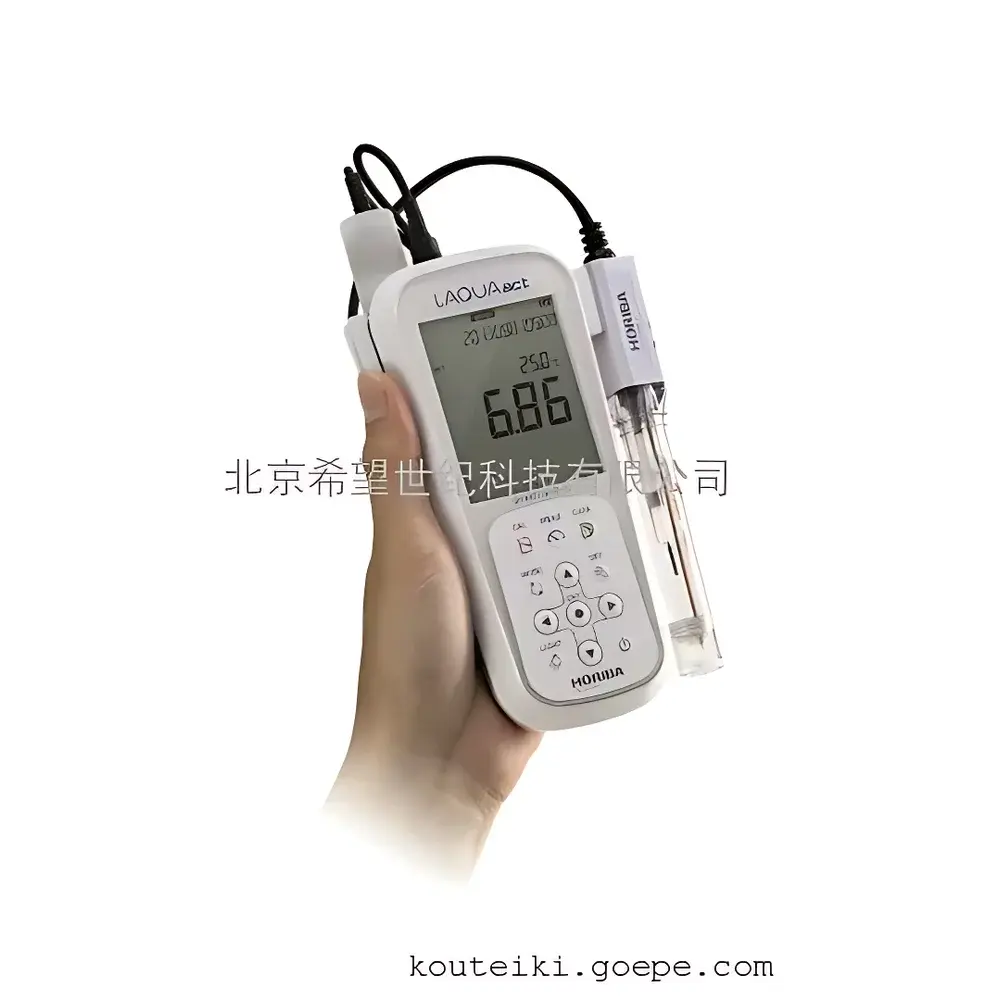
HORIBA OM-71 Portable Dissolved Oxygen Meter
| Brand | HORIBA |
|---|---|
| Origin | Japan |
| Model | OM-71 |
| Instrument Type | Portable/Handheld Water Quality Analyzer |
| Measurement Parameter | Dissolved Oxygen (DO) |
| Detection Principle | Membrane-Type Galvanic Cell |
| Temperature Compensation Range | 0–40 °C |
| Salinity Compensation Range | 0–40 ppt |
| Atmospheric Pressure Compensation | Yes |
| DO Range | 0.00–20.00 mg/L |
| Resolution | 0.01 mg/L |
| Accuracy | ±0.1 mg/L ±1 digit |
| Saturation DO Range | 0.0–200.0 % |
| Oxygen Concentration Range | 0.0–50.0 % |
| Display | Backlit Monochrome LCD |
| Data Storage | 1,000 measurements with timestamp, ID, and temperature |
| Environmental Rating | IP67 |
| Operating Temperature | 0–45 °C |
| Power | 2× AAA alkaline or Ni-MH batteries (≈500 h life) |
| Dimensions | 67 × 28 × 170 mm (max thickness 80 mm) |
| Weight | 270 g (body only) |
Overview
The HORIBA OM-71 is a rugged, field-deployable dissolved oxygen (DO) meter engineered for high-reproducibility measurements in environmental monitoring, wastewater treatment, aquaculture, and freshwater/saltwater research. It employs a membrane-type galvanic cell sensor—a stable, zero-power-consumption electrochemical transducer that generates a current proportional to the partial pressure of molecular oxygen diffusing through a gas-permeable Teflon membrane. This principle ensures long-term baseline stability and eliminates the need for external polarization voltage, reducing drift and maintenance frequency. The instrument integrates automatic temperature compensation (0–40 °C), atmospheric pressure correction (via built-in barometric sensor or manual entry), and salinity compensation (0–40 ppt), enabling accurate DO quantification across diverse aquatic matrices—from low-salinity rivers to coastal seawater—without recalibration between sites. Designed for compliance with standard field protocols, the OM-71 delivers traceable, GLP-aligned data under ISO/IEC 17025–informed operational conditions.
Key Features
- IP67-rated housing for full dust ingress protection and immersion resistance up to 1 m for 30 minutes—validated for harsh outdoor, riverbank, and marine deployment.
- Backlit monochrome LCD with large-character display ensures legibility under direct sunlight or low-light conditions; AutoHold function freezes stable readings for recording without error-prone manual transcription.
- Integrated real-time clock, sample ID tagging, and 1,000-measurement internal memory with timestamp, temperature, DO concentration, saturation %, and O2 %—all stored in non-volatile memory without SD card dependency.
- Dual-parameter capability: When paired with compatible HORIBA D-70 series main units (e.g., D-75), the OM-71 sensor module supports simultaneous DO + pH, ORP, conductivity, or salinity measurement—enabling multi-parameter profiling in single immersion events.
- Self-diagnostic system continuously monitors electrode response kinetics and membrane integrity; post-calibration status indicators confirm sensor readiness before field use.
- Low-power architecture: Operates on two AAA alkaline or rechargeable Ni-MH cells with ≤2 mA standby current and ≈500 hours of continuous operation—meeting EPA Method 360.1 and ASTM D888 field endurance expectations.
Sample Compatibility & Compliance
The OM-71 is validated for use with natural waters (freshwater, estuarine, seawater), treated effluents, aquaculture tanks, and process streams where DO concentrations fall within 0.00–20.00 mg/L. Its galvanic sensor exhibits minimal flow dependence above 10 cm/s, permitting static immersion or gentle stirring without agitation artifacts. All calibration and measurement procedures align with international standards including ASTM D888-22 (Standard Test Methods for Dissolved Oxygen in Water), ISO 5814:2012 (Water quality — Determination of dissolved oxygen — Electrochemical probe method), and US EPA Method 360.1. Data output supports GLP/GMP audit trails via optional RS-232 or USB-to-serial interface, enabling traceable export to LIMS or Excel-compatible formats with full metadata (operator ID, location tag, calibration history, environmental conditions).
Software & Data Management
No proprietary software installation is required for basic operation. Raw measurement files (CSV format) are exported directly via serial communication using standard terminal emulators or HORIBA’s LAQUA Connect utility (Windows/macOS). Each record includes: date/time stamp, user-defined sample ID, measured DO (mg/L), saturation (%), O2 concentration (%), temperature (°C), atmospheric pressure (hPa), salinity (ppt), and sensor status flag. The instrument logs calibration events—including date, buffer values used, slope, and offset—satisfying FDA 21 CFR Part 11 requirements when paired with validated electronic signature workflows. Firmware updates are delivered via HORIBA’s secure support portal, with version-controlled release notes and validation documentation available upon request.
Applications
- Regulatory water quality monitoring per national discharge permits (e.g., NPDES, EU WFD)
- Biochemical oxygen demand (BOD) incubation tracking in wastewater labs
- Aquaculture pond management—real-time hypoxia detection and aeration control
- River and lake stratification studies, including diel DO profiling
- Field validation of online DO sensors in treatment plants
- Educational fieldwork and undergraduate environmental science laboratories
FAQ
What calibration standards are required for the OM-71?
The OM-71 uses a two-point calibration: zero oxygen (sodium sulfite solution) and saturated air (100% air-saturated water at known temperature and pressure). NIST-traceable DO standards are recommended for regulatory reporting.
Can the OM-71 measure DO in high-turbidity or viscous samples?
Yes—the galvanic sensor is insensitive to suspended solids; however, biofouling or oil films on the membrane must be cleaned prior to measurement using mild detergent and deionized water.
Is the sensor compatible with third-party data loggers?
Only via HORIBA’s official D-70/D-75 host platforms; analog or digital outputs are not exposed for external integration.
How often should the membrane and electrolyte be replaced?
HORIBA recommends membrane replacement every 6 months under normal use, and electrolyte refill every 3 months—or immediately after exposure to hydrogen sulfide, heavy metals, or organic solvents.
Does the OM-71 meet drinking water testing requirements?
It complies with ISO 5814 and ASTM D888 for field DO determination but is not certified for direct compliance with WHO or US EPA drinking water regulations (which require laboratory-grade benchtop analyzers for final compliance reporting).
Related Products







