
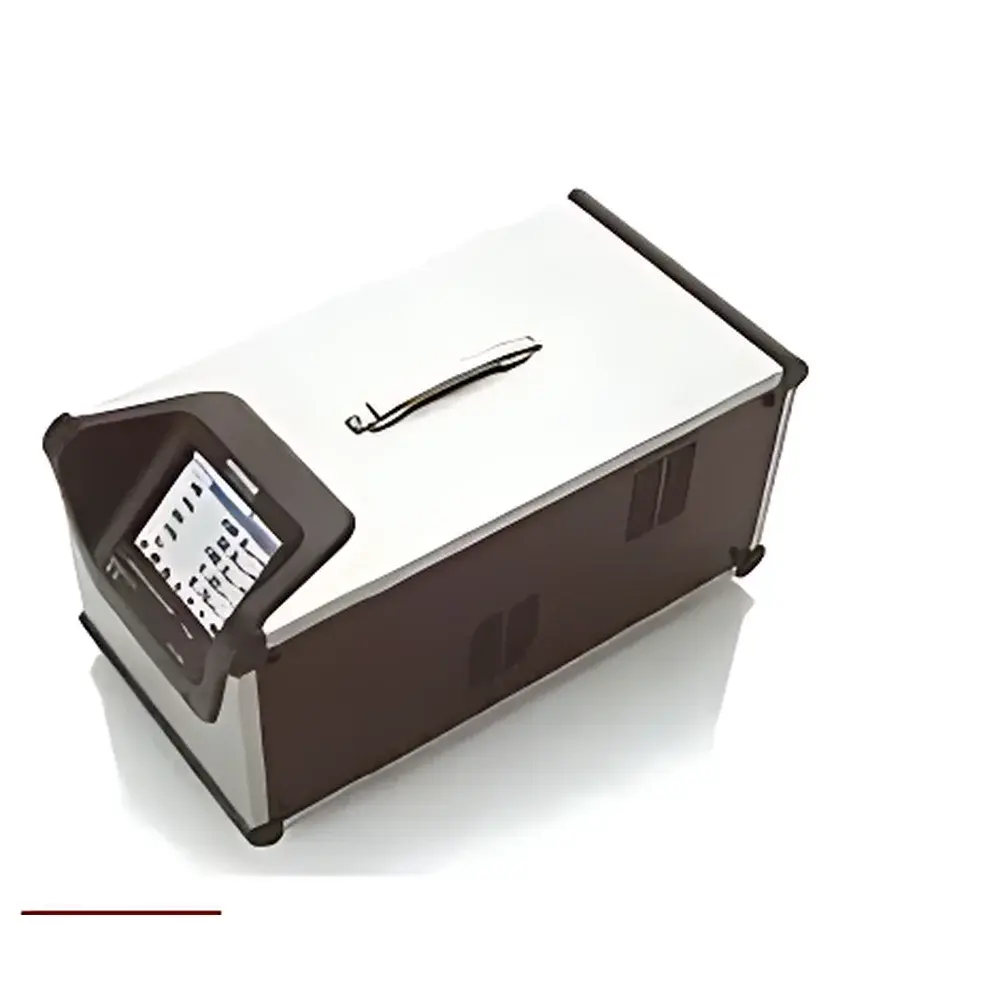
HORIBA PG-300 Series Portable Flue Gas Analyzer
| Brand | HORIBA |
|---|---|
| Origin | Japan |
| Model | PG-300 Series |
| Detection Principles | Pulsed Flow Modulation Chemiluminescence (NOₓ), Pulsed Flow Modulation NDIR (SO₂, CO, CH₄), Broadband NDIR (CO₂), Galvanic Cell (O₂) |
| Measured Gases | SO₂, NOₓ, CO, CO₂, O₂, CH₄ (optional) |
| Range | NOₓ: 0–2500 ppm (7 ranges), SO₂: 0–3000 ppm (4 ranges), CO: 0–5000 ppm (5 ranges), CO₂: 0–30 vol% (3 ranges), O₂: 0–25 vol% (3 ranges), CH₄: 0–5000 ppm |
| Accuracy | ±1.0% F.S. (±2.0% F.S./day for SO₂) |
| Repeatability | ±1.0% F.S. |
| Linearity | ±2.0% F.S. |
| T90 Response Time | ≤45 s (SO₂: ≤180 s) |
| Sample Flow Rate | ~0.5 L/min |
| Warm-up Time | 30 min (±2.0% F.S. stabilized within 2 h) |
| Display | Color TFT LCD with touch interface, real-time trend graphs & step-by-step operation guidance |
| Data Storage | SD card (user-configurable interval) |
| Outputs | 4–20 mA analog, Ethernet |
| Power Supply | 100–120 VAC / 200–240 VAC, 50/60 Hz |
| Dimensions | 226 × 265 × 510 mm (W×H×D) |
| Weight | ~14 kg |
| Operating Environment | 5–40 °C, ≤85% RH |
| Certifications | TÜV (EU), MCERTS (UK), GOST-R (Russia), ETV (US), China Metrology Certification (CMC), Korea Metrology Certification, Japan JIS/JCSS |
Overview
The HORIBA PG-300 Series Portable Flue Gas Analyzer is an engineered solution for high-fidelity, on-site measurement of combustion exhaust and process gases. Designed to deliver laboratory-grade accuracy under field conditions, the PG-300 employs multiple gas-specific detection principles in a single compact platform: pulsed flow modulation chemiluminescence for NOₓ, pulsed flow modulation non-dispersive infrared (NDIR) for SO₂, CO, and CH₄, broadband NDIR for CO₂, and electrochemical galvanic cell sensing for O₂. This multi-principle architecture ensures minimal cross-sensitivity, robust baseline stability, and compliance with international performance criteria for continuous emission monitoring systems (CEMS). Its portable form factor—weighing just 14 kg and featuring integrated shock-absorbing mechanical design—enables rapid deployment across industrial stacks, engine test cells, catalyst evaluation rigs, and university research laboratories without compromising metrological integrity.
Key Features
- Multi-gas capability: Simultaneous real-time quantification of SO₂, NOₓ, CO, CO₂, and O₂; optional CH₄ channel expands applicability to biogas and fuel reforming studies.
- Optimized field responsiveness: 30-minute warm-up time and T90 response ≤45 seconds (≤180 s for SO₂) support time-critical transient measurements during combustion tuning or regulatory audits.
- Intuitive human-machine interface: 7-inch color TFT touchscreen with graphical trend display, context-sensitive operational guidance, and on-screen calibration status tracking.
- Integrated sample conditioning: Built-in electronic condensate trap with automatic/manual drainage and programmable purge cycles ensure stable moisture management without external chillers.
- Full-system traceability: On-device calibration log storage (including zero/span timestamps, drift values, and operator ID), exportable via SD card for GLP/GMP audit trails.
- Flexible data handling: SD-card logging at user-defined intervals (1 s to 1 h); dual-output configuration supporting 4–20 mA analog transmission and IEEE 802.3 Ethernet for SCADA integration.
Sample Compatibility & Compliance
The PG-300 is validated for use with hot, humid, and particulate-laden flue gases typical of coal-, oil-, and gas-fired boilers, municipal waste incinerators, cement kilns, and internal combustion engines. Its heated sampling line (standard option) and internal thermal management maintain sample integrity across ambient temperatures from 5 to 40 °C and relative humidity up to 85% RH. The analyzer meets or exceeds key international regulatory requirements including EN 15267-3 (EU), MCERTS (UK), EPA Method 6C/7E/10 (US), ISO 12039 (CO/CO₂), ISO 6974 (CH₄), and China’s HJ 75–2017 and HJ 76–2017 standards for CEMS verification. All certified configurations include full documentation packages compliant with ISO/IEC 17025 and FDA 21 CFR Part 11 (electronic records and signatures) when paired with HORIBA’s optional secure data management software.
Software & Data Management
Data acquisition and post-processing are supported by HORIBA’s proprietary PG-Link software suite, compatible with Windows-based workstations. PG-Link enables remote configuration, live parameter visualization, automated report generation (PDF/CSV), and spectral diagnostics for sensor health assessment. Calibration history, alarm logs, and raw time-series datasets are timestamped with UTC synchronization and stored with cryptographic hash verification to prevent tampering. For enterprise-level deployment, the PG-300 supports Modbus TCP and OPC UA protocols over Ethernet, allowing seamless integration into centralized environmental monitoring platforms and cloud-based analytics infrastructure. All firmware updates are digitally signed and delivered via secure HTTPS channels to maintain system integrity.
Applications
- CEMS backup and verification: Rapid validation of fixed-installation analyzers during maintenance windows or regulatory inspections.
- Combustion optimization: Real-time stoichiometric analysis for burner tuning, excess air control, and NOₓ/SO₂ minimization in thermal power plants.
- Catalyst development: In situ gas composition profiling during catalytic converter testing, SCR deNOₓ evaluation, and Fischer–Tropsch synthesis studies.
- Mobile emissions testing: On-road and off-road engine certification per ISO 8178, SAE J1939, and EU Stage V protocols.
- Academic research: Quantitative gas kinetics modeling, fuel reforming efficiency assessment, and greenhouse gas flux quantification in controlled lab environments.
- Industrial hygiene and safety: Spot-checking of confined-space atmospheres where O₂ deficiency or toxic gas accumulation poses occupational risk.
FAQ
What gas detection technologies does the PG-300 employ?
It combines pulsed flow modulation chemiluminescence (NOₓ), pulsed flow modulation NDIR (SO₂, CO, CH₄), broadband NDIR (CO₂), and galvanic cell electrochemistry (O₂) — each optimized for selectivity, stability, and low maintenance.
Can the PG-300 be used as a primary CEMS analyzer?
No — it is certified as a portable reference analyzer and CEMS backup device. For permanent CEMS installation, HORIBA offers the stationary PG-350R and PG-360 series with enhanced redundancy and 24/7 operational qualification.
How is calibration traceability maintained?
All calibrations are performed using NIST-traceable standard gases; calibration events are logged with operator ID, date/time, span gas concentration, and post-calibration verification results — all exportable via SD card.
Is the PG-300 suitable for high-dust applications?
Yes — when equipped with the optional heated filter probe and cyclonic pre-filter, it handles particulate concentrations up to 5 g/m³ without signal degradation or sensor fouling.
Does the analyzer support remote diagnostics?
Yes — Ethernet connectivity enables secure remote access for firmware updates, configuration changes, and real-time diagnostic telemetry including sensor voltage outputs, temperature gradients, and flow rate stability metrics.
Related Products







