
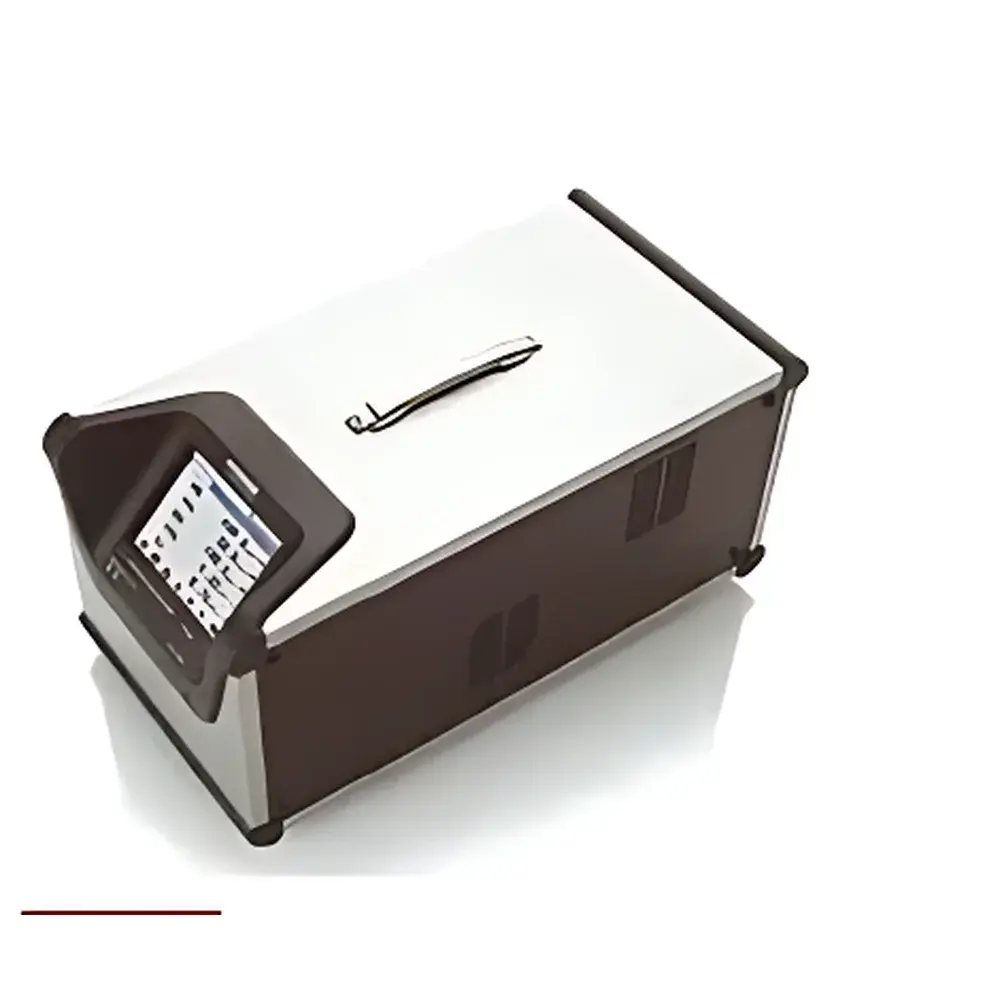
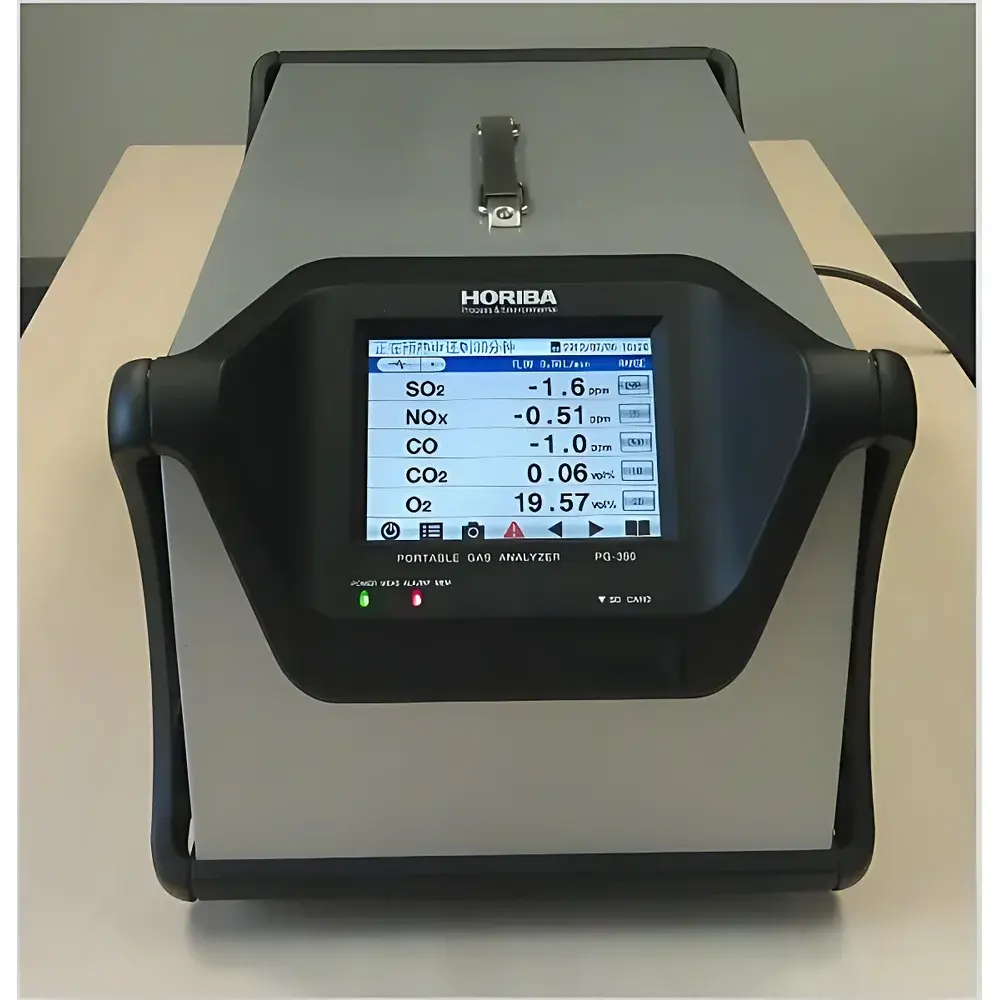
HORIBA PG-350 Portable Flue Gas Analyzer
| Brand | HORIBA |
|---|---|
| Origin | Japan |
| Model | PG-350 |
| Instrument Type | Portable Flue Gas Analyzer |
| Accuracy | ≤1.0% FS |
| Repeatability | ≤1.0% FS |
| Response Time (T90) | ≤45 s (SO₂ ≤180 s) |
| Stability | ≤2.0% FS/2 h |
| Measured Gases | SO₂, NO, CO, O₂, CO₂ (optional CH₄) |
| Detection Principles | Pulsed Flow Modulation Chemiluminescence (NOₓ), Pulsed Flow Modulation NDIR (SO₂, CO, CH₄), Broadband NDIR (CO₂), Galvanic Cell (O₂) |
| Sample Flow Rate | ~0.5 L/min |
| Display | Color TFT Touchscreen with Real-time Trend Plotting |
| Data Storage | SD Card (user-configurable interval) |
| Output Interfaces | 4–20 mA analog, Ethernet |
| Warm-up Time | 30 min |
| Operating Environment | 5–40 °C, ≤85% RH |
| Dimensions | 226 × 265 × 510 mm (W×H×D) |
| Weight | ~14 kg |
Overview
The HORIBA PG-350 Portable Flue Gas Analyzer is an engineered solution for high-fidelity, on-site measurement of combustion exhaust gases in regulatory, industrial, and research environments. Designed and manufactured in Japan, the PG-350 employs a combination of validated physical detection principles—including pulsed flow modulation chemiluminescence for NOₓ, pulsed flow modulation non-dispersive infrared (NDIR) spectroscopy for SO₂, CO, and CH₄, broadband NDIR for CO₂, and galvanic electrochemical sensing for O₂—to deliver laboratory-grade accuracy under field conditions. Its architecture supports simultaneous quantification of five core flue gas components (SO₂, NO, CO, CO₂, O₂), with optional CH₄ capability, across multi-range configurations optimized for diverse emission sources—from low-emission boilers to high-concentration industrial stacks. The instrument meets stringent metrological requirements defined by international standards bodies, including ISO 12039, EN 15267, and EPA Method 6C/7E, and has received formal type approval from TÜV (EU), MCERTS (UK), GOST-R (Russia), ETV (USA), and national metrology institutes in China, Korea, and Japan.
Key Features
- Compact, ruggedized portable design weighing only ~14 kg—20% lighter than prior-generation equivalents—enabling single-operator deployment across rooftops, boiler rooms, and mobile monitoring platforms.
- Integrated electronic condensate management system with automatic/manual drainage and programmable anti-condensation heating, ensuring stable sample conditioning without external chillers or dryers.
- High-resolution color TFT touchscreen with intuitive icon-driven interface, real-time trend curve visualization, and context-sensitive on-screen guidance for calibration, diagnostics, and operation.
- Multi-range auto-scaling gas channels: NOₓ (0–25 to 2500 ppm, 7 ranges), SO₂ (0–200 to 3000 ppm, 4 ranges), CO (0–200 to 5000 ppm, 5 ranges), CO₂ (0–10 to 30 vol%), O₂ (0–5 to 25 vol%), and CH₄ (0–2000/5000 ppm).
- Full-system calibration traceability—including heated sampling probe, particulate filter, and internal optical/electrochemical cells—validated against certified reference gases per ISO 6145 and ASTM D6522.
- Onboard data logging via removable SD card with user-defined sampling intervals (1 s to 1 h); time-stamped records include raw sensor outputs, diagnostic flags, and calibration metadata.
Sample Compatibility & Compliance
The PG-350 is designed for direct extraction of hot, humid, and particulate-laden flue gas streams up to 200 °C (with optional high-temp probe). Its heated sampling line (120–180 °C) prevents acid gas condensation and sulfate deposition, while the integrated particulate filter (5 µm cutoff) protects optical cells and electrochemical sensors. All gas measurements comply with GLP-aligned data integrity protocols: audit trails for calibration events, user authentication logs, and tamper-evident file encryption on SD storage. Regulatory compliance includes full alignment with EU Directive 2010/75/EU (IED), China’s HJ 75–2017 and HJ 76–2017, US EPA Performance Specification 2 (PS-2), and ISO 14001 environmental management system integration requirements.
Software & Data Management
Data acquisition and configuration are managed through HORIBA’s proprietary PG-Link software suite, compatible with Windows-based PCs and supporting remote firmware updates, batch report generation (PDF/CSV), and automated compliance reporting templates for CEMS backup validation. Ethernet connectivity enables seamless integration into plant-wide SCADA or DCS systems using Modbus TCP or custom RESTful API endpoints. All analog 4–20 mA outputs are independently configurable per gas channel with NIST-traceable span verification. Internal clock synchronization supports GPS-timestamped measurements where required for cross-site correlation studies.
Applications
- Continuous Emission Monitoring System (CEMS) backup and periodic verification in power plants, cement kilns, and waste incinerators.
- Combustion optimization and air-to-fuel ratio tuning in industrial boilers and thermal oxidizers.
- Catalyst performance evaluation in SCR/SNCR denitrification and desulfurization pilot units.
- Engine and fuel cell exhaust characterization during R&D and certification testing (e.g., ISO 8178, SAE J1939-74).
- Academic and governmental air quality surveys requiring traceable, field-deployable multi-gas analysis.
- Environmental consultancy services conducting stack testing per ISO 10849 and EPA Method 3A/6C.
FAQ
What gas detection principles does the PG-350 employ?
It uses pulsed flow modulation chemiluminescence for NOₓ, pulsed flow modulation NDIR for SO₂/CO/CH₄, broadband NDIR for CO₂, and galvanic electrochemical sensing for O₂.
Is the PG-350 suitable for high-moisture flue gas applications?
Yes—the built-in electronic condensate management system maintains sample dew point control and enables reliable operation at relative humidity up to 85% RH without external drying.
How is measurement traceability ensured?
Each unit ships with factory calibration certificates traceable to NMI-Japan (NMIJ) standards; field calibrations use ISO 6145-certified gas mixtures with documented uncertainty budgets.
Can the PG-350 be used for regulatory stack testing in China?
Yes—it holds China Metrology Accreditation (CMC) and complies fully with HJ 75–2017 and HJ 76–2017 technical specifications for flue gas CEMS validation.
Does the analyzer support remote diagnostics and firmware updates?
Yes—via Ethernet connection using PG-Link software, enabling secure remote access for troubleshooting, parameter adjustment, and over-the-air firmware upgrades.
Related Products







