
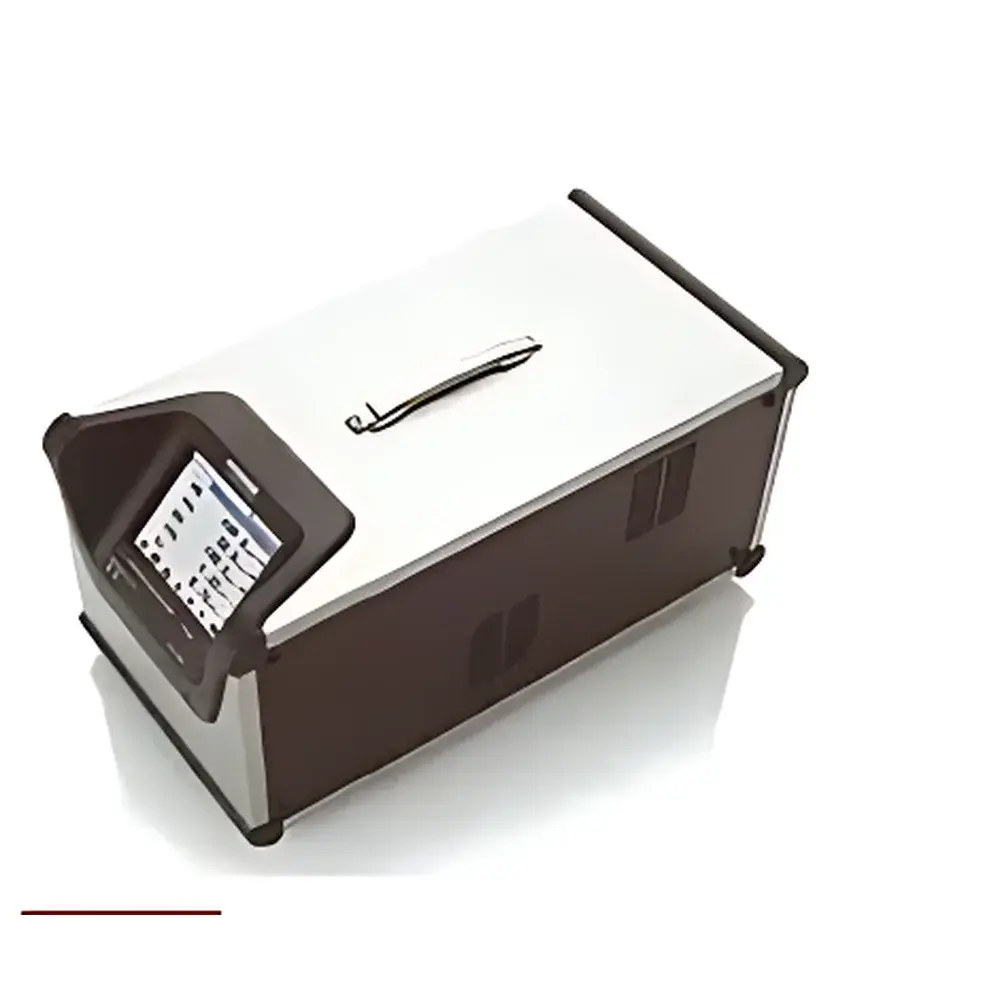
HORIBA PG-350 Portable Flue Gas Analyzer
| Brand | HORIBA |
|---|---|
| Origin | Japan |
| Model | PG-350 |
| Instrument Type | Portable Flue Gas Analyzer |
| Accuracy | ±2.0% FS |
| Repeatability | ±1.0% FS |
| Response Time (T90) | ≤45 s for NOₓ, CO, CO₂, O₂ |
| Drift | ±1.0% FS/day (SO₂: ±2.0% FS/day) |
| Warm-up Time | 30 min |
| Sample Flow Rate | ~0.5 L/min |
| Display | Color TFT LCD with Touch Interface |
| Data Storage | Removable SD Card |
| Output | 4–20 mA DC analog output, Ethernet interface |
| Power Supply | 100–120 VAC / 200–240 VAC, 50/60 Hz |
| Dimensions | 226 × 265 × 510 mm (W × H × D) |
| Weight | ~14 kg |
| Operating Environment | 5–40 °C, ≤85% RH |
Overview
The HORIBA PG-350 Portable Flue Gas Analyzer is an engineered solution for on-site, real-time quantification of critical combustion exhaust gases under field conditions requiring laboratory-grade metrological integrity. Designed for compliance-driven environmental monitoring and process optimization, the PG-350 employs a multi-principle detection architecture: alternating flow modulation chemiluminescence (AFM-CLD) for NOₓ; alternating flow modulation non-dispersive infrared (AFM-NDIR) for SO₂, CO, and CH₄; broadband NDIR for CO₂; and electrochemical (galvanic cell) sensing for O₂. This hybrid optical–electrochemical configuration ensures high selectivity, minimal cross-sensitivity, and stable baseline performance across variable stack conditions—including fluctuating temperature, pressure, and moisture content. Unlike conventional portable analyzers relying on single-technology platforms, the PG-350 integrates signal synchronization and dynamic background compensation to maintain traceability to primary standards across its full operating range.
Key Features
- Simultaneous measurement of five regulated flue gas components: NOₓ, SO₂, CO, CO₂, and O₂—with optional CH₄ capability
- Multi-range configurable detection channels: NOₓ (0–25 to 0–2500 ppm, 7 ranges), SO₂ (0–200 to 0–3000 ppm, 4 ranges), CO (0–200 to 0–5000 ppm, 5 ranges), CO₂ (0–10 to 0–30 vol%), O₂ (0–5 to 0–25 vol%), CH₄ (0–2000/5000 ppm)
- Color TFT touchscreen interface with intuitive icon-based navigation and real-time trend plotting (up to 72 hours of on-device visualization)
- Integrated electronic condensate management system with auto/manual drainage and programmable purge cycles
- Full-system calibration support—including probe, sampling line, and analyzer—traceable to NIST or JIS-certified reference gases
- Robust mechanical design: IP54-rated enclosure, shock-absorbing chassis, and vibration-damped optical path for reliable operation in industrial field environments
- Comprehensive diagnostics: automated zero/span verification logging, alarm-triggered event capture, and firmware-updatable calibration coefficients stored on removable SD card
Sample Compatibility & Compliance
The PG-350 is validated for use with hot, humid, and particulate-laden flue gases from coal-, oil-, gas-, and biomass-fired combustion sources. Its heated sampling train (maintained at >180 °C) prevents acid condensation and ensures quantitative recovery of SO₂ and NOₓ. The analyzer meets international regulatory requirements for continuous emission monitoring system (CEMS) backup and periodic stack testing, including MCERTS (UK), TÜV-certified EN 15267-3 (EU), EPA Method 6C/7E/10/21 (US), GOST R 55707-2013 (Russia), and China’s JJG 968–2019 verification regulation. It supports audit-ready data integrity per FDA 21 CFR Part 11 through secure user authentication, electronic signature capability, and immutable SD-card logging with timestamped metadata.
Software & Data Management
Data acquisition and reporting are managed via HORIBA’s proprietary PG-Link software suite, compatible with Windows-based PCs and accessible remotely over Ethernet. The system supports scheduled data export (CSV/Excel), configurable alarm thresholds (high/low, rate-of-change), and automatic generation of compliance reports aligned with ISO 14064-3 and EU Directive 2010/75/EU Annex IV templates. All raw sensor outputs, calibration records, and diagnostic logs are time-stamped and cryptographically signed to ensure data provenance. Firmware updates are performed via SD card or network push, preserving configuration integrity across revisions.
Applications
- Backup verification and QA/QC auditing of fixed CEMS installations
- Stack testing for regulatory compliance (e.g., EPA PS-17, EN 14181 QAL2/QAL3)
- Combustion optimization studies in boilers, kilns, incinerators, and gas turbines
- Catalyst performance evaluation in SCR/SNCR and desulfurization systems
- R&D applications in fuel cell development, engine emissions characterization, and alternative fuel combustion research
- Academic and governmental air quality monitoring programs requiring portable, certified-grade instrumentation
FAQ
What gas components does the PG-350 measure by default?
The standard PG-350 configuration measures NOₓ, SO₂, CO, CO₂, and O₂ simultaneously. CH₄ detection is available as a factory-configured option.
Is the PG-350 suitable for measuring wet flue gas without external conditioning?
Yes—the integrated heated sampling system (180 °C) and Peltier-cooled condensate trap enable direct analysis of saturated flue gas up to 15% water vapor content without external chillers or permeation dryers.
How is calibration traceability maintained during field deployment?
Each unit ships with a certificate of calibration against NIST-traceable reference gases. Field recalibration uses certified span gases, with all calibration parameters—including slope, offset, and nonlinearity corrections—stored in device memory with digital signatures.
Does the PG-350 support remote diagnostics and firmware updates?
Yes—via Ethernet connection, authorized users can initiate real-time health checks, download diagnostic logs, and deploy firmware patches without physical access to the instrument.
What certifications does the PG-350 hold for international use?
It carries TÜV certification to EN 15267-3 (EU), MCERTS approval (UK), ETV verification (US), GOST R certification (Russia), KOLAS accreditation (South Korea), and China Metrology Certification (CMC).







