
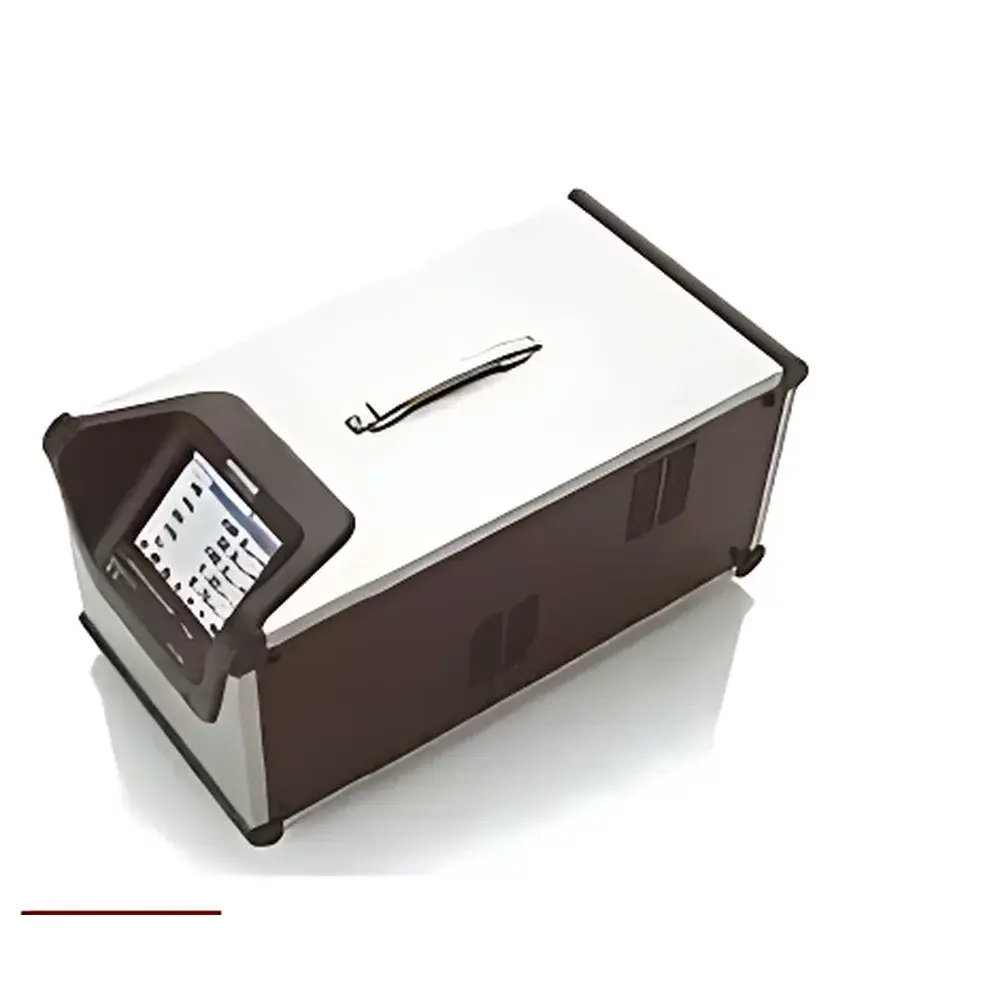
HORIBA PG-350 Portable Flue Gas Analyzer
| Brand | HORIBA |
|---|---|
| Origin | Japan |
| Model | PG-350 Series |
| Instrument Type | Portable Flue Gas Analyzer |
| Repeatability | ±1.0% FS |
| Response Time (T90) | ≤45 s (except SO₂: ≤180 s) |
Overview
The HORIBA PG-350 Portable Flue Gas Analyzer is an engineered field-deployable solution for high-fidelity, real-time measurement of combustion exhaust gases in regulatory, industrial, and research environments. Designed around dual optical detection principles—alternating flow modulation non-dispersive infrared (NDIR) spectroscopy for SO₂, CO, CH₄, and CO₂, and alternating flow modulation chemiluminescence detection (CLD) for NOₓ—the system delivers laboratory-grade accuracy under variable ambient conditions. Oxygen is measured via galvanic electrochemical cell technology, ensuring stable long-term baseline performance without external reference gas requirements. The PG-350 operates at atmospheric pressure with integrated sample conditioning—including electronic condensate management, automatic purge cycles, and heated sampling line compatibility—enabling robust operation across diverse stack geometries and emission profiles. Its architecture complies with the fundamental metrological requirements of EN 15267, ISO 16911, and EPA Method 6C/7E, supporting its use as a certified backup to Continuous Emission Monitoring Systems (CEMS) and for periodic compliance verification.
Key Features
- Multi-gas simultaneous analysis: NOₓ (NO + NO₂), SO₂, CO, CO₂, O₂, with optional CH₄ channel
- Modular range selection: 7 programmable NOₓ ranges (0–25 to 0–2500 ppm), 4 SO₂ ranges (0–200 to 0–3000 ppm), 5 CO ranges (0–200 to 0–5000 ppm), 3 CO₂ and O₂ ranges (0–10 vol% to 0–30 vol%; 0–5 to 0–25 vol%)
- High-speed response: T₉₀ ≤ 45 s for NOₓ, CO, CO₂, O₂, and CH₄; ≤ 180 s for SO₂—optimized for dynamic process monitoring
- Integrated sample handling: Electronic cold trap with auto/manual drainage, programmable back-purge, and timed sleep/wake functionality
- Touch-enabled color LCD interface: Real-time numeric display (3–4 digits), dynamic trend curves, step-by-step on-screen guidance, and alarm-triggered event logging
- Comprehensive calibration traceability: Full-system calibration capability—including probe, filter, and analyzer modules—with audit-ready calibration history exportable via SD card
- Robust mechanical design: Shock- and vibration-resistant chassis (IEC 60068-2-64 compliant), IP54-rated enclosure, and 14 kg mass optimized for single-operator portability
Sample Compatibility & Compliance
The PG-350 accepts raw or conditioned flue gas streams with particulate loading ≤ 10 mg/m³ and dew point ≤ 4°C after internal condensation control. It supports direct probe insertion into ducts ≥ 150 mm diameter and accommodates sample line lengths up to 30 m with optional heated tubing. Regulatory alignment includes UK MCERTS, German TÜV certification per EN 14181, Russian GOST R IEC 61298-1, US EPA ETV validation, China CNAS-accredited CMA certification, Korea KOLAS accreditation, and Japan JIS Z 8000 series conformity. Data integrity meets GLP/GMP expectations through timestamped SD-card storage (FAT32 format), configurable logging intervals (1 s to 1 h), and 21 CFR Part 11–compatible audit trail generation when paired with HORIBA’s optional data management software.
Software & Data Management
Field data acquisition is managed via embedded firmware supporting dual output protocols: isolated 4–20 mA analog channels (user-mappable per gas) and IEEE 802.3 Ethernet (TCP/IP) for integration into SCADA, DCS, or cloud-based EMS platforms. Raw and processed data—including flow rate (~0.5 L/min), span/gain coefficients, zero drift logs, and diagnostic flags—are stored on removable SD cards with FAT32 formatting and time-stamped filenames (YYYYMMDD_HHMMSS). Optional HORIBA GasView™ PC software enables post-processing, report generation (PDF/CSV), spectral overlay comparison, and remote firmware updates. All calibration events—including manual zero/span, auto-zero triggers, and sensor health diagnostics—are recorded with operator ID, timestamp, and deviation metrics—enabling full traceability during regulatory audits.
Applications
- CEMS redundancy and periodic performance verification per ISO 14064-3 and EN 14181 QAL2/QAL3 protocols
- Combustion optimization in utility boilers, industrial furnaces, and waste-to-energy plants
- Catalyst efficiency evaluation in selective catalytic reduction (SCR) and flue gas desulfurization (FGD) systems
- Emissions testing for IC engines, fuel cells, and biomass gasifiers under transient load conditions
- Academic and governmental air quality research requiring traceable, transportable measurement capability
- Third-party environmental testing laboratories performing accredited stack testing (ISO/IEC 17025)
FAQ
What gases does the PG-350 measure by default, and can CH₄ be added post-purchase?
The standard PG-350 configuration measures NOₓ, SO₂, CO, CO₂, and O₂. CH₄ detection is available as a factory-installed option only; retrofitting is not supported due to optical path reconfiguration requirements.
Is the PG-350 suitable for high-moisture or corrosive flue gas applications?
Yes—integrated electronic condensate removal, stainless-steel sample path wetted parts, and optional heated sampling accessories enable reliable operation in moisture-saturated or mildly acidic gas streams (e.g., coal, biomass, or municipal solid waste combustion).
How is calibration traceability maintained during field use?
Each calibration event—including zero, span, and system checks—is digitally signed, time-stamped, and archived with sensor-specific metadata. SD card exports include CSV-formatted logs compatible with LIMS and regulatory submission templates.
Does the PG-350 meet EPA or EU requirements for CEMS backup use?
Yes—it holds MCERTS certification (UK), TÜV approval per EN 15267-3, and EPA ETV validation for NOₓ/SO₂/CO/O₂, satisfying technical equivalency criteria for periodic CEMS verification under 40 CFR Part 60 and EU Directive 2010/75/EU.
What is the minimum preheat time required before achieving ±2.0% FS accuracy?
30 minutes at ambient temperature (23 °C); extended stabilization (up to 2 hours) is recommended for high-precision compliance measurements or after significant thermal transients.
Related Products







