
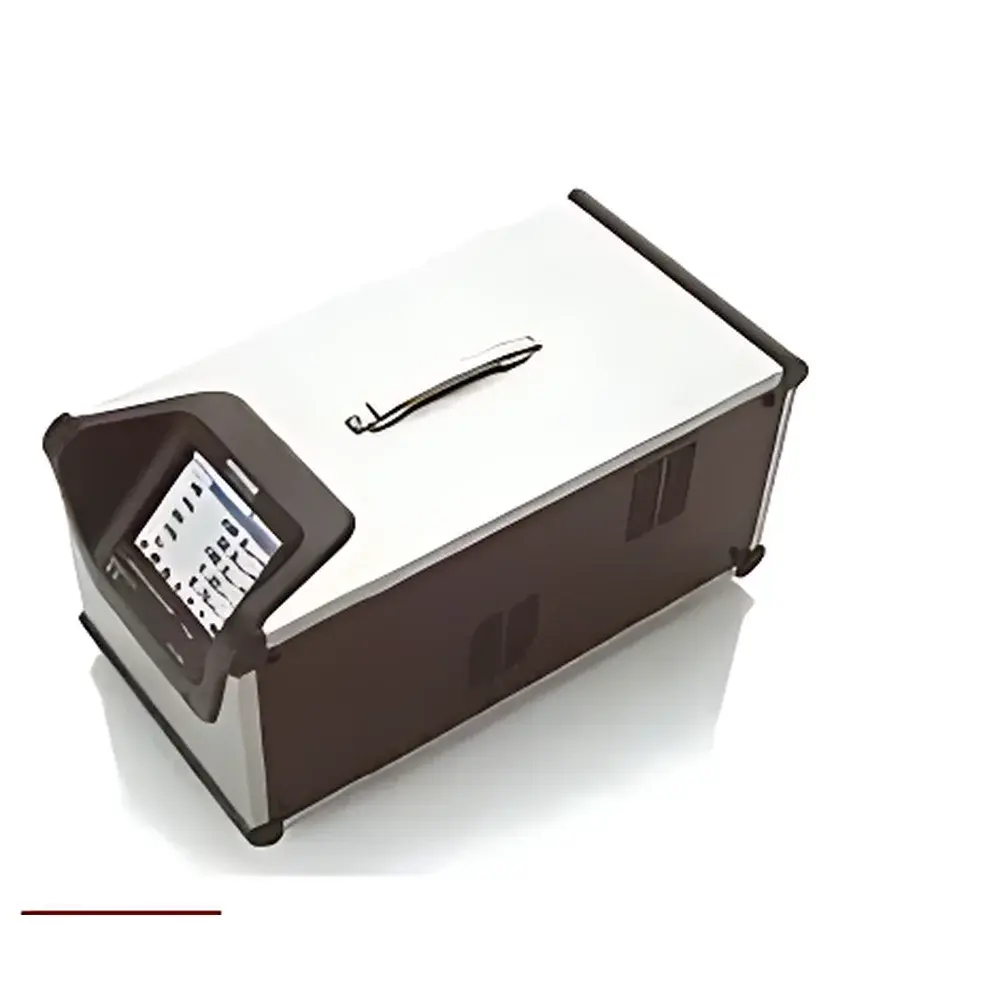
HORIBA PG-350 Portable Multi-Gas Analyzer
| Brand | HORIBA |
|---|---|
| Origin | Japan |
| Model Series | PG-300 |
| Instrument Type | Portable |
| Measured Gases | NOₓ, SO₂, CO, CO₂, O₂ (optional CH₄) |
| Measurement Principles | Pulsed Flow Modulation Chemiluminescence (NOₓ), Pulsed Flow Modulation NDIR (SO₂, CO, CH₄), Broadband NDIR (CO₂), Galvanic Cell (O₂) |
| Range Options | NOₓ: 0–25 to 2500 ppm (7 ranges) |
| SO₂ | 0–200 to 3000 ppm (4 ranges) |
| CO | 0–200 to 5000 ppm (5 ranges) |
| CO₂ | 0–10 to 30 vol% |
| O₂ | 0–5 to 25 vol% |
| CH₄ | 0–2000/5000 ppm |
| Repeatability | ±1.0% F.S. |
| Drift | ±1.0% F.S./day (SO₂: ±2.0% F.S./day) |
| Linearity | ±2.0% F.S. |
| Response Time (T₉₀) | ≤45 s (SO₂: ≤180 s) |
| Sample Flow Rate | ~0.5 L/min |
| Warm-up Time | 30 min (±2.0% F.S. stabilized within 2 h) |
| Display | Color TFT LCD with touch interface, real-time trend curves, step-by-step on-screen guidance |
| Data Storage | SD card (user-configurable interval) |
| Outputs | 4–20 mA analog, Ethernet |
| Environmental Operating Conditions | 5–40 °C, ≤85% RH |
| Dimensions | 226 × 265 × 510 mm (W × H × D) |
| Weight | ~14 kg |
| Certifications | TÜV (EU), MCERTS (UK), GOST-R (Russia), ETV (USA), China Metrology Certification (CMC), Korea KOLAS, Japan JIS/JCSS |
Overview
The HORIBA PG-350 Portable Multi-Gas Analyzer is a field-deployable, laboratory-grade instrument engineered for simultaneous, real-time quantification of up to five critical combustion and ambient gases: nitrogen oxides (NOₓ), sulfur dioxide (SO₂), carbon monoxide (CO), carbon dioxide (CO₂), and oxygen (O₂), with optional methane (CH₄) detection. Its measurement architecture integrates multiple gas-specific optical and electrochemical techniques: pulsed flow modulation chemiluminescence (PFM-CL) for NOₓ; pulsed flow modulation non-dispersive infrared (PFM-NDIR) for SO₂, CO, and CH₄; broadband non-dispersive infrared (NDIR) for CO₂; and a temperature-compensated galvanic cell sensor for O₂. This hybrid methodology ensures high selectivity, minimal cross-sensitivity, and compliance with international performance criteria for extractive gas monitoring in regulatory and research contexts. Designed for CEMS backup, stack testing, catalyst evaluation, and mobile emission studies, the PG-350 delivers trace-level accuracy (ppm to vol% range) under variable environmental conditions without requiring permanent installation or external gas conditioning systems.
Key Features
- Field-optimized portable platform: 14 kg mass and compact footprint (226 × 265 × 510 mm) enable single-operator deployment across industrial sites, power plants, and academic field campaigns.
- Multi-principle detection engine: Independent, interference-minimized optical and electrochemical modules ensure robustness against matrix effects common in flue gas and ambient air sampling.
- Intuitive color TFT touchscreen interface with contextual on-screen guidance—reducing operator training time and minimizing procedural errors during calibration or data retrieval.
- Real-time graphical display: Simultaneous numeric concentration readouts (3–4 digits), dynamic trend curves, and configurable alarm thresholds support immediate diagnostic interpretation.
- Integrated pre-conditioning system: Built-in electronic condensate trap with auto/manual drainage and programmable purge cycles maintains sample integrity under high-humidity conditions (≤85% RH).
- Comprehensive calibration management: Full-system (sensor + sampling line) zero/span verification with timestamped audit logs stored on removable SD card—supporting GLP/GMP traceability requirements.
- Flexible data handling: User-defined logging intervals, dual output channels (4–20 mA analog + Ethernet TCP/IP), and secure remote diagnostics via encrypted firmware updates.
Sample Compatibility & Compliance
The PG-350 is validated for use with hot, humid, and particulate-laden sample streams typical of combustion exhaust, biogas, and indoor air applications. Its heated sampling line (standard configuration) prevents condensation-induced adsorption losses for SO₂ and NH₃-sensitive measurements. The analyzer meets or exceeds key international regulatory benchmarks: EN 15267-3 (QAL1 certification pathway), MCERTS Performance Standards (UK), US EPA Conditional Test Method (CTM-034 equivalent), and China’s HJ 1045–2019 standard for portable flue gas analyzers. All gas sensors are traceably calibrated against NIST-traceable reference standards, and full system drift verification is performed per ISO 12039 and ASTM D6522 protocols. The device carries formal metrological approval under Japan’s Measurement Act (JIS Z 8001), Korea’s KOLAS ILAC-MRA accreditation, and Russia’s GOST-R certification framework.
Software & Data Management
Data acquisition and reporting are managed through HORIBA’s proprietary embedded firmware, supporting both autonomous operation and network-integrated workflows. Raw sensor outputs, temperature/pressure compensation values, and diagnostic flags are logged at user-selectable intervals (1 s to 60 min) onto industrial-grade SD cards with FAT32 formatting. Ethernet connectivity enables remote configuration via web-based GUI (HTTP/HTTPS), live streaming to SCADA or cloud platforms (MQTT/OPC UA optional), and secure firmware upgrades. Audit trails include operator ID (if enabled), calibration timestamps, alarm events, and sensor health metrics—all compliant with FDA 21 CFR Part 11 requirements when deployed in regulated QA/QC environments. Export formats include CSV and XML, compatible with LIMS integration and third-party statistical analysis tools.
Applications
- CEMS redundancy and validation: On-site verification of continuous emissions monitoring systems per EU Directive 2010/75/EU and US EPA 40 CFR Part 60 Appendix B.
- Combustion optimization: Real-time O₂/CO ratio analysis for boiler tuning, furnace efficiency assessment, and stoichiometric control in thermal power generation.
- Catalyst and aftertreatment research: Quantitative NOₓ conversion efficiency mapping in SCR, SNCR, and DOC systems under transient load conditions.
- Mobile source testing: In-field exhaust characterization of marine engines, locomotives, and heavy-duty diesel vehicles per ISO 8178 and UN GTR No. 49.
- Air quality surveying: Spatial mapping of urban CO/NOₓ gradients, landfill CH₄ fugitive emissions screening, and indoor air quality (IAQ) audits in commercial buildings.
- Academic and R&D laboratories: Method development for gas-phase reaction kinetics, sensor cross-interference studies, and validation of computational fluid dynamics (CFD) models.
FAQ
What gases does the PG-350 measure by default, and can additional components be added post-purchase?
The PG-350 measures NOₓ, SO₂, CO, CO₂, and O₂ as standard. CH₄ detection is available as a factory-installed option; retrofitting is not supported due to hardware-level sensor integration requirements.
Is the instrument suitable for high-dust or corrosive flue gas applications?
Yes—when equipped with HORIBA’s optional heated probe and particulate filter kit (PG-FIL-H), the system handles dust loads up to 10 g/m³ and HCl concentrations ≤100 ppm without sensor degradation.
How is calibration traceability maintained during field operation?
Each unit ships with a Certificate of Calibration referencing NIST SRM 1969 (NO), SRM 1617 (SO₂), and SRM 1621 (CO). Field calibrations are documented with digital signatures and stored in tamper-evident binary logs on the SD card.
Does the PG-350 comply with cybersecurity requirements for industrial IoT deployment?
Firmware v3.2+ includes TLS 1.2 encryption, role-based access control (RBAC), and disabled default credentials—meeting IEC 62443-3-3 SL2 baseline for networked instrumentation.
What is the recommended maintenance interval for routine verification?
HORIBA recommends zero/span verification every 72 hours during continuous operation, and full system calibration every 30 days—or immediately following exposure to >500 ppm SO₂ or condensate ingress.
Related Products







