
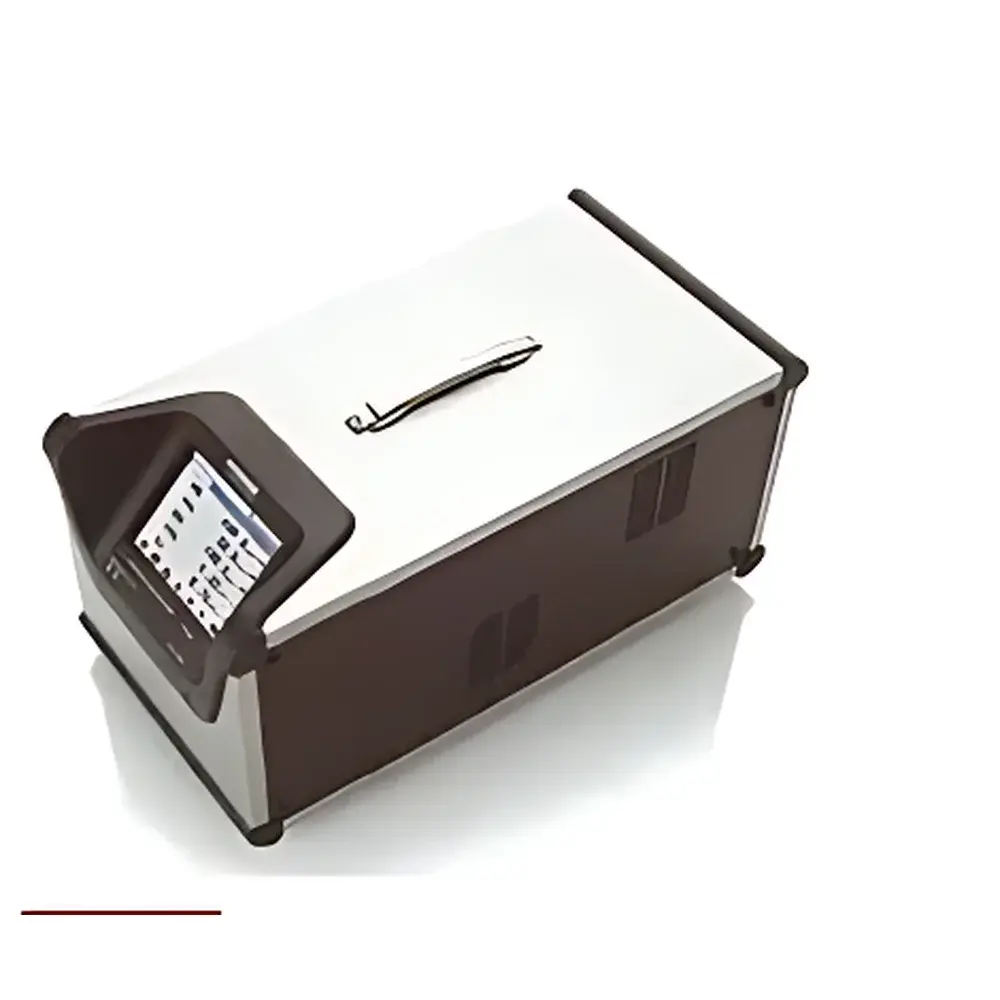
HORIBA PG-350 Portable Multi-Gas Analyzer
| Brand | HORIBA |
|---|---|
| Origin | Japan |
| Model | PG-350 |
| Instrument Type | Portable |
| Measured Gases | NOx, SO₂, CO, CO₂, O₂ |
| Detection Principle | Pulsed Flow Modulation Chemiluminescence (NOx), Pulsed Flow Modulation NDIR (SO₂, CO, CH₄), Broadband NDIR (CO₂), Galvanic Cell (O₂) |
| Range Options | NOx: 0–25/50/100/250/500/1000/2500 ppm (7 ranges) |
| SO₂ | 0–200/500/1000/3000 ppm (4 ranges) |
| CO | 0–200/500/1000/2000/5000 ppm (5 ranges) |
| CO₂ | 0–10/20/30 vol% (3 ranges) |
| O₂ | 0–5/10/25 vol% (3 ranges) |
| CH₄ (optional) | 0–2000/5000 ppm |
| Repeatability | ±1.0% F.S. |
| Drift | ±1.0% F.S./day (SO₂: ±2.0% F.S./day) |
| Linearity | ±2.0% F.S. |
| Response Time (T90) | ≤45 s (SO₂: ≤180 s) |
| Sample Flow Rate | ~0.5 L/min |
| Warm-up Time | 30 min |
| Operating Temperature | 5–40 °C |
| Relative Humidity | ≤85% RH |
| Dimensions | 226 × 265 × 510 mm (W×H×D) |
| Weight | ~14 kg |
| Data Storage | SD card (user-configurable interval) |
| Outputs | 4–20 mA analog, Ethernet |
| Power Supply | 100–120 VAC / 200–240 VAC, 50/60 Hz |
| Certifications | TÜV (EU), MCERTS (UK), GOST (Russia), ETV (US), China Metrology Certification (CMC), KOLAS (Korea), JIS (Japan) |
Overview
The HORIBA PG-350 is a high-performance portable multi-gas analyzer engineered for field-deployable, laboratory-grade quantitative analysis of combustion and process emissions. It employs a suite of validated, industry-standard detection principles: pulsed flow modulation chemiluminescence (PFM-CLD) for NOx, pulsed flow modulation non-dispersive infrared (PFM-NDIR) for SO2, CO, and CH4, broadband NDIR for CO2, and galvanic electrochemical sensing for O2. This hybrid architecture ensures selectivity, minimal cross-sensitivity, and compliance with regulatory measurement requirements across diverse gas matrices. Designed for continuous or intermittent monitoring in demanding environments—including stack testing, catalyst evaluation, engine development, and university-based emission research—the PG-350 delivers trace-level resolution and robust stability without requiring permanent installation or external gas conditioning systems beyond its integrated electronic condensate management.
Key Features
- Integrated multi-principle detection platform enabling simultaneous real-time quantification of NOx, SO2, CO, CO2, and O2—with optional CH4 channel—within a single compact chassis (14 kg, 226 × 265 × 510 mm).
- Color capacitive touchscreen interface with guided workflow navigation, dynamic trend visualization, and on-screen calibration status tracking—reducing operator dependency and field error rates.
- Optimized thermal and mechanical architecture: 20% weight reduction versus prior-generation field analyzers, enhanced shock/vibration resistance per IEC 60068-2, and reduced warm-up time to 30 minutes with <±2.0% F.S. accuracy achieved within 2 hours.
- Automated system diagnostics including scheduled zero/span verification, alarm-triggered event logging, and full calibration history exportable via SD card for audit-ready GLP/GMP documentation.
- Onboard electronic condensate management with auto/manual drain cycles and programmable anti-freeze heating—eliminating manual trap maintenance during extended unattended operation.
- Dual-output capability: isolated 4–20 mA analog channels (configurable per gas) and IEEE 802.3-compliant Ethernet interface supporting Modbus TCP and HTTP-based data retrieval for integration into central SCADA or cloud-based environmental data platforms.
Sample Compatibility & Compliance
The PG-350 is validated for direct sampling of hot, humid, and particulate-laden flue gases following standard extractive probe configurations (e.g., heated sampling line, particle filter, and optional dilution module). Its internal sample handling system maintains consistent flow (~0.5 L/min) and pressure control across ambient temperature fluctuations (5–40 °C) and relative humidity up to 85% RH. The analyzer meets internationally recognized performance specifications under ISO 12039 (CO/CO2), ISO 7935 (SO2), ISO 10849 (NOx), and EN 15267-3 for automated measuring systems. Regulatory certifications include TÜV-certified conformity with EU Directive 2010/75/EU (IED), UK MCERTS Tier 3 approval, Russian GOST R IEC 61511, US EPA ETV verification for CEMS backup applications, China’s CMC (Certificate of Metrological Verification), Korea’s KOLAS accreditation, and Japan’s JIS B 7981 compliance for portable emission analyzers.
Software & Data Management
Data acquisition and configuration are managed via embedded firmware supporting configurable logging intervals (1 s to 24 h), automatic timestamping, and cyclic SD card storage with file rotation and write-protection options. All calibration events, fault codes, sensor diagnostics, and raw signal outputs are recorded with metadata (operator ID, location tag, ambient conditions) to satisfy FDA 21 CFR Part 11 requirements for electronic records and signatures when used in regulated QA/QC environments. Remote access is enabled through secure HTTP endpoints or Modbus TCP mapping, allowing integration with third-party LIMS, CMMS, or enterprise environmental dashboards. Firmware updates are performed offline via encrypted SD card image—no internet connectivity required during field deployment.
Applications
- CEMS redundancy and periodic validation per EPA Method 205 and EN 14181 QAL2/QAL3 protocols.
- In-situ combustion efficiency assessment in industrial boilers, kilns, and incinerators.
- Catalyst deactivation studies and SCR/SNCR optimization in pilot-scale reactors.
- Mobile emissions testing for internal combustion engines, fuel cells, and hydrogen combustion systems.
- Academic and governmental air quality research requiring spatially resolved, multi-parameter stack characterization.
- Environmental consultancy services supporting ISO 14064-3 GHG verification and UNFCCC reporting workflows.
FAQ
What gases does the PG-350 measure by default, and can CH4 be added post-purchase?
Standard configuration measures NOx, SO2, CO, CO2, and O2. CH4 detection is available as a factory-installed option only; hardware-level NDIR optical path modification is required and cannot be retrofitted in the field.
Does the PG-350 require external zero/span gas cylinders during routine operation?
Yes—calibration must be performed using certified span gases traceable to NIST or equivalent national standards. The unit supports automated zero/span sequences but does not generate calibration gases internally.
Is the PG-350 suitable for unheated sampling lines?
No. For SO2 and NOx measurements, a heated sampling line (≥180 °C) is mandatory to prevent condensation-induced adsorption losses and ensure measurement integrity per EN 15267-3 Annex C.
How is data integrity ensured during power interruption?
All active measurements and system logs are written to non-volatile memory before shutdown. Upon restart, the device resumes logging from the last confirmed timestamp without data gap or corruption.
Can the PG-350 meet US EPA PS-11 requirements for NOx analyzers?
When operated with PFM-CLD detection, heated sampling, and verified calibration protocols, the PG-350 satisfies PS-11 performance criteria for field-portable reference analyzers—subject to site-specific QAPP approval and documented interference testing.
Related Products







