
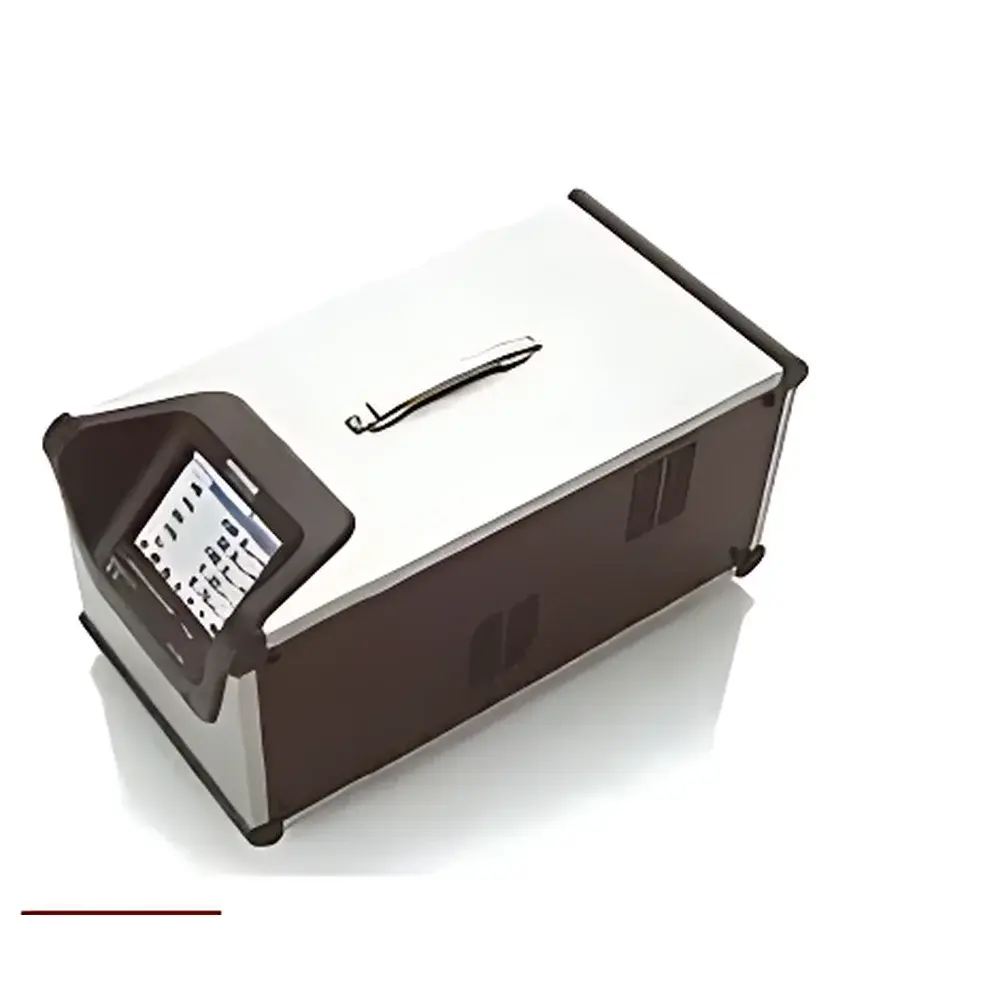
HORIBA PG-350 Portable Multi-Gas Analyzer
| Brand | HORIBA |
|---|---|
| Origin | Japan |
| Model | PG-350 |
| Instrument Type | Portable |
| Detection Targets | NOx, SO₂, CO, CO₂, O₂ |
| Range Options | 0–5 / 0–10 / 0–25 vol% (for CO₂ and O₂) |
| Repeatability | ±1.0% FS |
| Response Time (T90) | ≤45 s (all gases except SO₂: ≤180 s) |
| Zero/ Span Drift | ±1.0% FS/day (SO₂: ±2.0% FS/day) |
| Linearity Error | ±2.0% FS |
| Sample Flow Rate | ~0.5 L/min |
| Display | Color LCD touchscreen with real-time trend plotting |
| Data Storage | SD card (user-configurable interval) |
| Output | 4–20 mA analog, Ethernet |
| Warm-up Time | 30 min |
| Operating Environment | 5–40 °C, ≤85% RH |
| Dimensions | 226 × 265 × 510 mm (W×H×D) |
| Weight | ~14 kg |
Overview
The HORIBA PG-350 Portable Multi-Gas Analyzer is an engineered field-deployable instrument designed for high-fidelity, real-time measurement of five critical combustion and environmental gas species: nitrogen oxides (NOx), sulfur dioxide (SO2), carbon monoxide (CO), carbon dioxide (CO2), and oxygen (O2). Built upon HORIBA’s proven alternating flow modulation (AFM) technology, the PG-350 integrates multiple detection principles within a single compact platform: pulsed chemiluminescence for NOx, non-dispersive infrared (NDIR) absorption with AFM for SO2, CO, and CH4, broadband NDIR for CO2, and galvanic electrochemical sensing for O2. This hybrid optical–electrochemical architecture ensures analytical specificity, minimizes cross-sensitivity, and delivers laboratory-grade accuracy under variable ambient conditions—without requiring continuous lab calibration or external gas standards during routine operation.
Key Features
- Modular multi-gas detection using alternating flow modulation to enhance signal-to-noise ratio and suppress baseline drift in NDIR and chemiluminescence channels
- Color touchscreen interface with intuitive menu navigation, on-screen operational guidance, and real-time graphical trend display (up to 72 hours of scrolling history)
- Integrated electronic condensate management: automatic and manual drainage, programmable purge cycles, and anti-condensation heating for reliable performance in high-humidity flue gas streams
- Full-system calibration capability—including sample probe, heated line, and analyzer—traceable to NIST-certified reference gases and compliant with ISO 12039, EN 15267, and US EPA PS-11 requirements
- Ruggedized mechanical design: shock- and vibration-resistant housing rated to IP54, optimized for transport between stack testing sites, mobile laboratories, and university field deployments
- Onboard data logging via removable SD card with configurable sampling intervals (1 s to 60 min); supports timestamped event tagging for calibration, alarm, and maintenance logs
- Dual-output architecture: isolated 4–20 mA analog outputs per gas channel + standard Ethernet (TCP/IP) for integration into SCADA, DCS, or cloud-based monitoring platforms
Sample Compatibility & Compliance
The PG-350 is validated for use with hot, humid, particulate-laden sample streams typical of industrial combustion sources—including coal-fired boilers, cement kilns, waste incinerators, and stationary engines. Its heated sampling system (maintained at 180 °C) prevents acid gas condensation and preserves volatile analyte integrity. The analyzer meets international regulatory and quality assurance frameworks: UK MCERTS, German TÜV certification (EN 14181 QAL1/QAL2), Russian GOST R IEC 61508, US EPA Environmental Technology Verification (ETV), and China’s CCCM (China Metrology Accreditation). All firmware and data handling routines comply with GLP audit trail requirements, including immutable timestamps, user-access logging, and electronic signature support for calibration records.
Software & Data Management
Data acquisition and configuration are managed through HORIBA’s proprietary PG-Link software suite, compatible with Windows OS and accessible via Ethernet or direct USB connection. The software enables remote parameter configuration, real-time waveform visualization, batch export of CSV/Excel reports, and automated generation of compliance-ready summary files (e.g., daily average, 1-hour maxima, zero/span verification logs). All stored data include embedded metadata: instrument serial number, sensor ID, calibration gas lot numbers, operator ID, and GPS-tagged location (when paired with optional GNSS module). Audit trails adhere to FDA 21 CFR Part 11 requirements for electronic records and signatures, supporting validation in regulated environments such as pharmaceutical combustion validation or fuel cell emissions certification.
Applications
- CEMS backup and periodic stack testing per ISO 14064 and EU Directive 2010/75/EU (IED)
- Combustion optimization and air-to-fuel ratio control in thermal power plants and industrial furnaces
- Catalyst performance evaluation in emission control systems (SCR, SNCR, DOC, DPF)
- Engine and turbine exhaust characterization for R&D and homologation testing
- Fuel cell stack off-gas analysis and hydrogen reformer monitoring
- Academic research in atmospheric chemistry, greenhouse gas flux studies, and indoor air quality assessment
- Third-party verification services for environmental consultancies and testing laboratories
FAQ
What gas components does the PG-350 measure simultaneously?
The standard PG-350 configuration measures NOx, SO2, CO, CO2, and O2 concurrently. Optional CH4 detection is available via NDIR channel reconfiguration.
Is the PG-350 suitable for high-moisture flue gas applications?
Yes—the integrated heated sampling line (180 °C), Peltier-cooled condensate trap, and automatic drain sequencing ensure stable operation even at dew points up to 90 °C and relative humidity >85% RH.
How is calibration traceability maintained in the field?
The PG-350 supports full-system zero/span calibration using certified gas cylinders. All calibration events—including date, gas concentration, cylinder lot, operator ID, and post-calibration verification results—are automatically logged to the SD card with cryptographic hash integrity protection.
Can the PG-350 be integrated into existing plant monitoring networks?
Yes—via dual 4–20 mA outputs (with HART protocol support) and native Ethernet TCP/IP communication, enabling seamless interoperability with Siemens Desigo, Honeywell Experion, ABB Ability, and other industrial automation systems.
What is the warm-up time required before achieving specification accuracy?
The analyzer achieves full metrological performance within 30 minutes after power-on, verified by internal diagnostic routines and meeting ±2.0% FS accuracy tolerance over the first two operating hours.







