
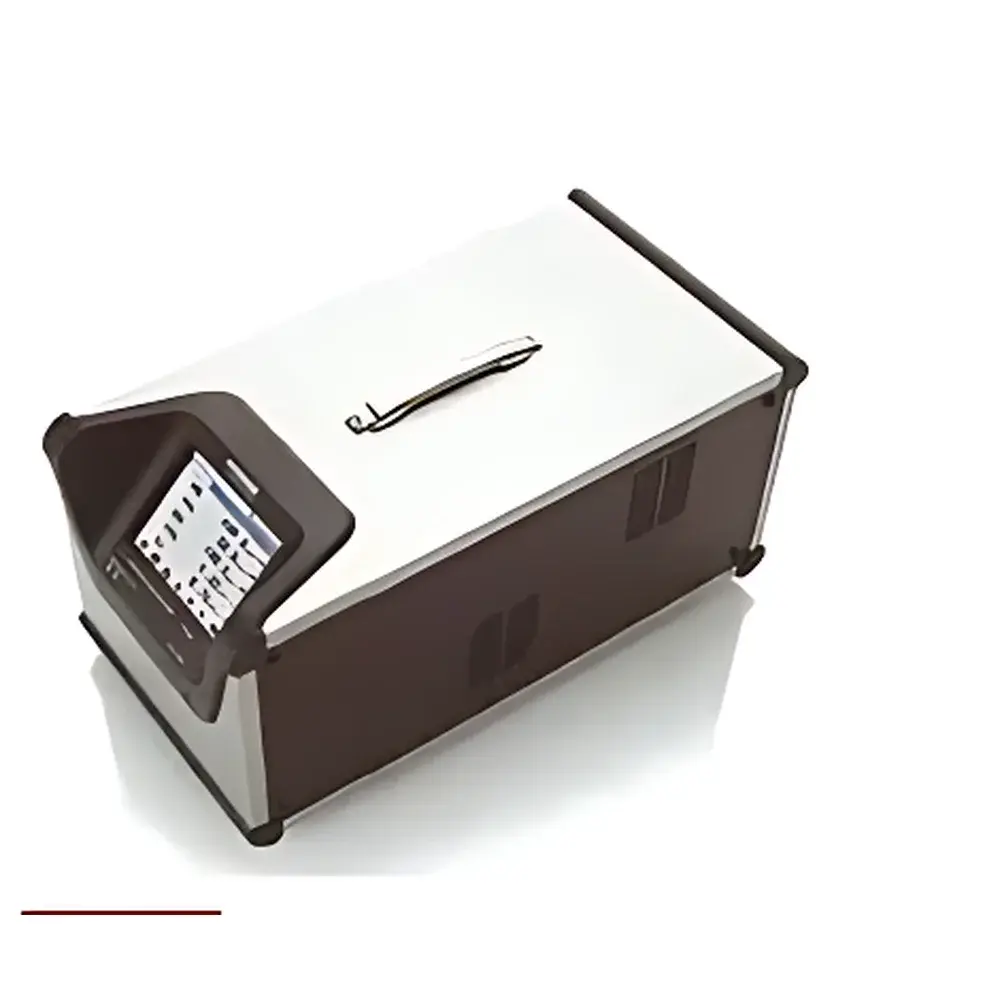
HORIBA PG-350 Portable Multi-Gas Analyzer
| Brand | HORIBA |
|---|---|
| Origin | Japan |
| Model | PG-350 |
| Instrument Type | Portable |
| Measured Gases | NOx, SO₂, CO, CO₂, O₂ |
| Range Options | 0–5 / 0–10 / 0–25 vol% (CO₂, O₂) |
| Repeatability | ±1.0% F.S. |
| Drift | ±1.0% F.S./day (±2.0% F.S./day for SO₂) |
| Linearity | ±2.0% F.S. |
| Response Time (T90) | ≤45 s (all gases except SO₂) |
| Sample Flow Rate | ~0.5 L/min |
| Power Supply | 100–120 VAC / 200–240 VAC, 50/60 Hz |
| Dimensions | 226 × 265 × 510 mm (W × H × D) |
| Weight | ~14 kg |
| Operating Environment | 5–40 °C, ≤85% RH |
| Compliance | MCERTS (UK), TÜV (EU), GOST (Russia), ETV (US), China Metrology Certification, KOLAS (Korea), JIS (Japan) |
| Data Storage | SD card (user-configurable interval) |
| Outputs | 4–20 mA analog, Ethernet |
| Preheat Time | 30 min (±2.0% F.S. stability achieved within 2 h) |
Overview
The HORIBA PG-350 Portable Multi-Gas Analyzer is a field-deployable, laboratory-grade instrument engineered for high-fidelity, real-time measurement of up to five critical combustion and ambient gases: nitrogen oxides (NOx), sulfur dioxide (SO2), carbon monoxide (CO), carbon dioxide (CO2), and oxygen (O2). Designed for regulatory compliance and research-grade accuracy, the PG-350 employs gas-specific detection principles optimized for robustness under variable environmental conditions. NOx is quantified via alternating-flow modulated chemiluminescence detection (AFM-CLD), delivering high selectivity and low cross-sensitivity in complex flue gas matrices. SO2, CO, and CH4 are measured using alternating-flow modulated non-dispersive infrared (AFM-NDIR) spectroscopy, while CO2 utilizes broadband NDIR absorption. O2 is determined by galvanic cell electrochemistry—providing stable, maintenance-light operation without consumable electrolytes. The system integrates an electronic condensate management unit with auto-drain and manual purge capability, ensuring consistent sample conditioning across humidity gradients typical of stack and ambient sampling.
Key Features
- Field-optimized architecture: 14 kg total mass with 20% weight reduction versus prior-generation portable analyzers; ruggedized chassis meets IEC 60068-2 shock and vibration requirements for transport and on-site deployment.
- Intuitive 7-inch color touchscreen interface with on-screen operational guidance, real-time trend plotting, and contextual help menus—reducing operator training time and minimizing procedural errors.
- Multi-range programmability per gas channel: seven selectable NOx ranges (0–25 to 0–2500 ppm), four SO2 ranges (0–200 to 0–3000 ppm), five CO ranges (0–200 to 0–5000 ppm), three CO2/O2 volume percent ranges (0–5 to 0–25 vol%), and dual CH4 options (0–2000/0–5000 ppm).
- Integrated calibration and diagnostics: automated zero/span verification logging, alarm-triggered event capture, and full-system calibration traceability—including pre-conditioning components such as heated sample lines and particulate filters.
- Extended data integrity: SD card storage with configurable logging intervals (1 s to 1 h); timestamped records compliant with GLP/GMP audit trail requirements; optional encryption and write-protection modes.
- Flexible connectivity: dual-output architecture supporting 4–20 mA analog transmission (per gas channel) and IEEE 802.3 Ethernet (TCP/IP) for integration into SCADA, DCS, or centralized environmental data management platforms.
Sample Compatibility & Compliance
The PG-350 is validated for continuous or intermittent analysis of hot, humid, and particulate-laden sample streams from combustion sources including utility boilers, industrial furnaces, incinerators, and engine test cells. Its heated sample path (maintained at ≥180 °C) prevents acid gas condensation and minimizes adsorption losses. The analyzer conforms to international performance standards required for regulatory reporting: MCERTS (UK), TÜV-certified EN 15267-3 (EU), EPA OTM-18 / ETV Protocol (US), China’s JJG 968–2022 (Metrology Verification Regulation for Flue Gas Analyzers), Korea’s KOLAS ILAC-G13, and Japan’s JIS B 7981. All measurements adhere to ISO 12039 (CO/CO2), ISO 7935 (SO2), ISO 10849 (NOx), and ASTM D6522 (O2) methodology frameworks. Built-in diagnostics support 21 CFR Part 11-compliant electronic signatures when paired with validated LIMS or CDS software.
Software & Data Management
The embedded firmware supports remote configuration, firmware updates, and diagnostic telemetry via secure Ethernet. Data export formats include CSV and XML, compatible with common environmental data validation tools (e.g., EPA’s CEAM, UK EA’s EMAS). The SD card archive retains raw sensor outputs, calibration logs, alarm histories, and system health metrics—including temperature, pressure, flow rate, and condensate level—enabling root-cause analysis during QA/QC review. Optional HORIBA GasManager™ desktop software provides advanced trending, statistical process control (SPC) charting, and automated report generation aligned with ISO/IEC 17025 documentation templates.
Applications
- CEMS backup and redundancy verification in power generation and cement manufacturing facilities.
- Stack testing and permit compliance audits per EPA Method 7E, 6C, 10, and EN 14181 QAL2/QAL3 protocols.
- Catalyst efficiency evaluation in automotive exhaust aftertreatment R&D laboratories.
- Combustion optimization studies in boiler and turbine OEM test cells.
- Field validation of sensor networks deployed in urban air quality monitoring stations.
- Academic research in atmospheric chemistry, bioenergy emissions profiling, and fuel reforming kinetics.
FAQ
What gases does the PG-350 measure natively, and is methane detection standard?
The PG-350 measures NOx, SO2, CO, CO2, and O2 as standard. CH4 detection is available as a factory-configured option.
Does the instrument require external calibration gas cylinders during routine operation?
Yes—zero and span calibration must be performed using certified reference gases traceable to NIST or equivalent national standards. The system supports automatic calibration scheduling and logging.
Can the PG-350 operate unattended for extended periods in remote locations?
It supports scheduled power-on/off cycles and includes battery-backed real-time clock functionality; however, continuous AC power is required for full thermal stabilization and condensate management.
Is the PG-350 suitable for measuring wet stack gas without external conditioning?
The integrated heated sample line and thermoelectric condenser enable direct sampling of gases up to 180 °C and 85% RH, though aggressive particulate loads may require upstream filtration per ISO 16146.
How is measurement uncertainty reported for regulatory submissions?
Uncertainty budgets follow EURACHEM/CITAC Guide CG4, incorporating repeatability, drift, linearity, and flow/temperature effects—fully documented in the instrument’s Certificate of Conformance and calibration report.







