
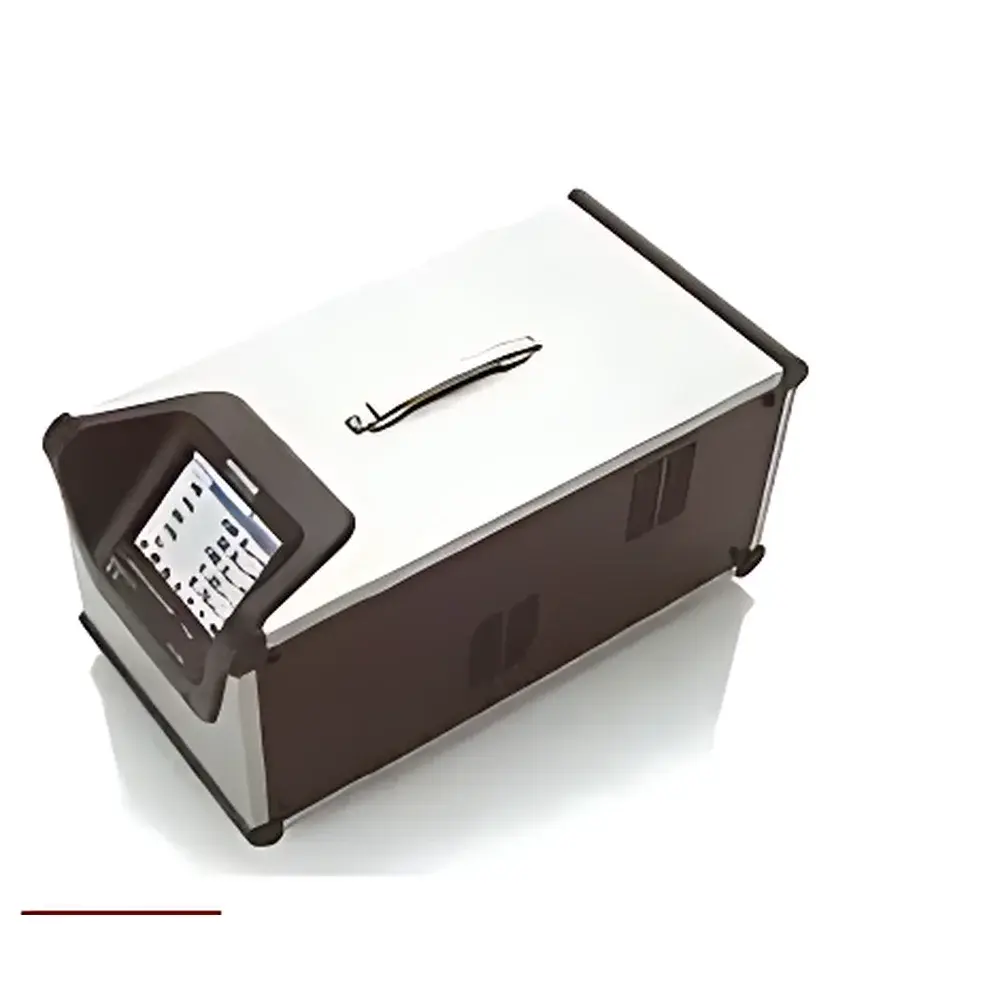
HORIBA PG-350 Portable Multi-Gas Analyzer
| Brand | HORIBA |
|---|---|
| Origin | Japan |
| Model | PG-350 |
| Instrument Type | Portable |
| Measured Gases | NOx, SO₂, CO, CO₂, O₂ |
| Range Options | NOx: 0–25/50/100/250/500/1000/2500 ppm (7 ranges) |
| SO₂ | 0–200/500/1000/3000 ppm (4 ranges) |
| CO | 0–200/500/1000/2000/5000 ppm (5 ranges) |
| CO₂ | 0–10/20/30 vol% (3 ranges) |
| O₂ | 0–5/10/25 vol% (3 ranges) |
| Repeatability | ±1.0% FS |
| Drift | ±1.0% FS/day (SO₂: ±2.0% FS/day) |
| Linearity | ±2.0% FS |
| Response Time (T90) | ≤45 s (SO₂: ≤180 s) |
| Sample Flow Rate | ~0.5 L/min |
| Warm-up Time | 30 min |
| Operating Temperature | 5–40 °C |
| Relative Humidity | ≤85% RH |
| Dimensions | 226 × 265 × 510 mm (W×H×D) |
| Weight | ~14 kg |
| Display | Color TFT LCD with touch interface |
| Data Storage | SD card (user-configurable interval) |
| Outputs | 4–20 mA analog, Ethernet |
| Power Supply | 100–120 VAC / 200–240 VAC, 50/60 Hz |
| Compliance | MCERTS (UK), TÜV (EU), GOST (Russia), ETV (US), China Metrology Certification, KOLAS (Korea), JIS (Japan) |
Overview
The HORIBA PG-350 is a high-precision, field-deployable multi-gas analyzer engineered for regulatory-grade ambient and stack gas monitoring. It employs a hybrid optical and electrochemical detection architecture to deliver laboratory-equivalent accuracy under real-world environmental conditions. Core measurement principles include alternating flow modulation chemiluminescence (AFM-CL) for NOx, alternating flow modulation non-dispersive infrared (AFM-NDIR) for SO2, CO, and CH4, dual-beam non-dispersive infrared (NDIR) for CO2, and galvanic cell technology for O2. This combination ensures minimal cross-sensitivity, high selectivity, and robust performance across variable sample matrices—including humid, particulate-laden, or low-concentration flue gas streams. Designed for continuous or intermittent operation in mobile laboratories, CEMS backup roles, and research-grade combustion studies, the PG-350 meets the metrological rigor required by ISO 12039, EN 15267, and EPA Method 6C/7E compliance frameworks.
Key Features
- Integrated five-gas analysis (NOx, SO2, CO, CO2, O2) with optional CH4 channel—enabling comprehensive combustion efficiency and emissions profiling.
- Touch-enabled 7-inch color TFT LCD with real-time trend curves, on-screen step-by-step guidance, and intuitive menu navigation—reducing operator training time and field error rates.
- Optimized mechanical architecture: 20% weight reduction versus prior-generation portable analyzers; shock- and vibration-resistant housing rated for transport over rough terrain and repeated field deployment.
- Advanced pre-conditioning system including electronic condensate trap with auto/manual drainage, programmable purge cycles, and integrated flow regulation (~0.5 L/min stable sample delivery).
- Full-system calibration capability—including sampling line, filter, dryer, and detector modules—traceable to NIST-certified standards and aligned with ISO/IEC 17025 laboratory accreditation requirements.
- Embedded diagnostics with automatic calibration logging, alarm event timestamping, and SD-card-based audit trail generation—supporting GLP/GMP data integrity protocols and FDA 21 CFR Part 11-compliant record retention when paired with validated software.
Sample Compatibility & Compliance
The PG-350 accommodates a broad range of sample types—from dry ambient air to wet, acidic flue gases at temperatures up to 180 °C (with optional heated probe). Its modular gas conditioning unit removes water vapor, particulates, and acid aerosols without catalytic scrubbing that may alter NO2/NO ratios. All measurement channels are independently validated against reference methods per ASTM D6522 (NOx), ASTM D5108 (SO2), and ISO 4037-3 (CO/CO2). Certified to MCERTS (UK), TÜV Class 1 (EU), ETV Tier 2 (US), and national metrology standards in Japan (JIS B 7981), Korea (KOLAS), Russia (GOST R ISO/IEC 17025), and China (CMC approval), the instrument satisfies technical acceptance criteria for regulatory reporting, QA/QC verification, and third-party audit readiness.
Software & Data Management
Data acquisition and configuration are managed via HORIBA’s proprietary PG-Link software suite, compatible with Windows-based PCs and supporting remote firmware updates, spectral diagnostics, and multi-instrument fleet monitoring. Raw sensor outputs, calibration logs, alarm histories, and environmental metadata (temperature, pressure, flow) are stored on removable SD cards with configurable logging intervals (1 s to 60 min). Dual communication interfaces—4–20 mA analog output (per gas channel) and IEEE 802.3 Ethernet—enable seamless integration into SCADA systems, cloud-based EMS platforms, or local HMI dashboards. Audit trails include user ID, timestamp, action type (e.g., zero/span, parameter change), and checksum-verified data packets—meeting ALCOA+ principles for attributable, legible, contemporaneous, original, accurate, complete, consistent, enduring, and available records.
Applications
- CEMS redundancy and validation—serving as an independent reference analyzer during routine stack testing and method equivalency assessments.
- Combustion optimization in industrial boilers, incinerators, and gas turbines—monitoring O2 excess, CO slip, and NOx/SO2 formation dynamics in real time.
- Catalyst evaluation and durability testing—tracking transient emission profiles during dynamic load cycling and aging protocols.
- Air quality mobile monitoring networks—deployed on vehicles or drones for spatial mapping of urban or industrial plume dispersion.
- Academic and government research—supporting emission factor development, atmospheric chemistry modeling, and fuel substitution studies (e.g., hydrogen-blended natural gas, biofuels).
- Fuel cell and battery test benches—quantifying trace contaminants (e.g., CO, SO2) that degrade PEM membrane integrity and catalyst activity.
FAQ
What gases does the PG-350 measure simultaneously?
The standard PG-350 configuration measures NOx, SO2, CO, CO2, and O2 concurrently. A CH4 measurement channel is available as a factory-installed option.
Is the PG-350 suitable for hot, wet stack gas sampling?
Yes—when used with HORIBA’s optional heated sampling probe and integrated condensate management system, the PG-350 maintains measurement stability across sample temperatures up to 180 °C and relative humidity levels exceeding 90% RH.
How is calibration traceability maintained?
All factory calibrations are performed using NIST-traceable certified gas standards. The instrument supports multi-point span/zero verification, and calibration certificates include uncertainty budgets compliant with ISO/IEC 17025 Annex A.
Can data be exported for regulatory reporting?
Yes—SD card exports generate CSV-formatted files containing timestamped concentration values, diagnostic flags, and environmental parameters, fully compatible with EPA CDX, EU ETS MRV, and national emissions reporting portals.
What is the warm-up time before achieving full specification accuracy?
The PG-350 achieves ±2.0% FS accuracy within 30 minutes of power-on; full metrological stability (±1.0% FS repeatability and drift control) is reached after 2 hours of continuous operation.
Related Products







