
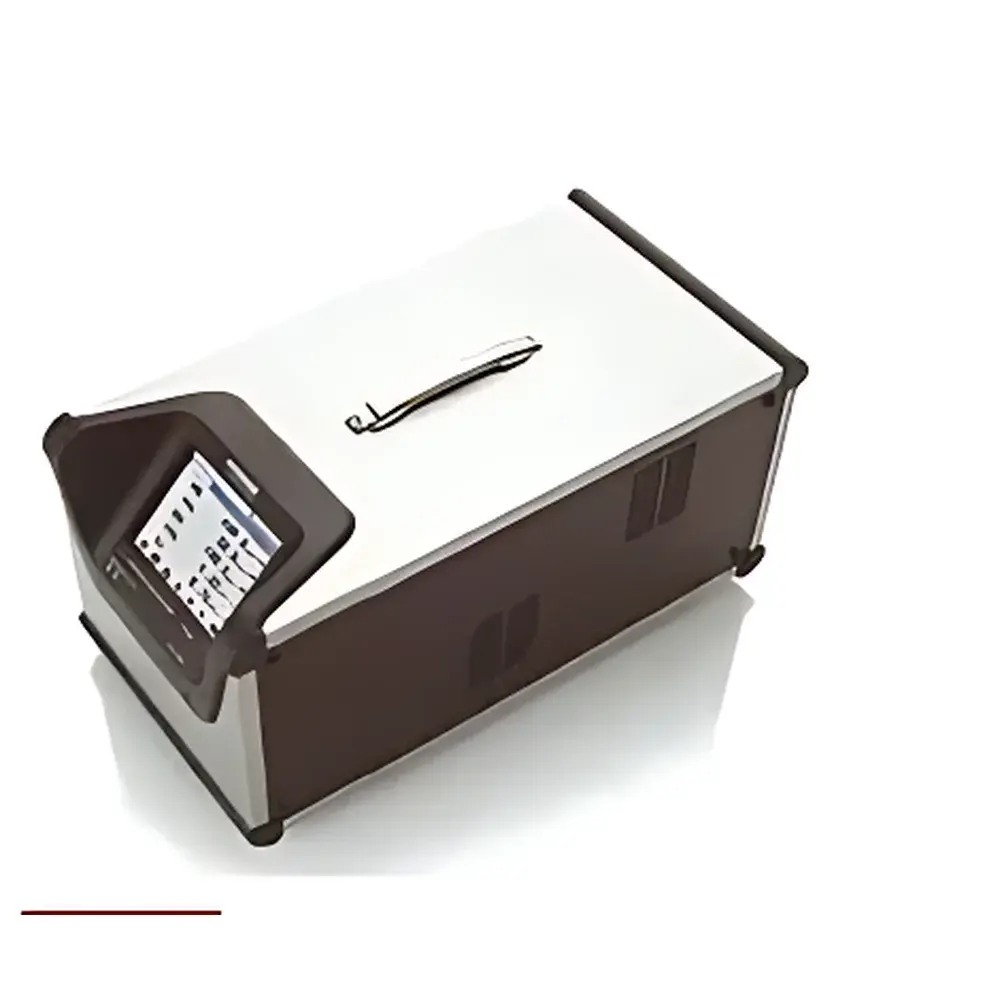
HORIBA PG-350 Portable Multi-Gas Analyzer
| Brand | HORIBA |
|---|---|
| Origin | Japan |
| Model | PG-350 |
| Instrument Type | Portable |
| Measurable Gases | NOx, SO₂, CO, CO₂, O₂ |
| Range Options | 0–5/10/25 vol% (CO₂, O₂) |
| Repeatability | ±1.0% F.S. |
| Drift | ±1.0% F.S./day (SO₂: ±2.0% F.S./day) |
| Linearity | ±2.0% F.S. |
| Response Time (T₉₀) | ≤45 s (all gases except SO₂) |
| Sample Flow Rate | ~0.5 L/min |
| Power Supply | 100–120 VAC / 200–240 VAC, 50/60 Hz |
| Dimensions | 226(W) × 265(H) × 510(D) mm |
| Weight | ~14 kg |
| Operating Environment | 5–40 °C, ≤85% RH |
Overview
The HORIBA PG-350 Portable Multi-Gas Analyzer is a field-deployable, laboratory-grade instrument engineered for high-fidelity, real-time quantification of up to five critical combustion and environmental gases—NOx, SO2, CO, CO2, and O2—in flue gas, stack emissions, and process streams. Its measurement architecture integrates multiple validated optical and electrochemical principles: alternating-flow modulated chemiluminescence detection (AFM-CLD) for NOx; alternating-flow modulated non-dispersive infrared (AFM-NDIR) for SO2, CO, and CH4; conventional non-dispersive infrared (NDIR) for CO2; and galvanic cell-based amperometry for O2. This hybrid sensor strategy ensures cross-interference minimization, robust signal stability under variable flow and temperature conditions, and compliance with international reference method equivalency requirements. Designed for regulatory-grade field verification and CEMS backup applications, the PG-350 delivers traceable accuracy without requiring permanent installation or external conditioning systems.
Key Features
- Modular multi-gas detection platform supporting simultaneous analysis of NOx, SO2, CO, CO2, and O2—with optional CH4 channel—within a single, integrated chassis.
- Advanced AFM-NDIR and AFM-CLD optical modules reduce zero drift and improve signal-to-noise ratio in high-moisture or particulate-laden sample streams.
- Full-system calibration capability—including internal sample conditioning (electronic condensate management, automatic purge, and programmable backflush)—enables end-to-end traceability per ISO 16911, EN 15267, and US EPA PS-15 protocols.
- Color TFT-LCD touchscreen interface with intuitive navigation, real-time trend graphs, and embedded operational guidance—eliminating reliance on external manuals during field deployment.
- Onboard SD card logging with user-defined sampling intervals (1 s to 24 h), timestamped calibration logs, alarm event records, and diagnostic metadata for GLP/GMP-compliant data integrity.
- Robust mechanical design: IP54-rated enclosure, shock-absorbing chassis, and thermal mass optimization for stable operation across ambient temperatures from 5 °C to 40 °C.
Sample Compatibility & Compliance
The PG-350 accepts raw or conditioned flue gas samples with particulate loading ≤10 mg/m³ and dew point ≤5 °C after integrated electronic condensation control. It accommodates sample flow rates of 0.4–0.6 L/min with built-in flow monitoring and pressure compensation. Certified to multiple international regulatory frameworks, including UK MCERTS, German TÜV, Russian GOST R, US EPA ETV, China CNAS CAL, Korea KOLAS, and Japan JIS Z 8000 series standards, the analyzer meets performance criteria for periodic emission monitoring, catalyst efficiency evaluation, and combustion optimization studies. Its output signals (4–20 mA analog + Ethernet TCP/IP) support integration into SCADA, DCS, and cloud-based EMS platforms while maintaining audit-trail readiness for FDA 21 CFR Part 11 and ISO/IEC 17025 environments.
Software & Data Management
Data acquisition and configuration are managed via HORIBA’s proprietary PG-Link software suite, compatible with Windows OS and accessible through Ethernet or USB connection. The system supports remote firmware updates, batch calibration report generation (PDF/CSV), and automated alarm-triggered data export. All calibration events—including span, zero, and linearity checks—are time-stamped, digitally signed, and stored alongside raw sensor outputs on the removable SD card. Audit logs record operator ID (via optional password protection), parameter changes, and fault diagnostics—fully compliant with GLP documentation requirements. Exported datasets include ISO 8601 timestamps, gas-specific uncertainty flags, and metrological traceability references.
Applications
- Continuous Emission Monitoring System (CEMS) backup and validation at power plants, cement kilns, and waste incinerators.
- In-situ combustion diagnostics for boiler tuning, furnace optimization, and NOx/SO2 abatement technology assessment.
- Mobile source testing—including diesel engine exhaust, fuel cell effluent, and biomass gasifier output—under transient operating conditions.
- Academic and industrial research in catalysis, reaction kinetics, and atmospheric chemistry where portability and multi-component resolution are essential.
- Environmental consultancy services requiring rapid-response stack surveys, fugitive emission screening, and regulatory compliance verification.
FAQ
What gases does the PG-350 measure simultaneously?
The standard PG-350 configuration measures NOx, SO2, CO, CO2, and O2 concurrently. A CH4 measurement channel is available as an optional upgrade.
Is the PG-350 suitable for hot, wet flue gas sampling?
Yes—the integrated electronic condensate trap, heated sample line interface (optional), and moisture-tolerant NDIR/CLD optics enable direct sampling of uncooled, saturated flue gases up to 180 °C when paired with appropriate probe accessories.
How is calibration traceability maintained?
Each unit ships with NIST-traceable calibration certificates for all installed sensors. Field calibration uses certified span gases and zero air; all calibration parameters, dates, and operator IDs are immutably logged to the SD card.
Does the PG-350 meet US EPA Performance Specification 15 (PS-15)?
Yes—the PG-350 has undergone third-party verification under EPA ETV program protocols and satisfies PS-15 requirements for portable analyzers used in relative accuracy test audits (RATA) and CEMS certification support.
Can data be exported in CSV format for LIMS integration?
Yes—PG-Link software exports time-series measurements, calibration history, and diagnostic logs in ISO-compliant CSV and PDF formats, with configurable field delimiters and UTC timestamps.
Related Products







