
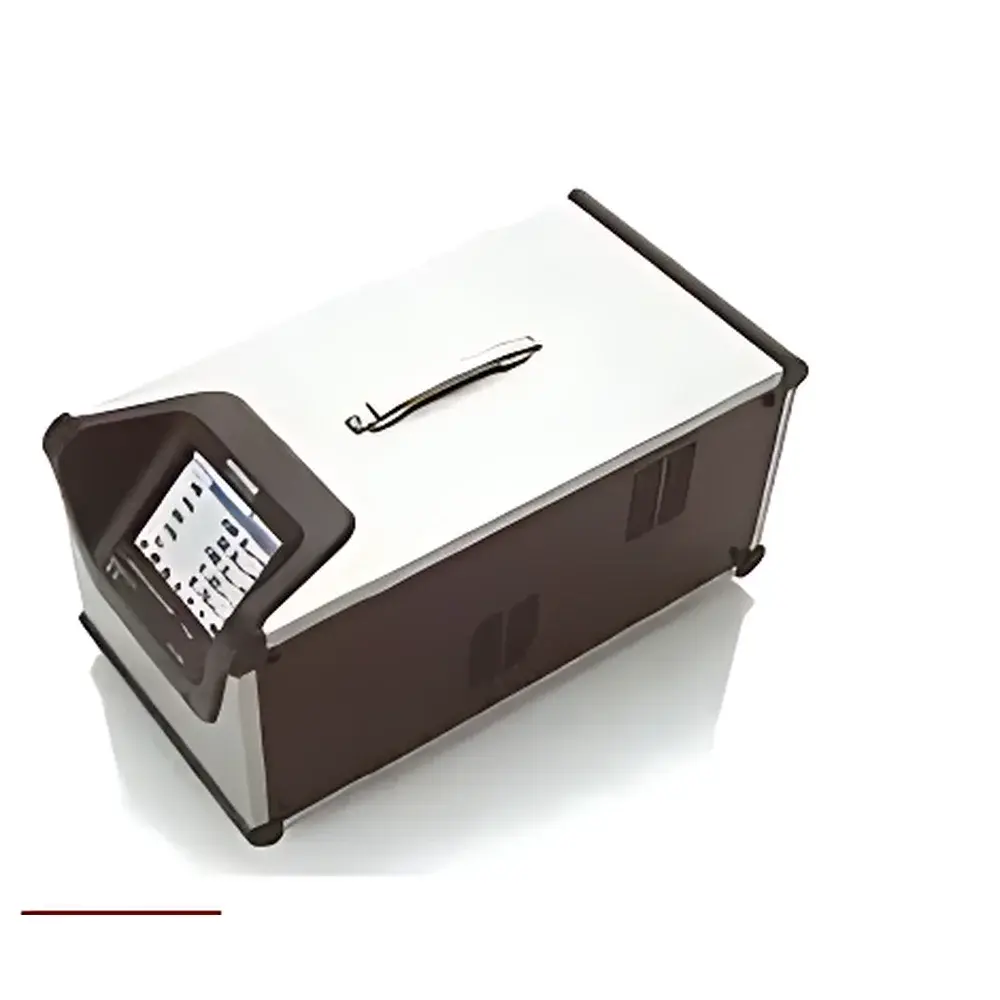
HORIBA PG-350 Portable Multi-Gas Analyzer
| Brand | HORIBA |
|---|---|
| Origin | Japan |
| Model | PG-350 |
| Instrument Type | Portable |
| Detection Targets | NOₓ, SO₂, CO, CO₂, O₂ (5-component simultaneous analysis) |
| Range Options | CO₂: 0–5/10/25 vol% |
| O₂ | 0–5/10/25 vol% |
| Repeatability | ±1.0% F.S. |
| Response Time (T₉₀) | ≤45 s (SO₂: ≤180 s) |
| Zero/Span Drift | ±1.0% F.S./day (SO₂: ±2.0% F.S./day) |
| Linearity Error | ±2.0% F.S. |
| Sample Flow Rate | ~0.5 L/min |
| Power Supply | 100–120 VAC / 200–240 VAC, 50/60 Hz |
| Dimensions | 226 × 265 × 510 mm (W×H×D) |
| Weight | ~14 kg |
| Operating Environment | 5–40 °C, ≤85% RH |
| Data Storage | SD card (user-configurable interval) |
| Outputs | 4–20 mA analog, Ethernet |
| Preheat Time | 30 min (±2.0% F.S. stability achieved within 2 h) |
| Compliance | MCERTS (UK), TÜV (EU), GOST-R (Russia), ETV (USA), China Metrology Certification, KORELMA (Korea), JIS (Japan) |
Overview
The HORIBA PG-350 Portable Multi-Gas Analyzer is an engineered field-deployable instrument designed for high-fidelity, real-time quantification of five critical combustion-related gas species—NOx, SO2, CO, CO2, and O2—in flue gas, stack emissions, and process streams. Built upon HORIBA’s proprietary alternating flow modulation (AFM) technology, the PG-350 integrates multiple detection principles within a single compact chassis: chemiluminescence detection (CLD) for NOx, non-dispersive infrared (NDIR) absorption with AFM for SO2, CO, and CH4, dual-beam NDIR for CO2, and electrochemical (galvanic cell) sensing for O2. This hybrid optical–electrochemical architecture ensures minimal cross-sensitivity, robust baseline stability, and compliance with international reference method equivalency requirements—including ASTM D6522 (NOx), ISO 7935 (CO), ISO 12039 (CO2), and EN 14792 (SO2). The analyzer delivers laboratory-grade metrological performance in a ruggedized portable format, enabling traceable measurements under variable ambient conditions without reliance on centralized calibration infrastructure.
Key Features
- Integrated alternating flow modulation (AFM) optics to suppress zero drift and enhance signal-to-noise ratio in NDIR and CLD channels
- Color TFT-LCD touchscreen interface with intuitive navigation, real-time trend plotting, and on-screen operational guidance
- Onboard electronic condensate management: automatic/manual drainage and Peltier-cooled dew point control (−5 °C typical)
- Full-system automated calibration capability—including sample line, filter, and sensor modules—with audit-trail logging to SD card
- Dual-stage particulate filtration (HEPA + sintered metal) and heated sample transport line (up to 180 °C optional) for high-dust or high-moisture applications
- Configurable data logging: time-stamped concentration values stored on removable SD card (interval programmable from 1 s to 1 h)
- Embedded communication protocols: isolated 4–20 mA analog outputs (per gas), Modbus TCP over Ethernet, and optional RS-232/485
- Reduced mass (14 kg) and optimized mechanical damping for shock/vibration resistance during vehicle-mounted or handheld deployment
Sample Compatibility & Compliance
The PG-350 accommodates raw, hot, and humid flue gas samples directly—without external dilution or conditioning—within its specified operating envelope (5–40 °C ambient, ≤85% RH). Internal sample flow is precisely regulated at ~0.5 L/min via integrated mass flow control. All gas-specific optical and electrochemical sensors are factory-calibrated against NIST-traceable standard gases and validated per ISO/IEC 17025 procedures. Regulatory conformance includes: UK MCERTS Performance Standard PS 17 (for SO2/NOx), EU TÜV-certified EN 15267-3 QAL1 equivalence, Russian GOST R ISO 14001-aligned verification, U.S. EPA ETV-verified performance for continuous emission monitoring support, China CNAS-accredited metrological certification (CMC), Korea KORELMA Type Approval, and Japan JIS B 7981 compliance. The system supports GLP/GMP data integrity through secure SD-card write-locking, timestamped calibration logs, and user-access-level authentication (admin/operator).
Software & Data Management
Data acquisition and configuration are managed via HORIBA’s proprietary PG-Link software suite, compatible with Windows-based host PCs. PG-Link enables remote setup, firmware updates, diagnostic diagnostics, and batch export of SD-card archives in CSV or XML formats. All measurement records include embedded metadata: sensor ID, calibration date, zero/span values, alarm flags, and environmental sensor readings (internal temperature/humidity). Audit trails comply with FDA 21 CFR Part 11 requirements when used with electronic signature-enabled configurations. For enterprise integration, the Ethernet interface supports SNMP monitoring and OPC UA server deployment, allowing seamless ingestion into SCADA, LIMS, or cloud-based environmental dashboards (e.g., AWS IoT Core or Azure IoT Hub).
Applications
- CEMS backup and verification auditing for power plants, waste incinerators, and cement kilns
- In-situ catalyst efficiency testing during boiler and SCR/SNCR commissioning
- Mobile emissions screening of industrial combustion sources (furnaces, boilers, turbines)
- Field validation of stationary source permits and regulatory reporting (e.g., EU IED, U.S. Clean Air Act Title V)
- Academic research in low-emission combustion, hydrogen-blended fuel trials, and carbon capture pilot studies
- QA/QC support for environmental consulting firms conducting stack testing per EPA Method 3A, 6C, 7E, 10, and 25A
FAQ
What gases does the PG-350 measure simultaneously?
The PG-350 measures NOx, SO2, CO, CO2, and O2 concurrently. CH4 detection is available as an optional configuration.
Is the PG-350 suitable for hot, wet stack sampling?
Yes—the analyzer accepts undiluted sample gas up to 180 °C (with optional heated probe) and incorporates active condensate removal; no external conditioning system is required for most CEMS validation scenarios.
How often must the instrument be calibrated?
Zero and span calibration is recommended before each measurement campaign; automated daily zero checks are supported, and full multi-point calibration intervals follow site-specific QA plans aligned with ISO 14001 or local regulatory mandates.
Does the PG-350 meet MCERTS requirements for UK emissions monitoring?
Yes—PG-350 holds MCERTS PS 17 certification for SO2 and NOx, fulfilling the performance specification for periodic verification and backup CEMS applications.
Can measurement data be exported for regulatory reporting?
Yes—time-synchronized concentration data, calibration logs, and system diagnostics are stored on SD card in comma-separated format and can be imported directly into EPA’s CEAM or EA’s EMAS reporting templates.
Related Products







