
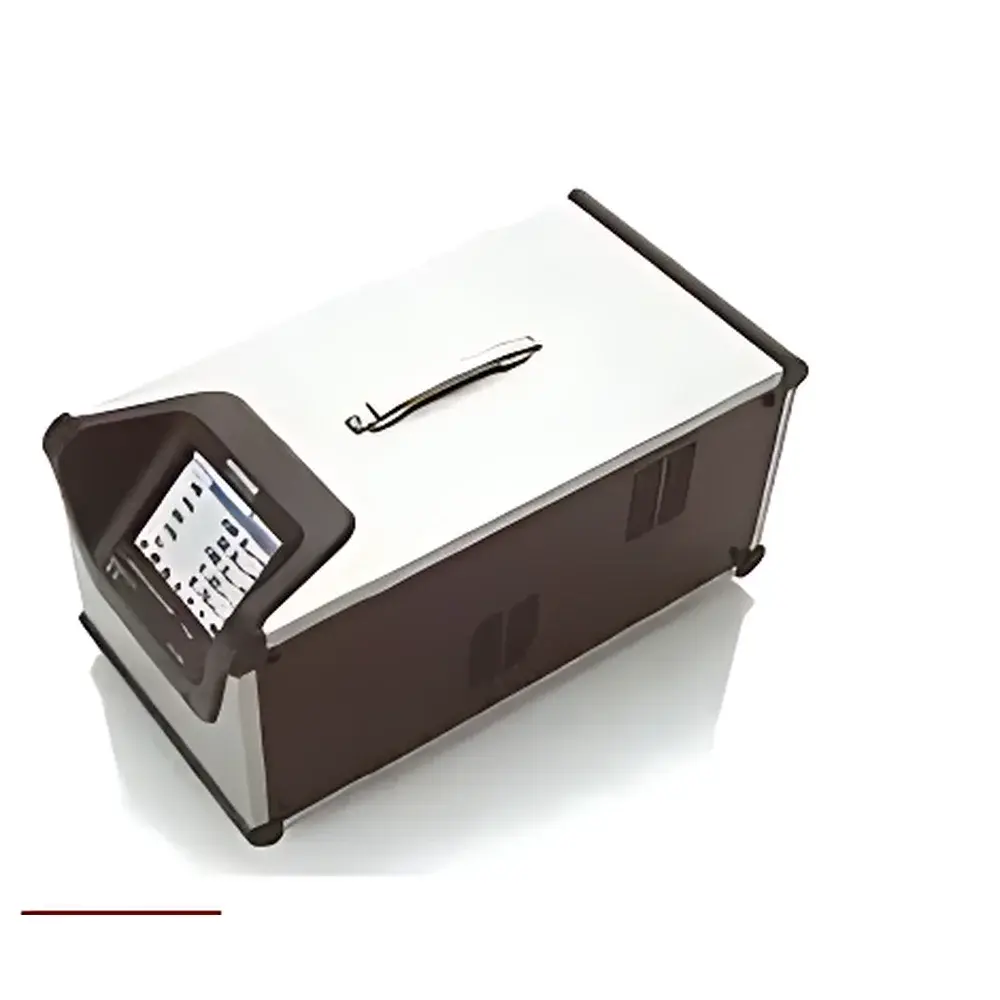
HORIBA PG-350 Portable Multi-Gas Analyzer
| Brand | HORIBA |
|---|---|
| Origin | Japan |
| Model | PG-350 |
| Instrument Type | Portable |
| Measurable Gases | NOx, SO₂, CO, CO₂, O₂ |
| Range Options | NOx: 0–25/50/100/250/500/1000/2500 ppm (7 ranges) |
| SO₂ | 0–200/500/1000/3000 ppm (4 ranges) |
| CO | 0–200/500/1000/2000/5000 ppm (5 ranges) |
| CO₂ | 0–10/20/30 vol% |
| O₂ | 0–5/10/25 vol% |
| Repeatability | ±1.0% FS |
| Drift | ±1.0% FS/day (SO₂: ±2.0% FS/day) |
| Linearity | ±2.0% FS |
| Response Time (T₉₀) | ≤45 s (all gases except SO₂) |
| SO₂ | ≤180 s |
| Sample Flow Rate | ~0.5 L/min |
| Warm-up Time | 30 min |
| Operating Temperature | 5–40 °C |
| Relative Humidity | ≤85% RH |
| Weight | ~14 kg |
| Dimensions (W×H×D) | 226 × 265 × 510 mm |
| Data Storage | SD card (user-configurable interval) |
| Outputs | 4–20 mA analog, Ethernet |
| Power Supply | 100–120 VAC / 200–240 VAC, 50/60 Hz |
| Compliance | UK MCERTS, EU TÜV, US EPA ETV, China CMA, Korea KOLAS, Japan JIS/MI |
Overview
The HORIBA PG-350 Portable Multi-Gas Analyzer is an engineered field-deployable solution for simultaneous, real-time quantification of five critical combustion and ambient gas species: nitrogen oxides (NOx), sulfur dioxide (SO2), carbon monoxide (CO), carbon dioxide (CO2), and oxygen (O2). Designed for regulatory-grade performance outside the laboratory, it integrates multiple detection principles within a single compact chassis: alternating-flow modulated chemiluminescence for NOx; alternating-flow modulated non-dispersive infrared (NDIR) for SO2, CO, and CH4; conventional NDIR for CO2; and galvanic electrochemical sensing for O2. This hybrid architecture ensures high specificity, minimal cross-sensitivity, and compliance with international reference method equivalency requirements—including those specified in EN 15267, ISO 12039, and US EPA Performance Specification 2 (PS-2) for continuous emission monitoring systems (CEMS). The PG-350 delivers laboratory-caliber accuracy (±2.0% FS linearity, ±1.0% FS repeatability) under variable environmental conditions, making it suitable for stack testing, mobile source emissions verification, catalyst efficiency evaluation, and ambient air quality assessment.
Key Features
- Integrated multi-principle detection platform enabling concurrent measurement of NOx, SO2, CO, CO2, and O2 without external gas switching or dilution.
- Optimized thermal and mechanical architecture: 20% weight reduction versus prior-generation portable analyzers; reinforced housing rated for shock and vibration resistance per IEC 60068-2 standards.
- High-resolution color touchscreen interface with on-screen operational guidance, real-time trend plotting (3–4 gas traces simultaneously), and contextual help menus for field personnel.
- Automated system diagnostics including self-calibration logging, alarm event timestamping, and fault-code-driven troubleshooting—data exportable via removable SD card for offline audit or remote support analysis.
- Intelligent sample conditioning: integrated electronic condensate trap with auto/manual drain control, programmable purge cycles, and temperature-stabilized flow regulation (~0.5 L/min).
- Configurable power management: scheduled wake-up/sleep mode, low-power standby during idle periods, and dual-voltage AC input compatibility (100–120 VAC / 200–240 VAC, 50/60 Hz).
Sample Compatibility & Compliance
The PG-350 accepts hot, wet, and particulate-laden flue gas streams after standard CEMS pre-treatment (e.g., heated sampling line, particle filter, and thermoelectric cooler). Its optical and electrochemical sensors are validated for operation across a wide dynamic range: NOx (0–2500 ppm), SO2 (0–3000 ppm), CO (0–5000 ppm), CO2 (0–30 vol%), and O2 (0–25 vol%). All measurement channels meet or exceed the stability and precision criteria defined in MCERTS (UK), TÜV Rheinland QAL1 certification (EU), US EPA ETV protocols, and China’s JJG 968–2019 metrological verification regulations. Full-system calibration traceability is maintained through documented zero/span checks, span-gas validation logs, and audit trails compliant with GLP and ISO/IEC 17025 data integrity requirements.
Software & Data Management
Data acquisition and instrument control are managed via embedded firmware supporting both local interaction and networked operation. Real-time values, range settings, and flow status are displayed numerically and graphically on the 7-inch LCD. Measurement records—including timestamps, calibration events, and diagnostic flags—are stored on user-supplied SD cards with configurable logging intervals (1 sec to 60 min). Analog outputs (4–20 mA) provide legacy integration into PLCs or SCADA systems, while Ethernet connectivity enables TCP/IP-based remote monitoring, firmware updates, and secure data transfer via HTTP or Modbus TCP. Audit trail functionality satisfies FDA 21 CFR Part 11 requirements for electronic records when operated in validated environments.
Applications
- Backup and verification of fixed CEMS installations in power plants, waste incinerators, and industrial boilers.
- Mobile emissions testing of stationary and mobile combustion sources—including diesel generators, gas turbines, and marine engines.
- In-situ catalyst characterization and deactivation studies in R&D laboratories and pilot-scale reactors.
- Field validation of low-emission technology performance (e.g., SCR, SNCR, FGD systems) under transient load conditions.
- Academic and governmental air quality surveys requiring traceable, multi-species concentration profiles at ambient or elevated temperatures.
- Fuel cell exhaust analysis, syngas composition monitoring, and biogas upgrading process control.
FAQ
What gases does the PG-350 measure simultaneously?
The PG-350 measures NOx, SO2, CO, CO2, and O2 concurrently. Methane (CH4) is available as an optional sixth channel.
Is the PG-350 certified for regulatory compliance reporting?
Yes—it holds MCERTS (UK), TÜV QAL1 (EU), US EPA ETV, China CMA, Korea KOLAS, and Japan JIS/MI certifications, enabling use in legally mandated monitoring programs.
How long does the analyzer require to stabilize before measurement?
Warm-up time is 30 minutes; measurement accuracy remains within ±2.0% FS over subsequent 2-hour intervals without recalibration.
Can the PG-350 operate in high-humidity or condensing gas streams?
Yes—the integrated electronic condensate management system automatically separates and drains liquid water, maintaining stable optical path integrity and sensor response.
Does the instrument support remote data access and configuration?
Yes—via built-in Ethernet port using standard protocols (Modbus TCP, HTTP), allowing secure remote diagnostics, firmware updates, and real-time data streaming to centralized platforms.
Related Products







