
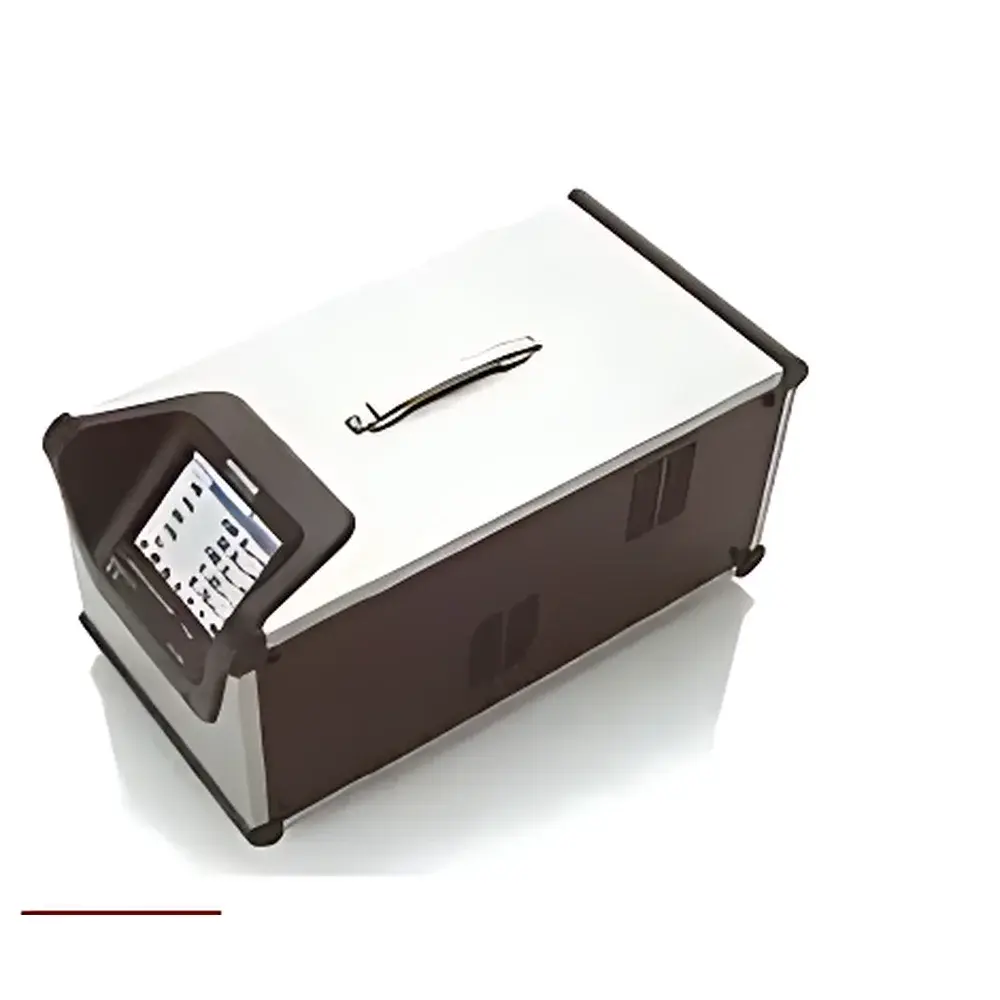
HORIBA PG-350 Portable Multi-Gas Analyzer
| Brand | HORIBA |
|---|---|
| Origin | Japan |
| Model | PG-350 |
| Instrument Type | Portable |
| Detection Targets | NOx, SO₂, CO, CO₂, O₂ |
| Measurement Principle | Pulsed Flow Modulation Chemiluminescence (NOx), Pulsed Flow Modulation NDIR (SO₂, CO, CH₄), Broadband NDIR (CO₂), Galvanic Cell (O₂) |
| Range Options | NOx: 0–25/50/100/250/500/1000/2500 ppm (7 ranges) |
| SO₂ | 0–200/500/1000/3000 ppm (4 ranges) |
| CO | 0–200/500/1000/2000/5000 ppm (5 ranges) |
| CO₂ | 0–10/20/30 vol% (3 ranges) |
| O₂ | 0–5/10/25 vol% (3 ranges) |
| Repeatability | ±1.0% F.S. |
| Drift | ±1.0% F.S./day (SO₂: ±2.0% F.S./day) |
| Linearity | ±2.0% F.S. |
| Response Time (T90) | ≤45 s (SO₂: ≤180 s) |
| Sample Flow Rate | ~0.5 L/min |
| Warm-up Time | 30 min |
| Operating Temperature | 5–40 °C |
| Relative Humidity | ≤85% RH |
| Dimensions | 226 × 265 × 510 mm (W×H×D) |
| Weight | ~14 kg |
| Data Storage | SD card (user-configurable interval) |
| Outputs | 4–20 mA analog, Ethernet |
| Power Supply | 100–120 VAC / 200–240 VAC, 50/60 Hz |
Overview
The HORIBA PG-350 Portable Multi-Gas Analyzer is an engineered field-deployable instrument designed for high-fidelity, real-time quantification of up to five critical combustion and ambient gases—NOx, SO2, CO, CO2, and O2—in a single compact platform. Its measurement architecture integrates multiple validated optical and electrochemical detection principles: pulsed flow modulation chemiluminescence for NOx; pulsed flow modulation non-dispersive infrared (NDIR) for SO2, CO, and CH4; broadband NDIR for CO2; and a temperature-compensated galvanic cell for O2. This hybrid sensor strategy ensures minimal cross-sensitivity, robust baseline stability, and compliance with international performance specifications for portable emissions monitoring. The PG-350 delivers laboratory-grade accuracy under variable field conditions—achieving ±1.0% full-scale repeatability and ≤45 s T90 response (≤180 s for SO2)—without requiring continuous gas conditioning or external calibration gas supplies during routine operation.
Key Features
- Modular multi-gas detection with independent, factory-aligned optical and electrochemical sensors—enabling simultaneous, concurrent analysis without time-multiplexing artifacts
- Intuitive 7-inch color TFT touchscreen interface with on-screen operational guidance, real-time trend visualization, and contextual help menus
- Integrated electronic condensate management system with automatic and manual drainage modes, eliminating manual trap servicing in humid environments
- Full-system calibration capability—including sample probe, heated line, and analyzer—traceable to NIST-certified standards and aligned with ISO 12039, EN 15267, and US EPA PS-15 protocols
- Onboard SD card logging with user-defined sampling intervals (1 s to 60 min), supporting GLP-compliant audit trails and post-acquisition time-series reconstruction
- Ruggedized mechanical design: IP54-rated enclosure, shock-absorbing chassis, and vibration-damped optical path—validated per IEC 60068-2-6 and MIL-STD-810G
- Power-flexible operation across global AC grids (100–240 VAC, 50/60 Hz) with internal thermal regulation ensuring stable detector bias over ambient temperature fluctuations (5–40 °C)
Sample Compatibility & Compliance
The PG-350 accepts raw or conditioned flue gas samples with particulate loading <10 mg/m³ and dew point <4 °C after integrated thermoelectric cooling. It complies with regulatory requirements for portable reference methods in CEMS backup verification (MCERTS UK, TÜV Germany, GOST-R Russia), U.S. EPA ETV validation, and national metrological certification in China (CMC), Korea (KOLAS), and Japan (JIS Z 8000 series). All gas channels meet ISO 12039 Annex B linearity and drift criteria; SO2 channel conforms to EN 14791 interference testing for H2O, CO, and NO. Firmware supports 21 CFR Part 11-compliant electronic signatures and audit-log retention for GxP environments.
Software & Data Management
Embedded firmware v3.2 provides dual-mode data handling: local real-time display (gas concentration, flow rate, range status, alarm flags) and networked telemetry via Ethernet (TCP/IP, Modbus TCP). Raw measurement values, diagnostic codes, calibration timestamps, and system health metrics are stored in CSV format on removable SD cards—with configurable write cycles and cyclic overwrite protection. Optional HORIBA DataLink software enables remote configuration, batch report generation (PDF/Excel), and spectral diagnostics for detector aging assessment. All data exports include embedded metadata (UTC timestamp, GPS coordinates if enabled, operator ID, instrument serial number) to satisfy ISO/IEC 17025 traceability requirements.
Applications
- CEMS redundancy verification and periodic stack testing per ISO 14064-3 and EU Directive 2010/75/EU
- Combustion optimization studies in industrial boilers, kilns, and incinerators
- Catalyst performance evaluation in R&D laboratories (e.g., SCR, DOC, DPF systems)
- Mobile source emissions profiling for engine test cells and fuel cell development platforms
- Ambient air quality surveys in urban, industrial, and landfill perimeter zones
- Educational use in university environmental engineering and analytical chemistry curricula
FAQ
What gases does the PG-350 measure simultaneously?
The standard PG-350 configuration measures NOx, SO2, CO, CO2, and O2 concurrently. CH4 detection is available as an optional sixth channel.
Is the PG-350 suitable for hot, wet stack gas sampling?
Yes—when used with HORIBA’s optional heated sampling probe and PTFE-lined sample line (up to 180 °C), and with its built-in thermoelectric cooler maintaining sample dew point below 4 °C prior to detection.
How is calibration traceability maintained?
Each unit ships with a Certificate of Calibration referencing NIST-traceable gas standards; field recalibration uses certified span gases with documented uncertainty budgets per ISO 6141.
Can data be exported for regulatory reporting?
Yes—CSV files generated on SD card include all parameters required by EPA Method 205 and EN 14181, and can be imported directly into regulatory submission platforms.
What maintenance intervals are recommended?
Optical windows require cleaning every 200 operating hours; O2 sensor replacement is recommended every 18 months; annual full-system verification is advised for GLP/GMP compliance.







