
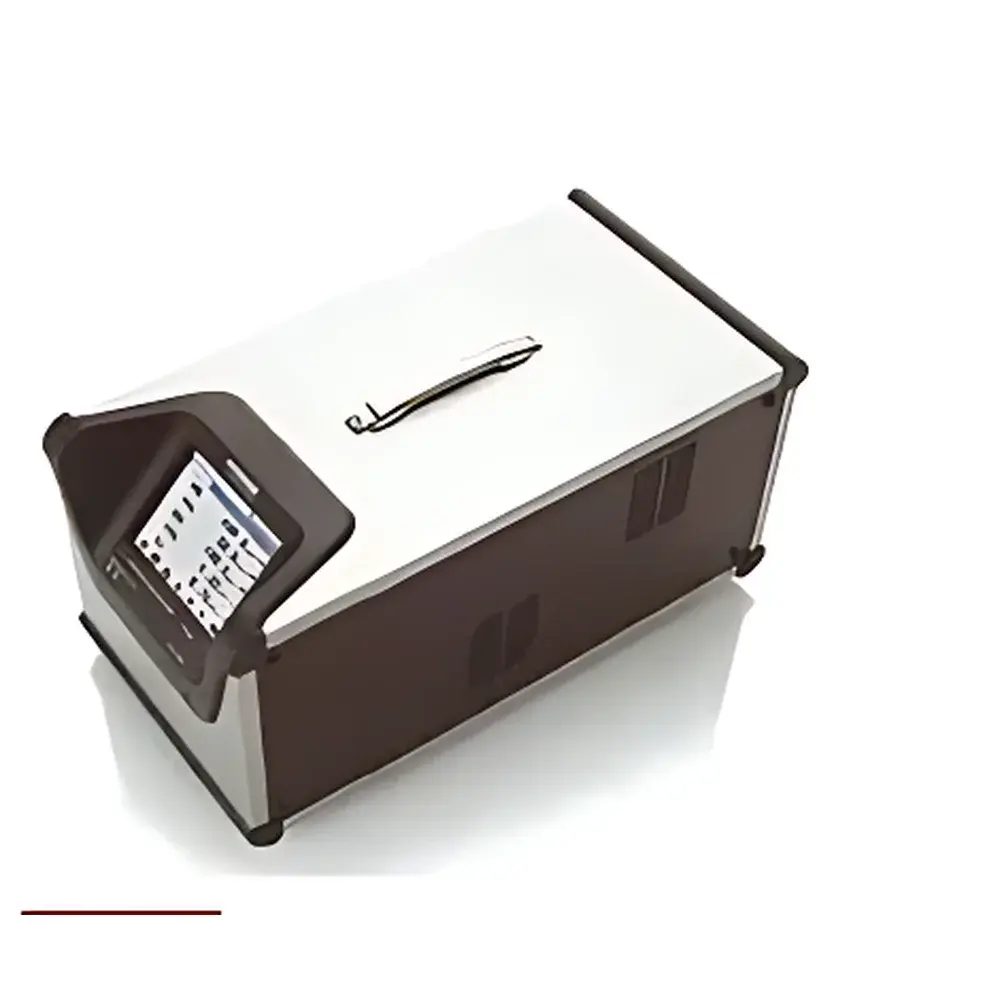
HORIBA PG-350 Portable Multi-Gas Analyzer
| Brand | HORIBA |
|---|---|
| Origin | Japan |
| Model | PG-350 |
| Instrument Type | Portable |
| Target Gases | NOx, SO₂, CO, CO₂, O₂ |
| Measurement Ranges | NOx: 0–25/50/100/250/500/1000/2500 ppm (7 ranges), SO₂: 0–200/500/1000/3000 ppm (4 ranges), CO: 0–200/500/1000/2000/5000 ppm (5 ranges), CO₂: 0–10/20/30 vol%, O₂: 0–5/10/25 vol% |
| Repeatability | ±1.0% F.S. |
| Drift | ±1.0% F.S./day (SO₂: ±2.0% F.S./day) |
| Linearity | ±2.0% F.S. |
| Response Time (T₉₀) | ≤45 s (SO₂: ≤180 s) |
| Sample Flow Rate | ~0.5 L/min |
| Power Supply | 100–120 VAC / 200–240 VAC, 50/60 Hz |
| Dimensions | 226 × 265 × 510 mm (W×H×D) |
| Weight | ~14 kg |
| Operating Environment | 5–40 °C, ≤85% RH |
| Compliance | MCERTS (UK), TÜV (EU), GOST (Russia), EPA ETV (US), CNAS/CMA (China), KOLAS (Korea), JIS (Japan) |
| Data Storage | SD card (user-configurable interval) |
| Output | 4–20 mA analog, Ethernet |
| Preheat Time | 30 min (±2.0% F.S. stability within 2 h) |
| Detection Principles | Pulsed Flow Modulation Chemiluminescence (NOx), Pulsed Flow Modulation NDIR (SO₂, CO, CH₄), Broadband NDIR (CO₂), Galvanic Cell (O₂) |
Overview
The HORIBA PG-350 Portable Multi-Gas Analyzer is an engineered field-deployable solution for simultaneous, real-time quantification of five regulated combustion exhaust gases: nitrogen oxides (NOx), sulfur dioxide (SO₂), carbon monoxide (CO), carbon dioxide (CO₂), and oxygen (O₂). Designed for compliance-grade environmental monitoring and process optimization, the PG-350 integrates multiple selective detection principles into a single robust platform. NOx is measured via pulsed flow modulation chemiluminescence — a method offering high specificity and low cross-sensitivity to hydrocarbons and water vapor. SO₂, CO, and methane (CH₄) are quantified using pulsed flow modulation non-dispersive infrared (NDIR) spectroscopy, while CO₂ employs broadband NDIR for enhanced stability across variable moisture and particulate loads. O₂ concentration is determined by a maintenance-free galvanic electrochemical cell with temperature-compensated output. All optical and electrochemical subsystems operate under constant pressure and temperature stabilization, enabling laboratory-equivalent accuracy (±2.0% F.S. linearity, ±1.0% F.S. repeatability) in uncontrolled ambient conditions.
Key Features
- Field-optimized portable architecture: 14 kg mass, shock- and vibration-resistant chassis compliant with IEC 60068-2 mechanical stress standards
- Intuitive 7-inch color capacitive touchscreen with on-screen operational guidance, real-time trend curves, and multilingual UI (English, Japanese, Chinese, Spanish)
- Integrated sample conditioning: built-in electronic condensate trap with auto/manual drainage, heated sample line (up to 180 °C optional), and programmable purge/flush cycles
- Full-system calibration capability: automated zero/span verification with traceable gas standards; calibration logs stored on SD card with time-stamped audit trail
- Dual communication interface: isolated 4–20 mA analog outputs (per gas channel) + IEEE 802.3 Ethernet (TCP/IP) supporting Modbus TCP and HTTP-based data export
- Extended data integrity: SD card logging at user-defined intervals (1 s to 1 h); local storage capacity up to 32 GB; timestamped records include gas values, flow rate, temperature, pressure, and diagnostic flags
- Rapid deployment readiness: 30-minute warm-up to ±2.0% F.S. stability; T₉₀ response ≤45 s for NOx, CO, CO₂, O₂ (SO₂: ≤180 s)
Sample Compatibility & Compliance
The PG-350 is validated for continuous or intermittent sampling of hot, humid, and particulate-laden flue gases from industrial boilers, incinerators, cement kilns, and stationary engines. Its sample inlet accepts nominal 6 mm OD stainless steel or PTFE tubing, with integrated particulate filtration (5 µm absolute rating) and water removal efficiency >95% at 15 °C dew point. The analyzer meets international regulatory requirements for reference method equivalence: certified to MCERTS (UK EA/SEPA), TÜV Class 1 (EN 15267-3), GOST R 57320-2016 (Russia), EPA Environmental Technology Verification (ETV) Protocol for Continuous Emission Monitoring Systems, and China’s JJG 968–2019 verification regulation for flue gas analyzers. It supports GLP-compliant operation through full electronic audit trail (calibration events, alarm history, configuration changes) and optional 21 CFR Part 11–compliant software modules.
Software & Data Management
Data acquisition and instrument control are managed via HORIBA’s proprietary PG-Link software, compatible with Windows 10/11 and deployable on local PCs or networked servers. The software provides remote configuration, real-time waveform visualization, multi-channel overlay plots, and automated report generation (PDF/CSV) per ISO 14064-3 and EN 14181 QA/QC requirements. All raw measurements are time-synchronized to UTC via NTP over Ethernet. SD card archives adhere to IEC 62443-3-3 security guidelines, with write-protected directories for calibration records and user-accessible folders for operational logs. Firmware updates are performed via signed .bin files with SHA-256 checksum validation to prevent unauthorized modification.
Applications
- CEMS backup and redundancy verification in power plants and waste-to-energy facilities
- Stack testing for EPA Method 7E, ISO 10849, and EN 14792 compliance audits
- In-situ catalyst performance evaluation during SCR/SNCR system commissioning
- Mobile emissions testing for marine auxiliary engines and locomotive exhaust
- University and research lab studies on combustion stoichiometry, flame chemistry, and greenhouse gas flux
- On-site verification of biogas upgrading efficiency (CH₄/CO₂ ratio tracking)
- Emergency response screening for industrial leak incidents involving toxic or asphyxiant gases
FAQ
What gas components does the PG-350 measure simultaneously?
The standard PG-350 configuration measures NOx, SO₂, CO, CO₂, and O₂ concurrently. Methane (CH₄) measurement is available as a factory-installed option.
Is the PG-350 suitable for hot, wet stack sampling without external conditioning?
It includes an integrated electronic condensate trap and heated sample line interface (optional), but for flue gases >180 °C or with >15 g/m³ moisture content, a dedicated heated probe and dilution system is recommended.
How is calibration traceability ensured?
All calibrations use NIST-traceable or equivalent national standard gases (e.g., BIPM-certified CRM mixtures); calibration certificates include uncertainty budgets per ISO/IEC 17025.
Can the PG-350 be integrated into existing SCADA or DCS systems?
Yes — via Modbus TCP over Ethernet or isolated 4–20 mA outputs with HART-compatible digital superimposition.
Does the analyzer support automatic zero/span checks during unattended operation?
Yes — scheduled auto-calibration sequences can be programmed with configurable frequency, gas selection, and pass/fail thresholds; results are logged and trigger email/SMS alerts if deviations exceed set limits.







