
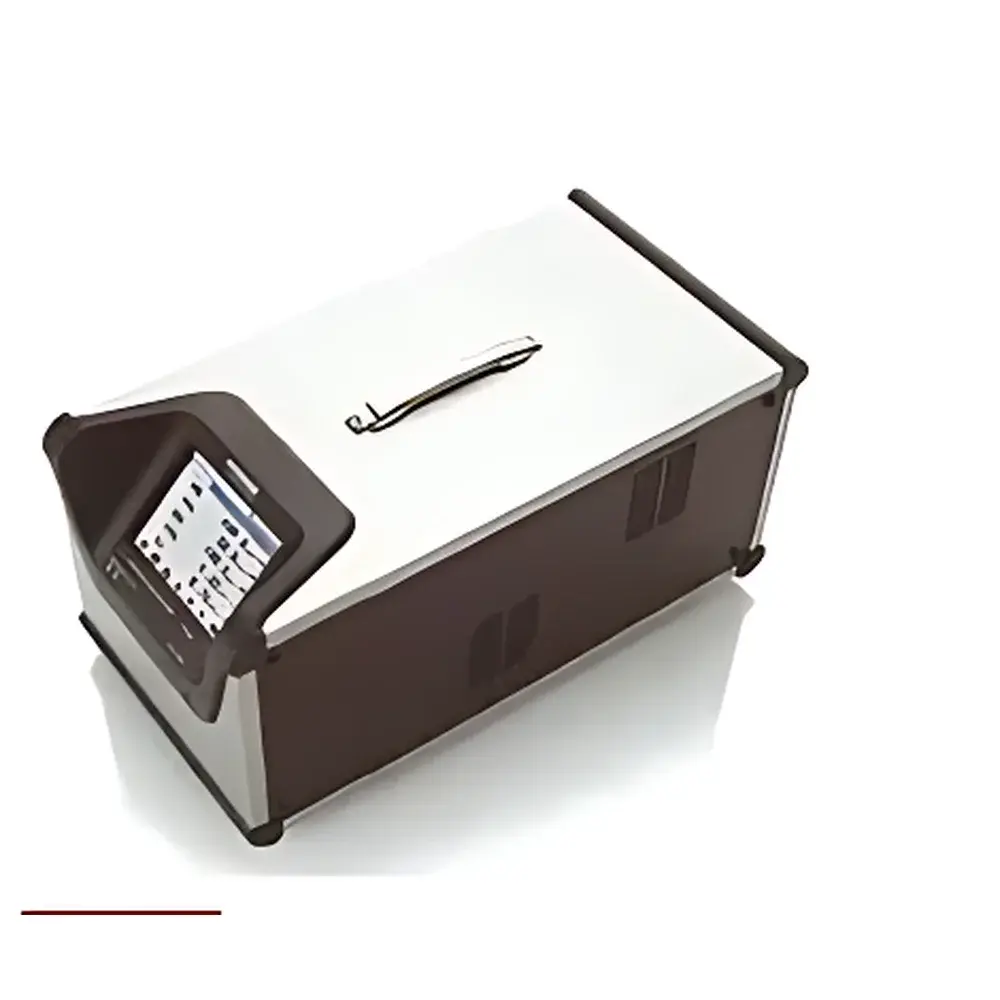
HORIBA PG-350 Portable Multi-Gas Emission Analyzer
| Brand | HORIBA |
|---|---|
| Origin | Japan |
| Model Series | PG-350 |
| Instrument Type | Portable |
| Measured Gases | NOₓ, SO₂, CO, CO₂, O₂ (optional CH₄) |
| Range Options | NOₓ: 0–25 to 2500 ppm (7 ranges) |
| SO₂ | 0–200 to 3000 ppm (4 ranges) |
| CO | 0–200 to 5000 ppm (5 ranges) |
| CO₂ | 0–10 to 30 vol% |
| O₂ | 0–5 to 25 vol% |
| CH₄ | 0–2000/5000 ppm |
| Repeatability | ±1.0% F.S. |
| Drift | ±1.0% F.S./day (SO₂: ±2.0% F.S./day) |
| Linearity | ±2.0% F.S. |
| Response Time (T₉₀) | ≤45 s (all gases except SO₂) |
| SO₂ | ≤180 s |
| Sample Flow Rate | ~0.5 L/min |
| Power Supply | 100–120 VAC / 200–240 VAC, 50/60 Hz |
| Operating Environment | 5–40 °C, ≤85% RH |
| Dimensions | 226 × 265 × 510 mm (W×H×D) |
| Weight | ~14 kg |
| Compliance | MCERTS (UK), TÜV (EU), GOST (Russia), EPA ETV (US), CNAS/CMA (China), KOLAS (Korea), JIS/MLIT (Japan) |
Overview
The HORIBA PG-350 Portable Multi-Gas Emission Analyzer is an engineered field-deployable instrument designed for high-fidelity, real-time quantification of combustion-related gaseous pollutants in stack emissions, flue gas ducts, and process exhaust streams. It employs a combination of validated physical measurement principles: alternating flow modulation chemiluminescence detection (AFM-CLD) for NOₓ; alternating flow modulation non-dispersive infrared (AFM-NDIR) for SO₂, CO, and CH₄; dual-beam non-dispersive infrared (NDIR) for CO₂; and galvanic electrochemical sensing for O₂. This hybrid optical–electrochemical architecture ensures metrological traceability, minimizes cross-sensitivity, and delivers laboratory-grade accuracy under variable ambient conditions. The PG-350 is not a simplified field tool—it is a certified reference-grade analyzer built to support regulatory compliance verification, CEMS backup validation, and transient emission profiling in mobile or constrained environments.
Key Features
- Integrated multi-gas detection platform measuring NOₓ, SO₂, CO, CO₂, and O₂ simultaneously—with optional CH₄ channel—without external gas switching valves or manual reconfiguration.
- Touch-enabled color LCD interface with intuitive menu navigation, real-time trend visualization (up to 72-hour rolling plots), and on-screen operational guidance for calibration, zero/span checks, and system diagnostics.
- Robust mechanical design compliant with IEC 60068-2 shock and vibration standards; IP54-rated enclosure for dust and moisture resistance during transport and outdoor deployment.
- Onboard electronic condensate management: automatic and manual drainage modes, programmable anti-condensation heating, and integrated Peltier-cooled dew point control to maintain sample integrity at ≤5 °C dew point.
- Full-system calibration capability—including sample probe, heated line, filter, and analyzer—traceable to NIST-certified standard gases and aligned with ISO 12039, EN 14181, and US EPA Method 6C/7E/10.
- Preheat time reduced to 30 minutes with stability maintained at ±2.0% F.S. over 2 hours—critical for rapid-response field audits and intermittent monitoring campaigns.
Sample Compatibility & Compliance
The PG-350 accepts hot, humid, and particulate-laden flue gas samples directly via its integrated heated sampling probe (up to 200 °C) and 3-meter heated transfer line (maintained at 180 °C). Particulate filtration occurs upstream using a ceramic sintered filter (pore size <5 µm), followed by catalytic conversion of NO₂ to NO for total NOₓ reporting. All measurement channels meet the performance criteria specified in MCERTS QAL1, TÜV Class 1, and EPA Performance Specification 2 (PS-2) for portable reference analyzers. Data acquisition and storage comply with GLP/GMP audit trail requirements: timestamped calibration logs, alarm events, and raw sensor outputs are recorded to removable SD card with configurable intervals (1 s to 60 min). Firmware supports 21 CFR Part 11-compliant user authentication and electronic signature protocols when operated in regulated QA/QC environments.
Software & Data Management
Data handling is facilitated through dual output interfaces: isolated 4–20 mA analog channels (user-assignable per gas) and IEEE 802.3 Ethernet (TCP/IP) for integration into SCADA, DCS, or cloud-based EMS platforms. The embedded firmware includes a RESTful API for remote configuration, firmware updates, and data pull via HTTP GET requests. Local data export supports CSV and XML formats, with metadata including instrument ID, calibration certificate number, ambient temperature/pressure, and flow rate. Optional HORIBA Emission Manager™ software provides post-processing tools for dilution correction (per ISO 14789), stoichiometric excess air calculation, and emission rate derivation (g/MJ, mg/m³ @ 3% O₂). All stored data retain full traceability to calibration gas certificates and environmental monitoring records.
Applications
- CEMS redundancy verification and periodic QAL2/QAL3 testing per EN 14181 and ISO 14064-1.
- Combustion optimization studies in industrial boilers, cement kilns, and waste incinerators—supporting NOₓ/SO₂ abatement strategy development.
- Mobile source testing: engine dynamometer exhaust characterization, fuel cell stack off-gas analysis, and catalyst light-off profiling.
- Academic and government research: atmospheric chemistry field campaigns, biomass co-firing emission mapping, and carbon capture pilot plant monitoring.
- Third-party environmental laboratories performing accredited stack testing under ISO/IEC 17025 scope.
FAQ
What regulatory certifications does the PG-350 hold for international use?
The PG-350 carries TÜV certification for EU market conformity (EN 15267-3), MCERTS approval for UK stack testing, EPA ETV validation for US federal reference method equivalency, and national type approvals from China (CMA), Korea (KOLAS), and Japan (MLIT/JIS Z 8401).
Can the PG-350 measure methane (CH₄) without hardware modification?
Yes—the CH₄ channel is factory-configurable as an optional fourth NDIR detector. No field retrofitting is required; activation is performed via firmware license key and calibration with certified CH₄ standard gas.
How is zero and span calibration performed in the field?
Zero calibration uses certified zero air (NOₓ-free, CO/CO₂ <0.1 ppm); span calibration employs individually certified multi-gas standards traceable to NIST SRMs. Automatic calibration logging records date/time, operator ID, gas lot numbers, and post-calibration residuals to SD card.
Is the PG-350 suitable for continuous unattended operation?
While designed primarily for periodic auditing and spot checks, the PG-350 supports scheduled auto-calibration cycles, remote wake-up via Ethernet, and 72-hour internal data buffering—enabling semi-continuous deployment up to 30 days with periodic SD card retrieval.
What maintenance intervals are recommended for routine field use?
Filter replacement every 200 operating hours; catalytic converter service every 12 months or 2000 hours; annual full system verification using certified reference gases and documented QAL1 procedures per EN 14181 Annex B.







