
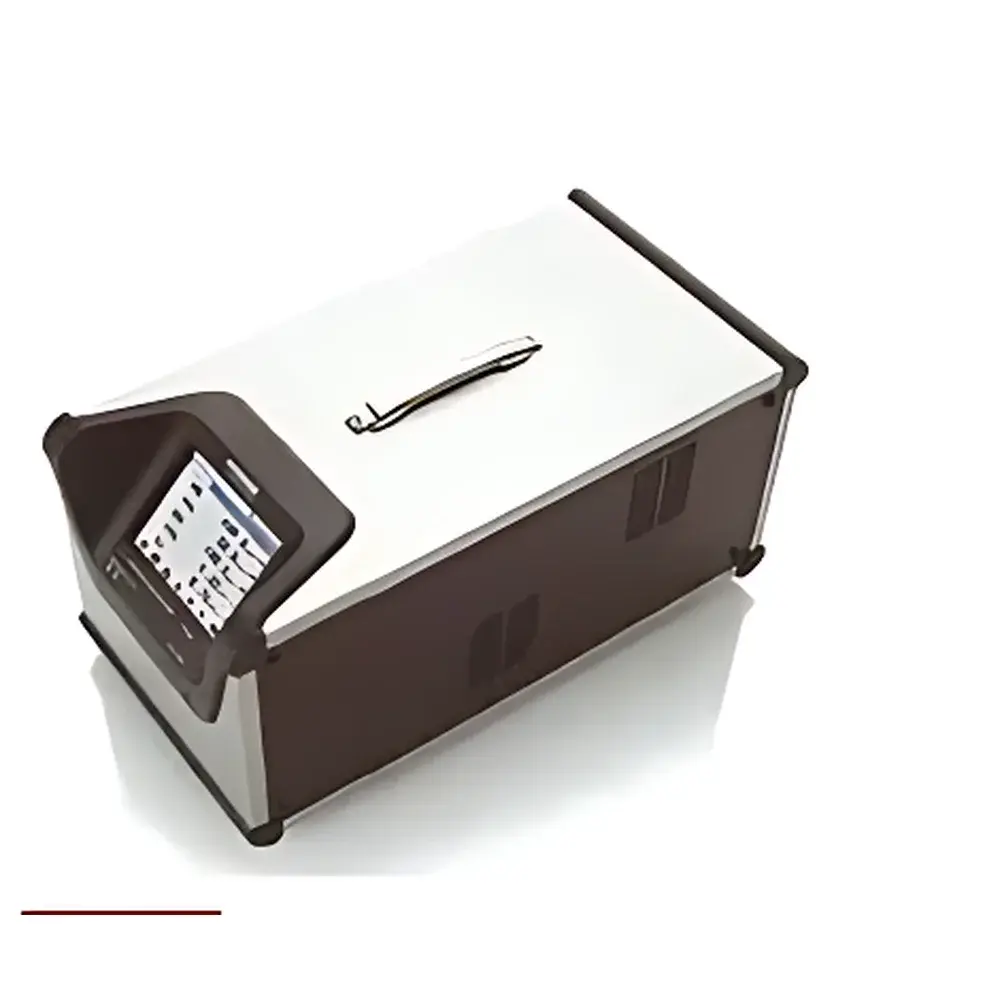
HORIBA PG-350 Portable Multi-Gas Emission Analyzer
| Brand | HORIBA |
|---|---|
| Origin | Japan |
| Model | PG-350 Series |
| Instrument Type | Portable |
| Measured Gases | NOx, SO₂, CO, CO₂, O₂ |
| Minimum Range | 0–5/10/25 vol% (O₂/CO₂) |
| Repeatability | ±1.0% F.S. |
| Response Time (T90) | ≤45 s (all gases except SO₂) |
| Zero/ Span Drift | ±1.0% F.S./day (SO₂: ±2.0% F.S./day) |
| Linearity Error | ±2.0% F.S. |
| Sample Flow Rate | ~0.5 L/min |
| Display | Color TFT Touchscreen with Real-Time Trend Plotting |
| Data Storage | SD Card (User-Configurable Interval) |
| Output | 4–20 mA DC, Ethernet |
| Warm-up Time | ≤30 min |
| Operating Environment | 5–40 °C, ≤85% RH |
| Dimensions | 226 × 265 × 510 mm (W×H×D) |
| Weight | ~14 kg |
| Certifications | TÜV (EU), MCERTS (UK), GOST-R (Russia), ETV (USA), CNAS/CMA (China), KOLAS (Korea), JIS (Japan) |
Overview
The HORIBA PG-350 Portable Multi-Gas Emission Analyzer is a field-deployable, laboratory-grade gas measurement system engineered for regulatory-compliant stack emission monitoring and combustion process optimization. It employs multiple validated physical detection principles in parallel: alternating flow modulation chemiluminescence (AFM-CLD) for NOx; alternating flow modulation non-dispersive infrared (AFM-NDIR) for SO2, CO, and CH4; broadband non-dispersive infrared (NDIR) for CO2; and galvanic electrochemical sensing for O2. This hybrid optical–electrochemical architecture ensures high selectivity, minimal cross-sensitivity, and long-term stability under variable flue gas conditions—including moisture, particulate load, and thermal transients—without requiring external dilution or complex conditioning hardware. Designed to meet the performance requirements of continuous emission monitoring systems (CEMS) as a portable backup or spot-check instrument, the PG-350 delivers trace-level quantification across seven programmable NOx ranges (0–25 to 0–2500 ppm), four SO2 ranges (0–200 to 0–3000 ppm), five CO ranges (0–200 to 0–5000 ppm), three CO2 and O2 volumetric ranges (0–10/20/30 vol% and 0–5/10/25 vol%), and optional CH4 (0–2000/5000 ppm). Its compact footprint and 14 kg mass reflect a 20% weight reduction over prior-generation field analyzers—enabling single-operator deployment at elevated or confined access points.
Key Features
- Integrated alternating flow modulation technology minimizes zero drift and enhances signal-to-noise ratio for NOx and SO2, achieving ±1.0% F.S. repeatability and <±2.0% F.S. linearity per ISO 12039 and EN 15267.
- Color TFT capacitive touchscreen with intuitive icon-driven interface, real-time multi-gas trend curves, and on-screen step-by-step operation guidance—reducing operator training time and minimizing procedural error.
- Onboard electronic condensate management with auto/manual drainage and Peltier-cooled dew point control ensures stable sample conditioning without external chillers or desiccants.
- Full-system calibration capability—including probe, sampling line, and analyzer—supports traceability to NIST-traceable standards and facilitates audit-ready documentation for GLP/GMP and EPA Method 7E/6C compliance.
- Embedded data logging via removable SD card (up to 32 GB), with user-defined interval recording (1 s to 24 h), timestamped calibration logs, alarm events, and diagnostic flags—all exportable in CSV or XML format.
- Dual analog (4–20 mA) and digital (Ethernet TCP/IP) output interfaces enable seamless integration into SCADA, DCS, or centralized environmental data management platforms.
Sample Compatibility & Compliance
The PG-350 is validated for direct analysis of hot, wet, and particulate-laden flue gases from industrial boilers, incinerators, cement kilns, and stationary engines. Its heated sampling probe (optional) and internal filtration prevent condensation-induced corrosion and filter clogging. The analyzer complies with international regulatory frameworks including EU Directive 2010/75/EU (IED), UK MCERTS Performance Standards, US EPA Methods 6C (SO2), 7E (NOx), and 3A (O2), China’s HJ 75–2017 and HJ 76–2017, and Japan’s JIS B 7982. All measurement modules are certified to IEC 61000-6-2/6-4 for electromagnetic compatibility and IP54-rated for dust and splash resistance during transport and field use.
Software & Data Management
Firmware v3.2+ supports full audit trail functionality compliant with FDA 21 CFR Part 11 requirements—including electronic signatures, role-based access control, and immutable event logs for calibration, maintenance, and alarm history. Data export is compatible with common LIMS and cloud-based platforms (e.g., AWS IoT Core, Microsoft Azure IoT Hub) via configurable HTTP POST or Modbus TCP. Remote firmware updates and diagnostic telemetry are supported over Ethernet or optional 4G LTE module (PG-350-LTE variant). Calibration certificates include uncertainty budgets calculated per ISO/IEC 17025:2017 Annex A.
Applications
- CEMS validation and periodic verification per EN 14181 QAL2/QAL3 protocols
- Combustion efficiency optimization in thermal power plants and waste-to-energy facilities
- Catalyst performance evaluation in SCR/SNCR and DeNOx systems
- Emission factor development for GHG reporting (Scope 1) under ISO 14064-1
- Research-grade exhaust characterization in engine test cells and fuel cell laboratories
- Academic air quality studies requiring mobile, multi-parameter stack profiling
FAQ
What gas species does the PG-350 measure by default?
The standard PG-350 configuration measures NOx, SO2, CO, CO2, and O2 simultaneously. CH4 detection is available as an optional channel.
Is the PG-350 suitable for hot, wet stack gas without external conditioning?
Yes—the analyzer incorporates a built-in Peltier cooler, heated sample line interface (optional), and robust particulate filtration to handle flue gas up to 200 °C and saturation humidity, meeting EN 15267-3 Class 1 requirements.
How is calibration traceability maintained?
Each PG-350 ships with factory calibration certificates traceable to NIST and JCSS standards; field calibration uses certified span gases (ISO 6141) with automated zero/span validation and electronic record retention.
Can the PG-350 be used for regulatory reporting?
It meets technical specifications for reference method equivalency under MCERTS, TÜV, and EPA guidelines; however, site-specific QA/QC procedures and third-party certification may be required per local permitting authority.
What is the typical service interval for preventive maintenance?
Recommended maintenance includes quarterly sensor verification, biannual optical path cleaning, and annual full system calibration—documented in accordance with ISO/IEC 17025 internal audit schedules.







