
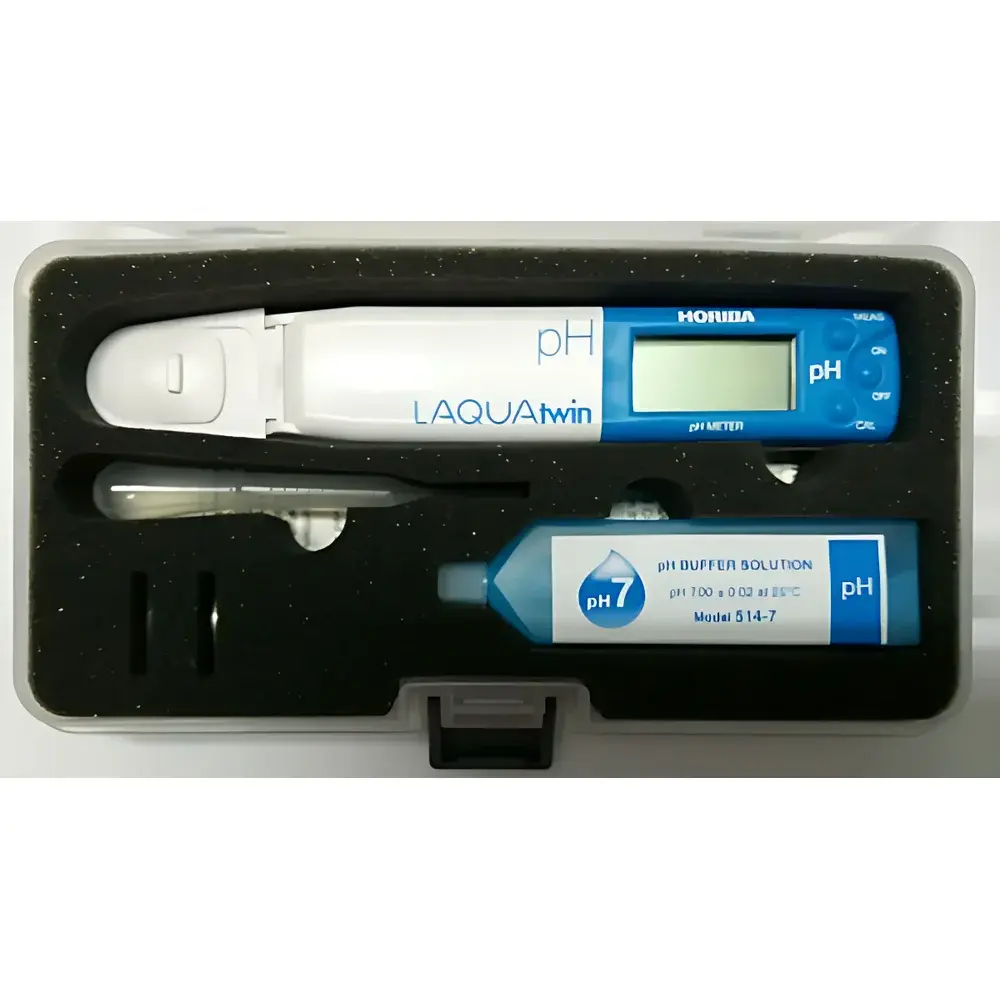
HORIBA PH-22 Portable pH Meter
| Brand | HORIBA |
|---|---|
| Origin | Japan |
| Model | PH-22 |
| Instrument Type | Pen-style pH Meter |
| Parameter Type | Single-parameter (pH) |
| Measurement Range | 0–14 pH |
| Resolution | ±0.01 pH |
| Accuracy | ±0.01 pH |
| Calibration Solutions | pH 4.01 and pH 7.00 standard buffers |
| Temperature Compensation | Automatic (ATC) |
| Electrode Type | Flat-surface pH sensor |
| Minimum Sample Volume | 100 µL |
| Compliance | Designed for routine field and lab use in accordance with ISO 7888 and ASTM D1293 guidelines |
Overview
The HORIBA PH-22 is a compact, pen-style portable pH meter engineered for rapid, reliable, and reproducible pH measurements in diverse operational environments—from aquaculture ponds and soil slurry testing to food quality control and routine laboratory verification. Built upon a solid-state flat-surface pH electrode architecture, the PH-22 eliminates conventional glass bulb vulnerability while maintaining Nernstian response characteristics. Its measurement principle relies on potentiometric detection of hydrogen ion activity across an ion-selective membrane, referenced against an integrated Ag/AgCl reference system. The device incorporates automatic temperature compensation (ATC) via a built-in thermistor, ensuring pH values are corrected to 25 °C per standard calibration conventions. With a full-scale range of 0–14 pH and a resolution and accuracy both specified at ±0.01 pH, the PH-22 meets the performance requirements for ISO 7888 (water quality — determination of pH) and ASTM D1293 (standard test method for pH of water), supporting traceable, auditable data generation in GLP-aligned workflows.
Key Features
- Flat-surface pH electrode design enables direct contact measurement on semi-solid matrices—including moist soil, gel-based food samples, and biofilm surfaces—without requiring sample dilution or homogenization.
- Optimized micro-volume capability: accurate readings achievable from as little as 100 µL of aqueous solution, reducing reagent consumption and enabling high-throughput screening in resource-constrained settings.
- One-button calibration protocol using two-point calibration with certified pH 4.01 and pH 7.00 standard buffer solutions; calibration status is displayed in real time with slope and offset diagnostics.
- Rugged, IP67-rated housing ensures resistance to dust ingress and immersion up to 1 m for 30 minutes—suitable for outdoor deployment in humid or splash-prone environments.
- Auto-power-off function (after 10 minutes of inactivity) extends battery life; powered by two standard AAA alkaline cells with typical service life exceeding 2,000 measurements per set.
Sample Compatibility & Compliance
The PH-22 is validated for use with aqueous and low-ionic-strength samples, including freshwater, wastewater effluents, nutrient solutions, fruit juice extracts, and saturated soil extracts prepared per ISO 10390. It is not recommended for highly viscous, non-aqueous, or strongly oxidizing media (e.g., concentrated HNO₃ or bleach solutions), which may degrade the electrode membrane. All factory calibration and verification procedures comply with traceability requirements under ISO/IEC 17025:2017 (clause 6.4.10). Device documentation includes a Declaration of Conformity referencing RoHS Directive 2011/65/EU and EMC Directive 2014/30/EU.
Software & Data Management
While the PH-22 operates as a standalone instrument without onboard memory or Bluetooth connectivity, its analog output interface (via optional RS-232 adapter kit) supports integration into centralized LIMS or SCADA platforms. Raw voltage and temperature data can be logged externally for post-acquisition recalibration or statistical process control (SPC) analysis. For regulated environments requiring audit trails, users may pair the PH-22 with validated third-party data capture software compliant with FDA 21 CFR Part 11 (electronic records and signatures), provided appropriate user access controls and electronic signature protocols are implemented at the host system level.
Applications
- Aquaculture and hydroponics: Real-time monitoring of pond, tank, and recirculating aquaculture system (RAS) water to maintain optimal pH for nitrification efficiency and fish health.
- Food safety and QC labs: Rapid verification of pH in fermented products (yogurt, sauerkraut), meat curing brines, and acidified canned goods per USDA-FSIS and EU Regulation (EC) No 2073/2005.
- Environmental field testing: On-site assessment of soil pH in agricultural land evaluation and remediation projects, aligned with ASTM D4972 and ISO 10390 methodologies.
- Educational laboratories: Teaching tool for electrochemical fundamentals, calibration theory, and Good Laboratory Practice (GLP) documentation in undergraduate chemistry and environmental science curricula.
FAQ
What calibration standards are required for the PH-22?
The PH-22 requires two-point calibration using traceable pH 4.01 and pH 7.00 standard buffer solutions at 25 °C. Certified reference materials (CRM) from NIST-traceable suppliers are recommended for compliance-critical applications.
Can the PH-22 measure pH in soil directly?
Yes—its flat-surface electrode allows direct insertion into moist, homogenized soil pastes (1:5 soil:water ratio per ISO 10390); avoid dry or rocky substrates that may damage the sensing surface.
Is the device suitable for GMP-regulated manufacturing?
As a Class II measuring instrument, the PH-22 may be deployed in GMP environments when incorporated into a documented calibration program, including periodic verification against master standards and maintenance of equipment logs per Annex 15.
How often should the electrode be cleaned and stored?
Rinse with deionized water after each use; store immersed in pH 4 buffer or专用 storage solution. Clean weekly with mild detergent if exposed to organic fouling; avoid abrasive cleaning agents or ethanol immersion.
Related Products





