
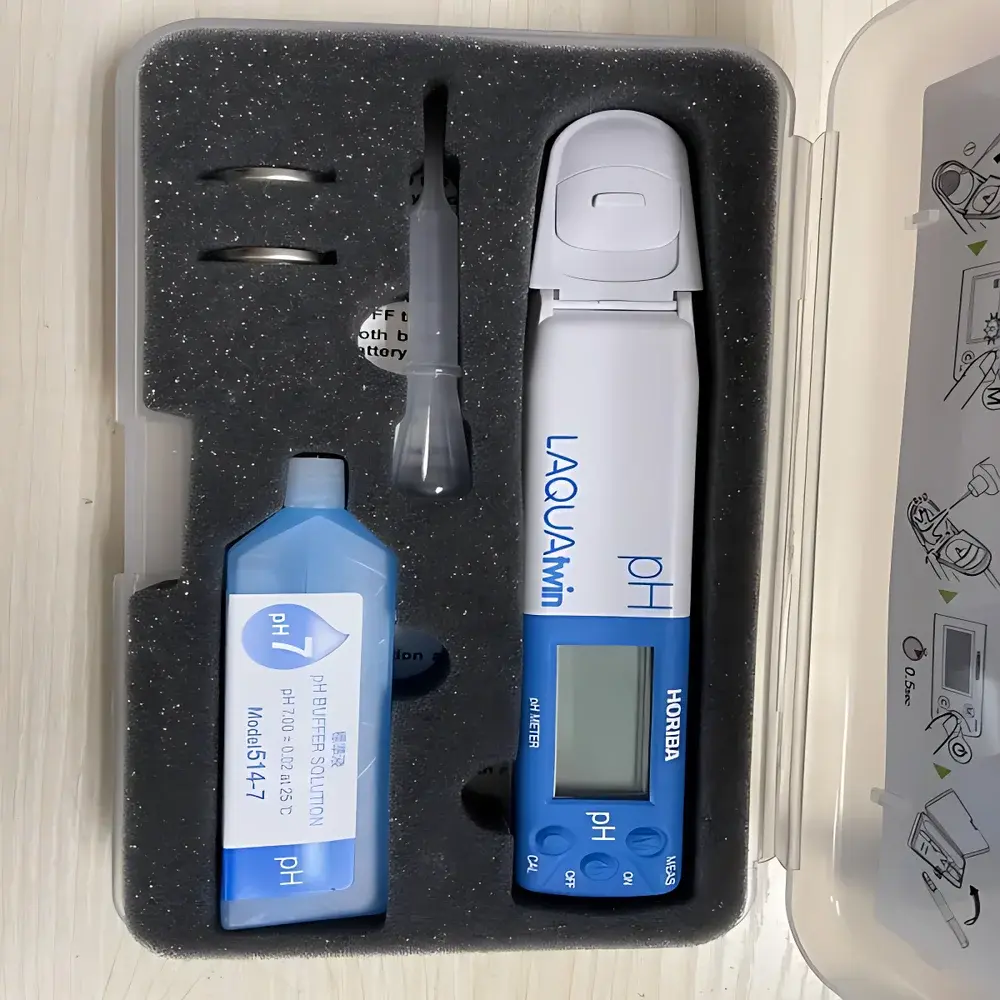
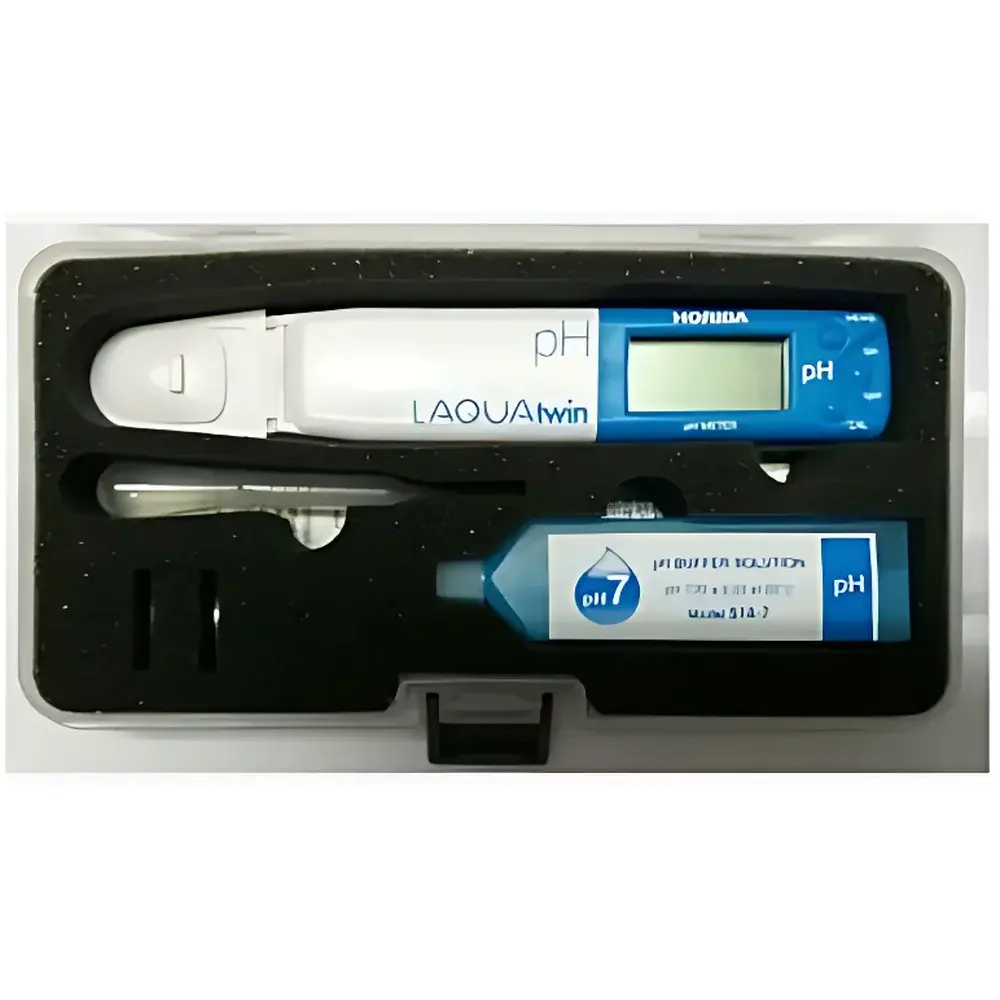
HORIBA PH-22 Portable pH Pen Meter
| Brand | HORIBA |
|---|---|
| Origin | Japan |
| Model | PH-22 |
| Instrument Type | Pen-style pH Meter |
| Parameter Type | Single-parameter (pH) |
| Measurement Range | 0–14 pH |
| Resolution | ±0.01 pH |
| Accuracy | ±0.01 pH |
| Calibration Solutions | pH 4.01 and pH 7.00 standard buffers |
| Temperature Compensation | Automatic (ATC) |
| Electrode Design | Flat-surface pH sensor |
| Minimum Sample Volume | 100 µL |
| Compliance | Designed for general laboratory, field, and quality control use per ISO 3696 (Grade 3 water), ASTM D1293, and JIS K 0107 |
Overview
The HORIBA PH-22 Portable pH Pen Meter is an engineered electrochemical measurement instrument designed for rapid, reliable, and field-deployable pH determination across diverse sample matrices. Built upon a solid-state flat-surface pH electrode architecture, the PH-22 operates on the principle of potentiometric measurement—detecting the potential difference between a pH-sensitive glass membrane and a stable internal reference electrode in response to hydrogen ion activity. Its integrated automatic temperature compensation (ATC) circuitry ensures thermally corrected readings without manual input, referencing the Nernst equation slope (≈59.16 mV/pH at 25 °C) across its operational range. Unlike conventional combination electrodes requiring immersion depth or stirring, the PH-22’s planar sensing surface enables direct contact measurements on semi-solid, viscous, or low-volume samples—including soil slurries, food surfaces, gel media, and micro-volume aqueous solutions—as little as 100 µL. This design eliminates air-gap errors and reduces contamination risk, making it particularly suitable for non-standard sampling environments where traditional rod-type meters are impractical.
Key Features
- Flat-surface pH electrode with chemically stable glass membrane and Ag/AgCl reference system for consistent response in heterogeneous or low-conductivity samples
- Integrated ATC using a high-stability NTC thermistor (±0.3 °C accuracy), enabling real-time slope correction across 0–50 °C
- High-resolution LCD display with backlight for legibility under variable lighting conditions
- One-button calibration protocol supporting two-point calibration (pH 4.01 and pH 7.00 buffers) with on-screen prompt guidance and calibration verification
- Auto-power-off after 10 minutes of inactivity to extend battery life (operates on two AAA batteries, typical life >2,000 measurements)
- IP67-rated housing for dust and temporary water immersion resistance—validated per IEC 60529 standards
- No moving parts or replaceable electrolyte cartridges; maintenance limited to routine electrode cleaning and buffer verification
Sample Compatibility & Compliance
The PH-22 demonstrates broad compatibility with liquid, semi-solid, and surface-contact applications including freshwater and seawater monitoring, aquaculture pond profiling, agricultural soil slurry analysis (per ASTM D4972), food product surface pH screening (e.g., meat, cheese, produce), and QC checks in pharmaceutical excipient preparation. It meets functional requirements outlined in ISO 7888 (water quality — determination of pH), USP (pH measurement in pharmaceutical preparations), and JIS K 0107 (general rules for pH measurement). While not certified for GLP/GMP audit trails or 21 CFR Part 11 compliance (as it lacks data logging or user authentication), its calibration traceability supports documented QC procedures when used with NIST-traceable pH 4.01 and 7.00 standard solutions.
Software & Data Management
The PH-22 is a standalone, non-data-logging instrument. All measurements are displayed in real time and retained only until power cycle or new reading acquisition. No proprietary software, USB interface, or Bluetooth connectivity is included. For laboratories requiring electronic record retention, users may manually transcribe values into LIMS or Excel-based tracking systems following internal SOPs. Calibration history must be recorded externally per ISO/IEC 17025 Clause 7.7 (uncertainty and traceability documentation). The device does not generate audit trails, electronic signatures, or password-protected settings—consistent with its role as a basic field verification tool rather than a regulated process analyzer.
Applications
- Aquaculture and environmental fieldwork: Rapid spot-checking of pond, river, or effluent pH without sample transfer
- Food safety and quality assurance: Surface pH mapping of cured meats, dairy products, and fermented foods per Codex Alimentarius guidelines
- Agricultural extension services: On-site soil pH estimation via saturated paste extracts (ASTM D4972)
- Teaching laboratories: Introductory electrochemistry demonstrations emphasizing Nernstian behavior and calibration fundamentals
- Pharmaceutical pre-formulation: Quick assessment of buffer capacity and excipient compatibility during early-stage development
- Hydroponics and greenhouse management: Daily nutrient solution monitoring with minimal reagent consumption
FAQ
Does the PH-22 support three-point calibration?
No—the PH-22 is configured for two-point calibration only (pH 4.01 and pH 7.00), which satisfies ISO 7888 requirements for routine accuracy verification.
Can the flat electrode be used for measuring pH of thick pastes or gels?
Yes—its planar geometry allows direct surface contact without penetration, minimizing mechanical disturbance and enabling reproducible readings on semi-solids when gently pressed and held for stabilization (typically 15–30 seconds).
Is the electrode replaceable as a standalone component?
No—the sensor is permanently sealed within the pen body; full unit replacement is required upon end-of-life or performance degradation.
What is the recommended storage condition for long-term stability?
Store upright with protective cap engaged, in a cool, dry environment; avoid prolonged exposure to extreme temperatures or desiccants, which may dehydrate the glass membrane.
How often should calibration be performed?
Calibrate before each use session or at least once per day when conducting critical measurements; verify calibration drift using a third check standard (e.g., pH 10.01) if extended operation is required.





