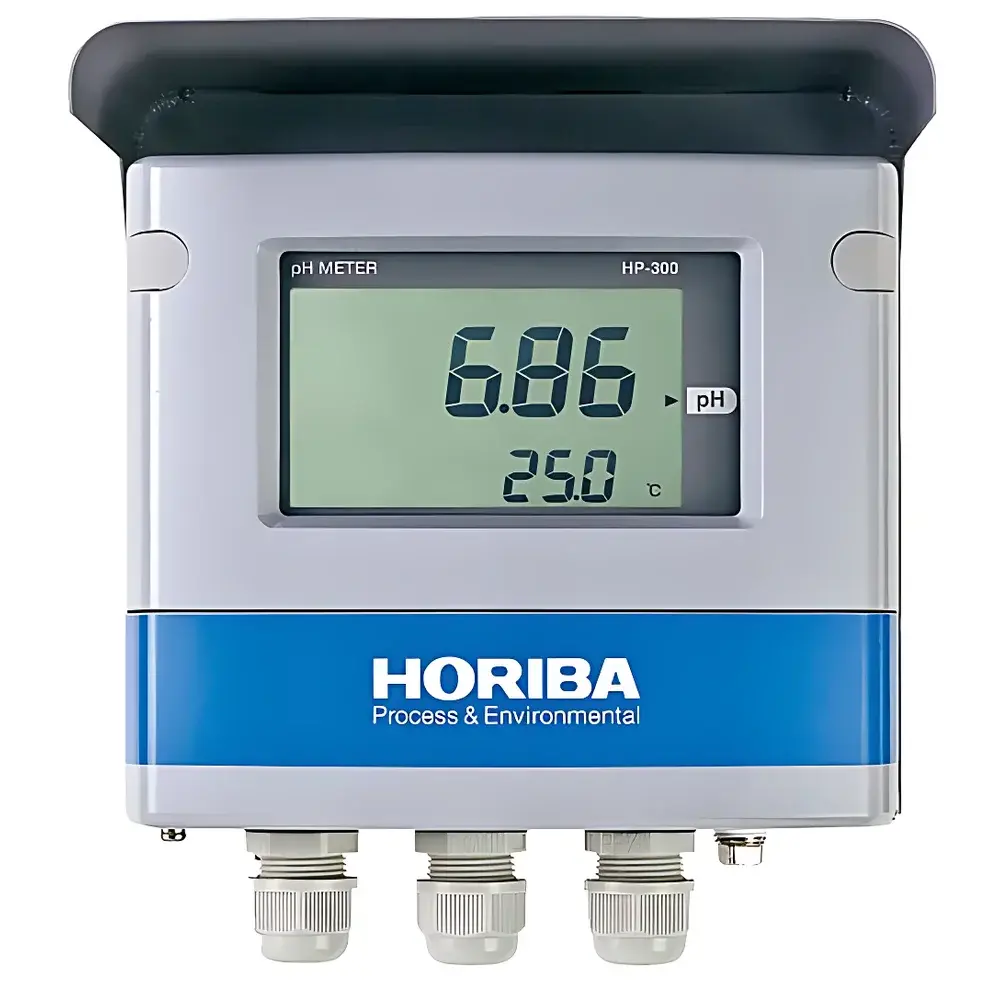
HORIBA pH-300 Online pH Analyzer
| Brand | HORIBA |
|---|---|
| Origin | Japan |
| Model | pH-300 |
| Measurement Range (pH) | 0–14 (display range: −1 to 15) |
| Temperature Range | 0–100 °C (display range: −10 to 110 °C, up to −20 to 130 °C with manual sensor type input) |
| Resolution | 0.01 pH / 0.1 °C |
| Accuracy | ±0.03 pH (equivalent input) / ±0.3 °C (equivalent input) |
| Output | 4–20 mA DC (galvanically isolated, load ≤600 Ω, linearity ±0.08 mA) |
| Power Supply | 24 V DC (21–32 V DC), ≤0.6 W |
| Enclosure | Aluminum alloy, IP65 (IEC 60529 / JIS C0920) |
| Operating Ambient | −20 to +60 °C, 5–90% RH (non-condensing) |
| Compliance | CE marking, FCC rules, RoHS, WEEE |
Overview
The HORIBA pH-300 Online pH Analyzer is a rugged, two-wire loop-powered transmitter engineered for continuous, high-reliability pH and temperature monitoring in industrial process control environments. Based on potentiometric measurement principles, the analyzer interfaces directly with glass pH electrodes and integrated temperature sensors—enabling real-time, compensated pH determination in aqueous solutions across demanding applications such as chemical manufacturing, wastewater treatment, food & beverage processing, and pharmaceutical water systems. Its design prioritizes long-term stability under fluctuating thermal, mechanical, and chemical stressors typical of outdoor or semi-outdoor installations. The unit operates within a wide ambient temperature range (−20 to +60 °C), features an IP65-rated aluminum enclosure, and complies with CE, FCC, RoHS, and WEEE directives—ensuring suitability for global deployment in regulated and non-regulated facilities alike.
Key Features
- Two-wire 4–20 mA output with galvanic isolation and configurable signal hold (3.8 mA or 21 mA fault signaling) during maintenance or sensor failure
- Integrated temperature compensation using Pt1000, 500 kΩ, 6.8 kΩ, or 10 kΩ RTD elements—with automatic sensor type detection or manual selection
- High-contrast LCD display with large, legible digits; supports simultaneous pH and temperature readout
- Comprehensive self-diagnostic suite detecting asymmetry potential drift, electrode sensitivity degradation, response time lag, reference junction impedance anomalies, and temperature sensor faults (open/short/cross-range)
- Non-lead electrode compatibility and RoHS-compliant construction supporting environmental compliance requirements in EU and North America
- Secure terminal block with captive-thread screw terminals minimizing wiring disconnection risk in vibration-prone environments
- Calibration memory stores date-stamped records of 1-, 2-, or 3-point calibrations using standard buffers (pH 2, 4, 7, 9, 10); calibration verification traceable to NIST-traceable references
Sample Compatibility & Compliance
The pH-300 is optimized for aqueous samples with conductivity ≥50 µS/cm and total dissolved solids (TDS) ≤10,000 ppm. It supports a broad selection of HORIBA-compatible pH electrodes—including gel-filled, refillable, double-junction, and low-maintenance designs—enabling adaptation to aggressive media (e.g., high-chloride, sulfide-rich, or viscous effluents). While not certified for intrinsic safety (ATEX/IECEx), its IP65 rating ensures protection against dust ingress and water jets, making it suitable for Zone 2/Class I, Division 2 environments when installed per local electrical codes. The device meets electromagnetic compatibility (EMC) requirements per EN 61326-1 (industrial environment) and adheres to essential safety standards outlined in EN 61010-1. Its architecture supports audit-ready operation in GLP/GMP contexts through timestamped calibration logs and diagnostic event history.
Software & Data Management
As a standalone analog transmitter, the pH-300 does not require external software for basic operation. However, its 4–20 mA output integrates seamlessly with DCS, PLC, SCADA, and MES platforms for centralized data acquisition and trending. Calibration data—including buffer pH values, measured mV, slope (%), offset (mV), and temperature—is retained in non-volatile memory and accessible via front-panel navigation. For facilities requiring electronic record integrity under FDA 21 CFR Part 11, integration with validated historian systems enables secure storage of calibration events, diagnostic alerts, and operator actions—supporting full traceability without native digital communication protocols (e.g., HART, Modbus).
Applications
- Continuous pH monitoring in primary and secondary wastewater treatment basins, neutralization tanks, and discharge points
- In-line control of acid/base dosing in chemical synthesis reactors and rinse water loops
- Boiler feedwater and cooling tower chemistry management in power generation and HVAC systems
- Real-time quality assurance in dairy pasteurization, brewery mash tuning, and beverage carbonation processes
- Environmental compliance monitoring at municipal and industrial outfalls per EPA Method 150.1 and ISO 10523
FAQ
Does the pH-300 support HART or digital communication protocols?
No—the pH-300 is an analog-only, two-wire 4–20 mA transmitter. It does not include HART, Modbus, or other digital interface capabilities.
Can the pH-300 perform automatic temperature compensation without an integrated sensor?
No—temperature compensation requires either a built-in RTD or an external temperature probe connected to the analyzer’s dedicated input terminals.
What is the maximum cable length between the pH-300 and the electrode?
For optimal noise immunity and signal fidelity, HORIBA recommends ≤15 m using shielded, twisted-pair cable rated for pH applications; longer runs require signal conditioning or remote preamplification.
Is the pH-300 suitable for use in explosive atmospheres?
It is not intrinsically safe or explosion-proof certified. Installation in hazardous areas must follow local authority requirements and may necessitate additional barriers or purged enclosures.
How often should calibration be performed?
Frequency depends on process stability and regulatory requirements—typically daily for critical pharmaceutical water systems, weekly for municipal wastewater, and monthly for stable industrial cooling loops. Diagnostic alerts indicate when recalibration is empirically warranted.
Related Products