
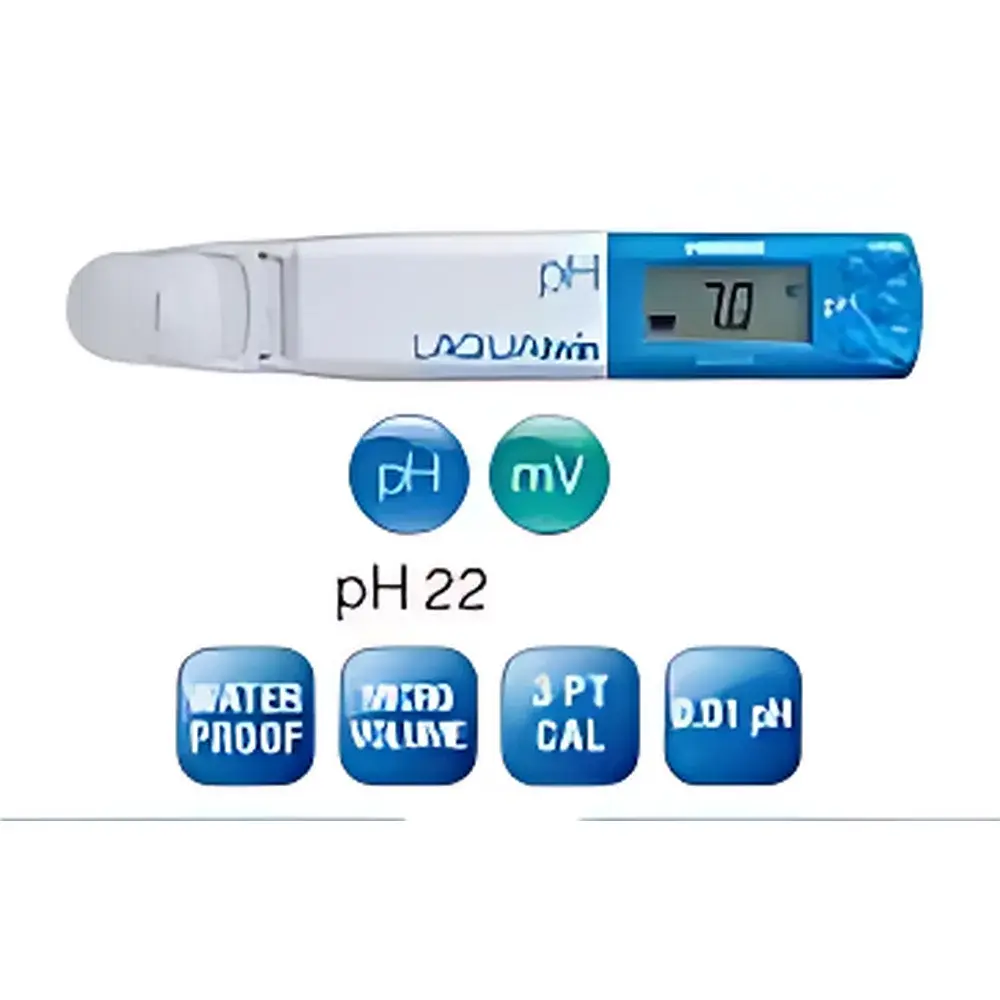
HORIBA PH22 Portable Pen-Style pH Meter
| Brand | HORIBA |
|---|---|
| Origin | Japan |
| Model | PH22 |
| Instrument Type | Pen-Style pH Meter |
| Parameter Type | Single-Parameter (pH) |
| Measurement Range | 0.00–14.00 pH |
| Resolution | ±0.01 pH |
| Accuracy | ±0.01 pH |
| Calibration Solutions | pH 4.01 and pH 7.00 standard buffers |
| Temperature Compensation | Automatic (ATC) with integrated temperature sensor |
| Sample Volume Requirement | As low as 100 µL |
| Electrode Design | Flat-surface pH sensing element |
Overview
The HORIBA PH22 is a compact, pen-style portable pH meter engineered for rapid, reliable field and benchtop pH measurements in resource-constrained or space-limited environments. It operates on the fundamental principle of potentiometric measurement: the potential difference between a pH-sensitive glass membrane electrode and a stable reference electrode is converted into a pH value using the Nernst equation (−59.16 mV/pH unit at 25 °C). Unlike conventional combination electrodes requiring immersion depth and stabilization time, the PH22 integrates a flat-surface pH sensing element that enables direct contact measurement on semi-solid surfaces (e.g., moist soil, food surfaces, gel media) and micro-volume liquid samples down to 100 µL—eliminating the need for sample transfer or dilution. Its built-in automatic temperature compensation (ATC) uses an integrated thermistor to correct for solution temperature deviations from 25 °C, ensuring traceable accuracy across 0–50 °C without manual input.
Key Features
- Flat-surface pH electrode design enabling direct surface contact measurement on soils, pastes, gels, and thin-film aqueous layers
- Micro-sample capability: validated performance with ≥100 µL sample volume—ideal for precious or limited-quantity samples
- High-precision analog-to-digital conversion circuitry delivering ±0.01 pH resolution and accuracy per ISO 3696 Grade 3 water standards
- Auto-ranging display with real-time stability indicator (flashing “READY” icon upon signal convergence)
- Two-point calibration protocol using standardized pH 4.01 and pH 7.00 buffer solutions—compliant with ASTM D1293 and ISO 10523 procedures
- Rugged, IP67-rated housing with chemical-resistant ABS/PC casing and sealed electrode junction—suitable for humid, dusty, or splash-prone environments
- Battery life exceeding 2,000 measurements on a single CR2032 coin cell; low-power shutdown after 10 minutes of inactivity
Sample Compatibility & Compliance
The PH22 is validated for use with aqueous solutions, buffered electrolytes, soil extracts (1:5 water suspension), homogenized food matrices (e.g., fruit pulp, dairy products), and aquaculture pond water. It meets the functional requirements of ISO 7888 (water quality — determination of pH), EPA Method 150.1 (pH measurement in drinking water), and JIS K 0102 (Japanese Industrial Standard for chemical analysis). While not certified for GLP/GMP-regulated release testing, its calibration traceability, ATC functionality, and documented repeatability (RSD ≤ 0.3% over n=10 replicates in pH 7.00 buffer) support routine QC/QA applications under ISO/IEC 17025-accredited laboratories. The flat electrode minimizes clogging risk in turbid or particulate-laden samples compared to conventional bulb-type electrodes.
Software & Data Management
The PH22 operates as a standalone instrument with no embedded Bluetooth, USB, or data logging capability. All measurements are displayed in real time on a high-contrast LCD screen (3-digit pH + sign + two decimal places). For regulatory compliance workflows, users are advised to record readings manually in bound logbooks or electronic lab notebooks (ELN) with timestamp and operator ID. When deployed in FDA-regulated environments, the device satisfies 21 CFR Part 11 criteria for “non-electronic records” provided calibration logs, buffer lot numbers, and environmental conditions (temperature, humidity) are contemporaneously documented per SOP. Firmware is non-upgradable; calibration constants are stored in non-volatile memory and retained for ≥10 years without battery power.
Applications
- Aquaculture and hydroponics: spot-checking pond, tank, or nutrient solution pH during feeding cycles or water exchange events
- Food safety and quality control: rapid pH verification of meat, cheese, fermented vegetables, and ready-to-eat products per HACCP critical limits
- Agricultural extension: on-site soil pH screening for lime requirement estimation (using saturated paste or 1:5 CaCl₂ extract protocols)
- Environmental field surveys: stream, wetland, or stormwater runoff monitoring where portability and minimal sample handling are essential
- Teaching laboratories: student experiments in general chemistry, environmental science, and food technology requiring intuitive, low-maintenance instrumentation
FAQ
What calibration buffers are required for daily operation?
The PH22 requires two-point calibration using certified pH 4.01 and pH 7.00 standard buffer solutions traceable to NIST SRM 186. Calibration should be performed before each measurement session or when ambient temperature shifts >5 °C.
Can the PH22 measure pH in non-aqueous or high-alcohol content samples?
No. The flat electrode is optimized for aqueous systems with conductivity ≥50 µS/cm. Measurements in solvents (e.g., ethanol, acetone) or low-ionic-strength samples (e.g., deionized water) will yield unstable or erroneous readings due to junction potential drift.
How often should the electrode be cleaned and reconditioned?
Rinse with deionized water after each use. For proteinaceous or oily residues, soak the sensing surface in 0.1 M HCl for 2 minutes, then rinse thoroughly. Reconditioning in pH 4 buffer for 30 minutes is recommended if response time exceeds 15 seconds.
Is the PH22 compliant with ISO/IEC 17025 for accredited testing?
Yes—as a measurement tool within an accredited scope—provided calibration is performed by a UKAS- or A2LA-accredited provider, uncertainty budgets include electrode drift and temperature probe error, and records meet clause 7.7 requirements for equipment traceability.





