
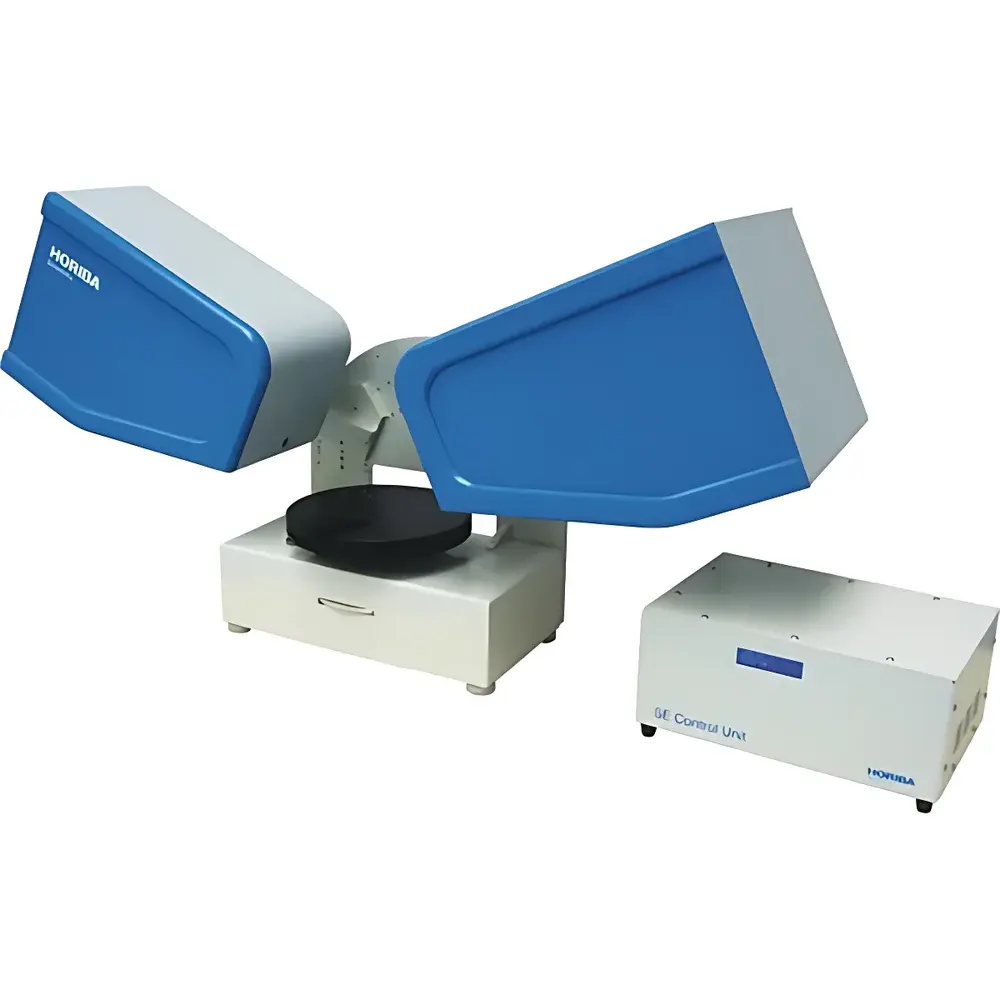
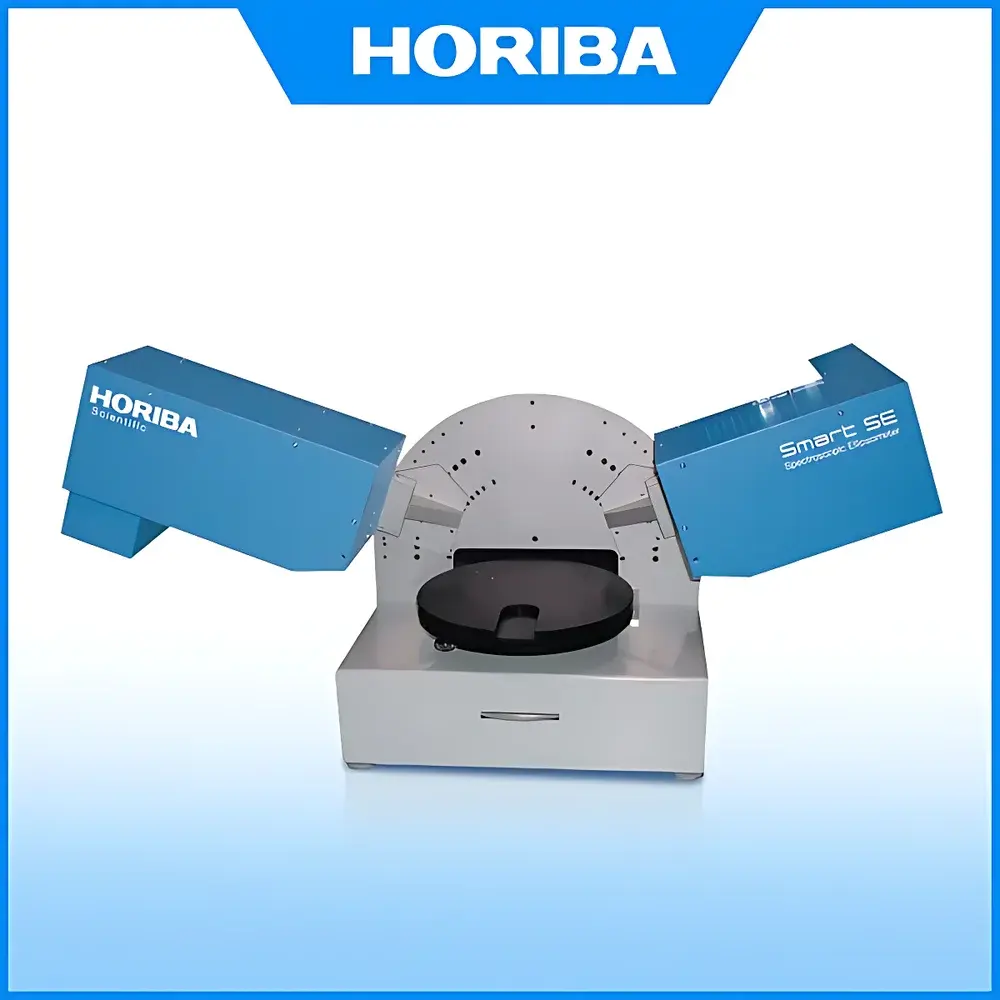
HORIBA Smart SE Spectroscopic Ellipsometer
| Brand | HORIBA |
|---|---|
| Origin | France |
| Model | Smart SE |
| Measurement Speed | 5 s (typical), down to 1 s (max) |
| Wavelength Range | 450–1000 nm |
| Spot Sizes | 7 selectable configurations (e.g., 75 µm × 150 µm to 500 µm × 500 µm) |
| Software | DeltaPsi² v5.x (Windows-based) |
| Compliance | Designed for GLP/GMP-aligned workflows |
Overview
The HORIBA Smart SE Spectroscopic Ellipsometer is a benchtop, non-contact optical metrology instrument engineered for rapid, high-precision characterization of thin films and surface interfaces. It operates on the fundamental principle of spectroscopic ellipsometry—measuring the change in polarization state (Δ and Ψ) of light upon reflection or transmission from a sample surface across a continuous spectral range (450–1000 nm). This change encodes quantitative information about film thickness (from sub-Ångström to ~15 µm), complex refractive index (n + ik), surface roughness, interfacial grading, layer uniformity, and optical dispersion. Unlike interferometric or profilometric techniques, ellipsometry requires no physical contact, calibration standards, or destructive sampling—making it ideal for in-line process monitoring, R&D validation, and QC in semiconductor fabrication, display manufacturing, photovoltaics, and advanced materials development.
Key Features
- Sub-second spectral acquisition: Full 450–1000 nm spectrum acquired in ≤1 s under optimized conditions; typical full-measurement-and-analysis cycle completes in <5 s.
- MyAutoView integrated spot visualization system: Real-time CCD-based imaging enables precise targeting of measurement spots—even on low-contrast, highly reflective, or micro-rough surfaces—eliminating positional uncertainty and ensuring repeatability across heterogeneous substrates.
- Seven motorized spot size options: Configurable rectangular apertures (e.g., 75 µm × 150 µm, 250 µm × 250 µm, 500 µm × 500 µm) support spatially resolved mapping and compatibility with micro-patterned devices, MEMS structures, and small-area samples.
- Modular hardware expandability: Optional motorized XYZ stage enables automated large-area mapping; temperature-controlled stages (−40 °C to +200 °C), liquid cells, electrochemical flow cells, gas-tight chambers, and transmission-mode accessories extend functionality to dynamic and environmental studies.
- Intelligent diagnostics and guided operation: Onboard self-check routines monitor optical alignment, lamp intensity, detector response, and mechanical positioning—providing actionable feedback via step-by-step troubleshooting wizards without requiring service engineer intervention.
Sample Compatibility & Compliance
The Smart SE accommodates rigid and flexible substrates up to 200 mm in diameter (with optional stage), including silicon wafers, glass, quartz, polymer foils, ITO-coated displays, and bio-functionalized sensor chips. Its non-destructive, ambient-atmosphere operation eliminates vacuum constraints while maintaining measurement fidelity for both single-layer and complex multilayer stacks (e.g., SiO₂/SiNₓ/a-Si:H, ITO/Ag/ITO, organic-inorganic hybrids). The system architecture and DeltaPsi² software are designed to support regulated environments: audit trail logging, electronic signatures, role-based user permissions, and data integrity controls align with GLP, ISO/IEC 17025, and FDA 21 CFR Part 11 requirements when deployed with documented configuration and validation protocols.
Software & Data Management
DeltaPsi² software serves as the analytical engine—built on over three decades of HORIBA Scientific (formerly Jobin Yvon) ellipsometry expertise. It provides a modular, Windows-native interface supporting advanced optical modeling: gradient layers, effective medium approximations (EMA), anisotropic dielectric functions, Tauc-Lorentz and Cody-Lorentz dispersion models, and BLMC (Boundary Layer Modeling Correction) algorithms for ultra-thin (<5 Å) and interfacial layers. The software includes automated background subtraction for thick transparent substrates, multi-start fitting with correlation analysis, parameter sensitivity mapping, and built-in material databases (e.g., Si, SiO₂, SiNₓ, ITO, amorphous carbon, polymers). All raw spectra, model parameters, fit residuals, and metadata are stored in vendor-neutral HDF5 format, enabling traceable data export for LIMS integration or third-party statistical analysis.
Applications
The Smart SE delivers quantitative metrology across academic and industrial domains: thickness and optical constants (n, k) of ALD/PECVD-deposited dielectrics; native oxide growth on Si; roughness evolution during CMP; crystallinity and bandgap (Eg) extraction in polycrystalline Si and perovskite films; composition profiling in graded HfO₂–SiO₂ stacks; real-time monitoring of self-assembled monolayers (SAMs); optical dispersion of transparent conductive oxides (TCOs); degradation kinetics of OLED encapsulation layers; and quality assurance of anti-reflective, hydrophobic, and photocatalytic coatings. Its speed and robustness make it suitable for high-throughput lot acceptance testing in TFT-LCD, micro-LED, and flexible electronics production lines.
FAQ
What is the minimum measurable film thickness?
The Smart SE achieves sub-Ångström resolution for well-characterized systems (e.g., native SiO₂ on Si) when combined with appropriate modeling constraints and high signal-to-noise acquisition.
Can it measure transparent substrates like fused silica or CaF₂?
Yes—DeltaPsi² includes automatic substrate background correction algorithms optimized for thick (>1 mm) transparent dielectrics.
Is real-time in-situ monitoring supported?
With optional environmental chambers and external trigger synchronization, the Smart SE supports time-resolved ellipsometry at up to 1 Hz frame rate for reaction kinetics and deposition monitoring.
Does it require routine recalibration?
No—factory calibration is retained via stable optical components and internal reference measurements; annual verification against NIST-traceable standards is recommended for GMP applications.
How is data security managed in regulated labs?
When deployed with DeltaPsi²’s Validation Pack, the system enforces 21 CFR Part 11-compliant electronic records—including immutable audit trails, biometric or token-based login, and configurable retention policies.





