
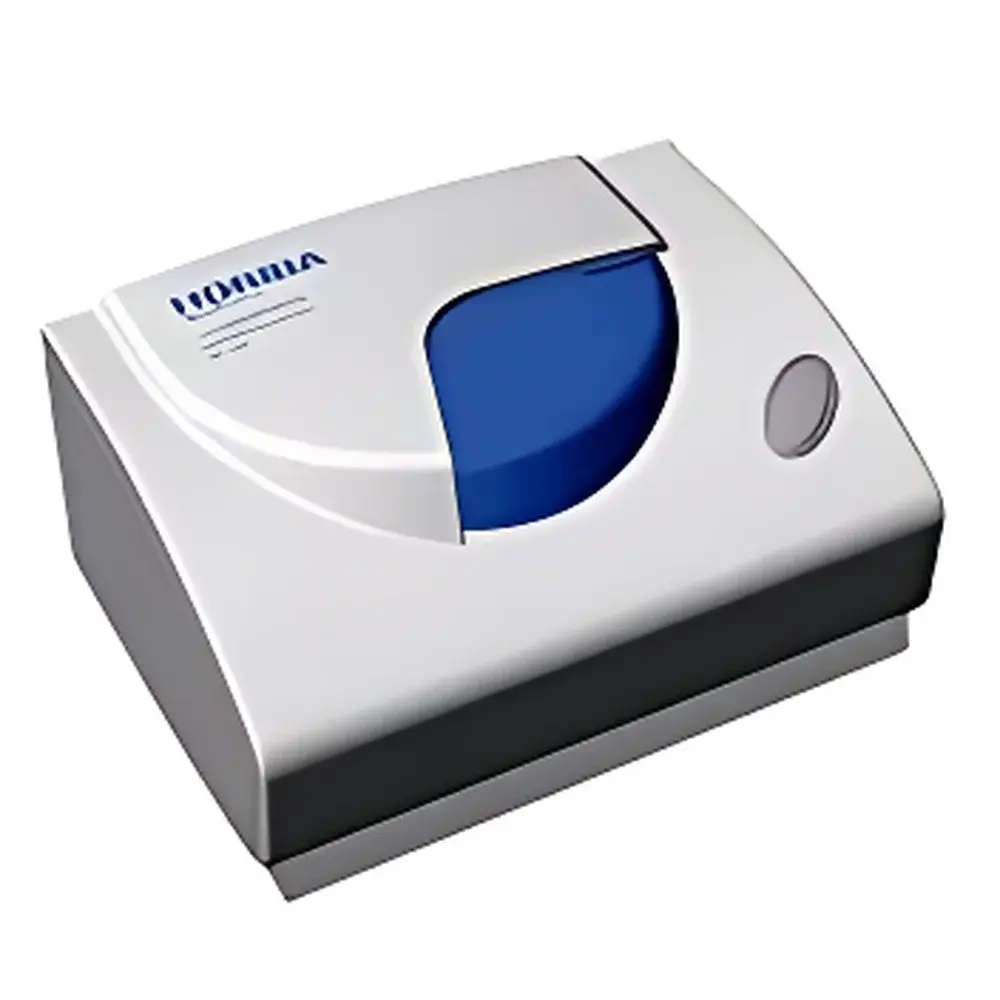
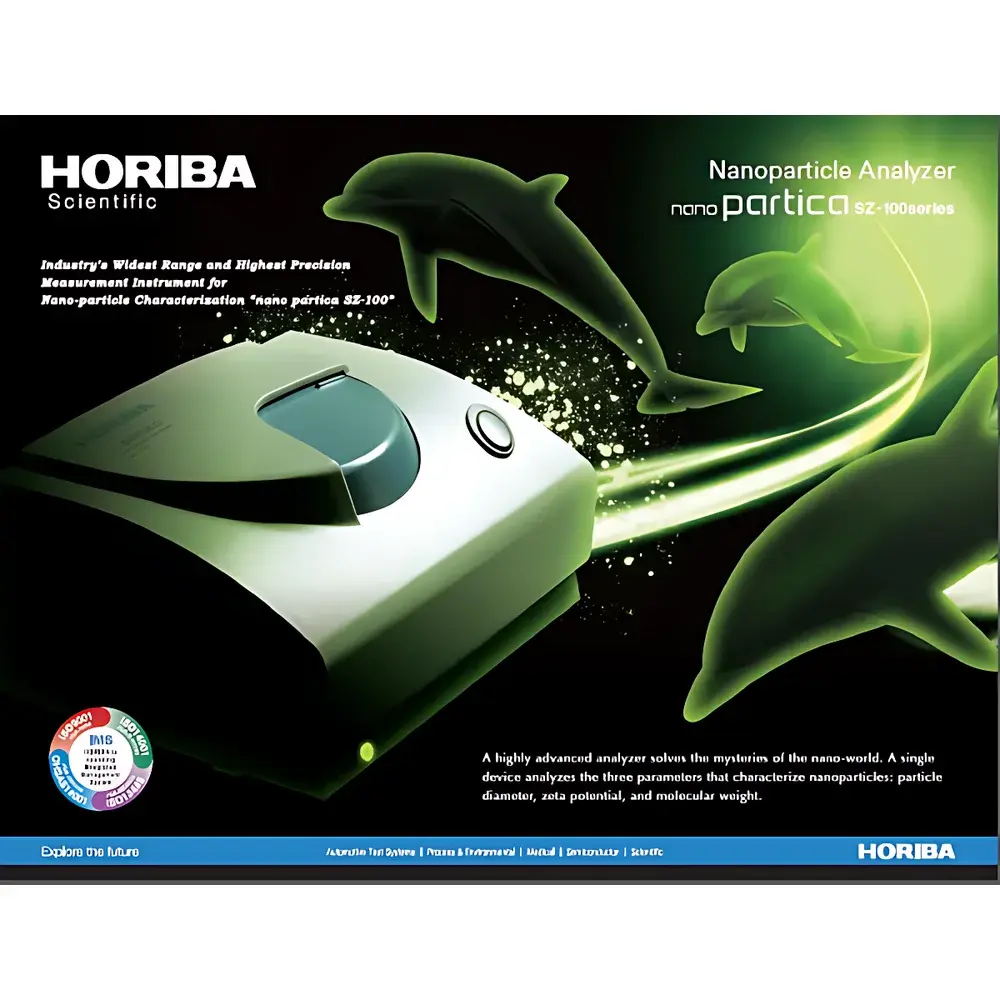
HORIBA SZ-100 Nanoparticle Size and Zeta Potential Analyzer
| Brand | HORIBA |
|---|---|
| Origin | Japan |
| Model | SZ-100 |
| Dispersion Method | Wet Dispersion |
| Measurement Range | 0.3 nm – 8 µm |
| Repeatability | <2% |
| Measurement Time | 120 s |
Overview
The HORIBA SZ-100 Nanoparticle Size and Zeta Potential Analyzer is a benchtop multi-parameter characterization system engineered for precision analysis of colloidal and macromolecular systems in research and quality control environments. It operates on the principle of Dynamic Light Scattering (DLS), also known as Photon Correlation Spectroscopy (PCS), to determine hydrodynamic diameter distributions of particles and molecules in suspension. Complementing DLS, the instrument integrates Electrophoretic Light Scattering (ELS) for Zeta potential measurement and Static Light Scattering (SLS) for absolute molecular weight determination—enabling comprehensive physicochemical assessment from a single platform. Its optical architecture features a high-stability 635 nm diode laser, optimized detection geometry, and proprietary HORIBA signal processing algorithms that minimize noise and maximize resolution across an exceptionally broad size range—from sub-nanometer biomolecules (e.g., peptides, monoclonal antibodies) to micron-scale agglomerates (e.g., polymer latexes, ceramic slurries). This dual-capability design supports both R&D investigations into colloidal stability mechanisms and routine QC monitoring aligned with regulatory expectations.
Key Features
- Triple-function capability: Simultaneous or sequential measurement of particle size (DLS), Zeta potential (ELS), and molecular weight (SLS) using a single optical path and cuvette holder.
- Ultra-broad dynamic range: Validated sizing from 0.3 nm (monomeric proteins) to 8,000 nm (8 µm), covering true nanoparticles, protein complexes, liposomes, and fine colloids without dilution or method switching.
- Minimal sample consumption: As little as 12 µL for size analysis and 100 µL for Zeta potential measurement—critical for precious biological samples, clinical isolates, or synthesized nanomaterials with limited yield.
- High-sensitivity optics: Integrated high-power laser source, low-noise avalanche photodiode detector, and HORIBA’s patented optical alignment system ensure robust signal-to-noise ratio even in highly diluted or low-scattering samples (e.g., saline-based biologics formulations).
- Temperature-controlled analysis: Peltier-regulated sample chamber (range: 0–90 °C, ±0.1 °C stability) enables kinetic studies of aggregation onset, thermal denaturation, or temperature-dependent colloidal behavior.
Sample Compatibility & Compliance
The SZ-100 accommodates standard quartz or disposable polystyrene cuvettes (for size/Zeta) and specialized low-volume cells for microsample analysis. It supports aqueous and organic dispersions (e.g., ethanol, THF, DMF) within viscosity and conductivity limits appropriate for ELS. The system complies with ISO 22412:2017 (DLS), ISO 13099-2:2012 (Zeta potential), and ASTM E2490-18 (nanoparticle size distribution by light scattering). Data acquisition and reporting modules support audit trails, electronic signatures, and user access controls required under FDA 21 CFR Part 11 and EU Annex 11 for regulated environments. Instrument qualification documentation—including IQ/OQ protocols—is available to facilitate GLP and GMP implementation.
Software & Data Management
HORIBA’s Particle Size Analysis Software (PSA v4.x) provides intuitive workflow-driven operation, real-time correlation function visualization, and automated multimodal deconvolution using CONTIN and NNLS algorithms. Raw intensity autocorrelation data are stored in vendor-neutral formats (e.g., .csv, .txt) alongside metadata (temperature, viscosity, refractive index, measurement date/time, operator ID). Batch processing, report templating (PDF/Excel export), and trend charting enable longitudinal stability assessment. For integration into enterprise LIMS or MES platforms, the software supports OPC UA and HL7-compliant data exchange. All processing parameters—including baseline correction, regularization constraints, and refractive index selection—are fully traceable and editable post-acquisition.
Applications
- Nanomaterial synthesis & QC: Monitoring size evolution during nanoprecipitation, sol-gel processes, or laser ablation; verifying batch-to-batch consistency of metal oxides (TiO₂, SiO₂), quantum dots, and carbon nanotubes.
- Biopharmaceutical development: Assessing aggregation propensity of monoclonal antibodies, PEGylated proteins, and viral vectors; evaluating formulation stability under stress conditions (pH, ionic strength, freeze-thaw).
- Colloid science: Quantifying electrostatic stabilization via Zeta potential mapping across pH or salt gradients; correlating surface charge with dispersion lifetime in coatings, inks, and CMP slurries.
- Academic & industrial research: Characterizing exosomes, liposomes, polymeric micelles, and dendrimers; supporting structure-function studies in drug delivery, catalysis, and functional food design.
FAQ
What measurement principles does the SZ-100 employ?
It uses Dynamic Light Scattering (DLS) for size, Electrophoretic Light Scattering (ELS) for Zeta potential, and Static Light Scattering (SLS) for molecular weight—all within one integrated optical module.
Can the SZ-100 analyze non-aqueous samples?
Yes—provided the solvent’s viscosity, dielectric constant, and conductivity fall within defined operational limits for reliable ELS and DLS performance.
Is SOP generation and validation support available?
HORIBA provides IQ/OQ documentation templates, calibration verification procedures, and application-specific SOP examples aligned with ISO/ASTM standards.
How is data integrity ensured for regulated use?
The software implements role-based access control, full audit trail logging, electronic signature capture, and immutable raw data archiving compliant with 21 CFR Part 11.
Does the system require external temperature control units?
No—the built-in Peltier temperature controller maintains precise, stable sample chamber temperatures without auxiliary chillers or circulators.



