
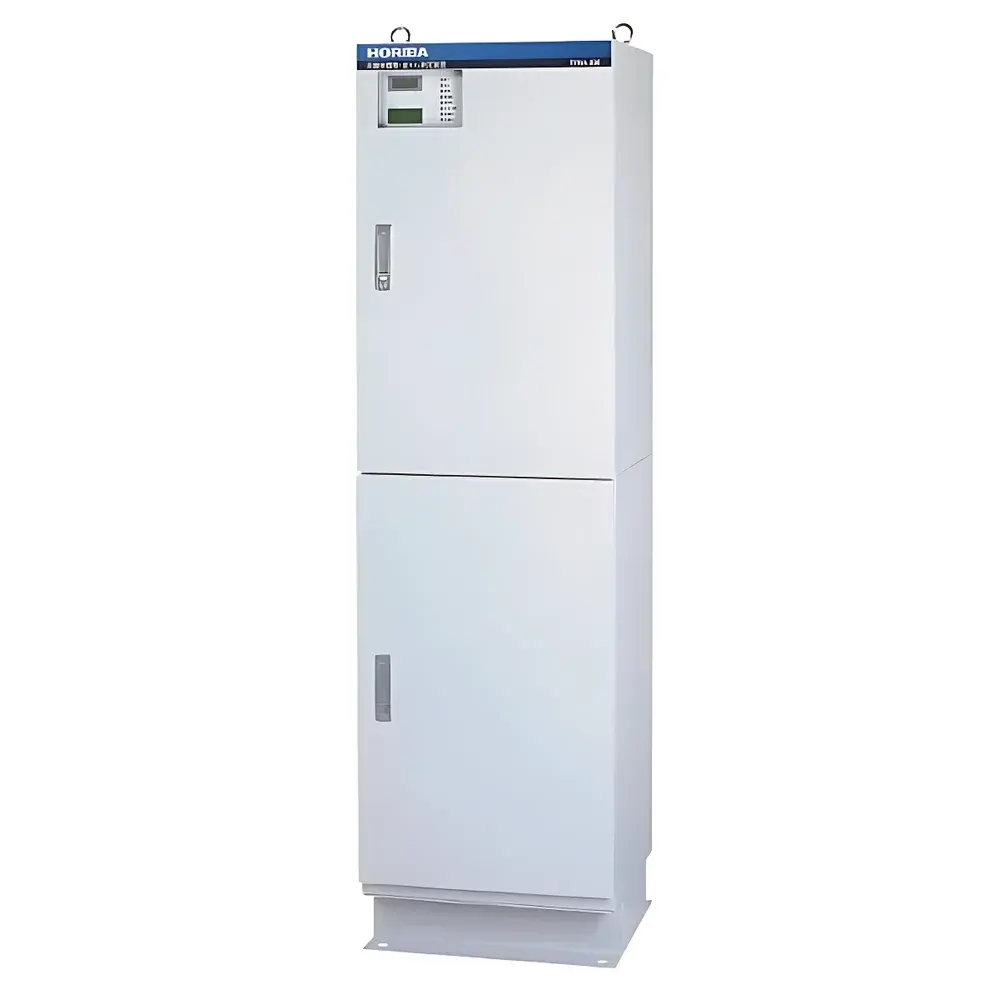
HORIBA TPNA-300 Automated Total Nitrogen and Total Phosphorus Analyzer
| Brand | HORIBA |
|---|---|
| Origin | Japan |
| Model | TPNA-300 |
| Measurement Principle | Alkaline persulfate/UV oxidation followed by UV-Vis spectrophotometry (TN) |
| Detection Range (Standard) | TN: 0–2 mgN/L, TP: 0–0.5 mgP/L |
| Detection Range (1-Stage Dilution) | TN: 0–5/10/20/50 mgN/L, TP: 0–1/2/5/10 mgP/L |
| Detection Range (2-Stage Dilution) | TN: 0–100/200/500/1000 mgN/L, TP: 0–20/50/100/250 mgP/L |
| Repeatability | ±3% FS (standard & 1-stage), ±5% FS (2-stage) |
| Sample Temp. | 2–40 °C |
| Flow Rate | 0.5–5 L/min |
| Analysis Cycle Time | 60 min |
| Analog I/O | 4–20 mA / 0–16 mA configurable |
| Power Supply | AC 100 V ±10 V, 50/60 Hz, ≤400 VA |
| Dimensions | 460 W × 380 D × 1500 H mm |
| Weight | ~80 kg |
| Enclosure Color | Munsell 5PB8/1 |
Overview
The HORIBA TPNA-300 is an automated, on-line total nitrogen (TN) and total phosphorus (TP) analyzer engineered for continuous, unattended monitoring of wastewater effluents, receiving waters, and industrial discharge streams. It implements a low-pressure, low-temperature UV-assisted oxidation methodology—distinct from high-pressure autoclave-based digestion—to achieve complete mineralization of organic and refractory nitrogenous and phosphorous compounds under ambient pressure and temperatures below 100 °C. This design eliminates the safety hazards, mechanical wear, and maintenance overhead associated with pressurized digestion systems while maintaining analytical rigor required for regulatory compliance under Japan’s Fifth Water Quality Total Load Control Program and analogous frameworks globally (e.g., EU Urban Wastewater Treatment Directive Annex I, US EPA Method 353.2/365.2 adaptations). The system integrates dual-channel photometric detection: TN quantification via UV absorption at 220 nm following alkaline persulfate/UV oxidation; TP determination via molybdenum blue complex formation and absorbance measurement at 880 nm after acidic persulfate/UV oxidation. Its architecture supports long-term data continuity by preserving strong correlation with conventional manual laboratory methods (e.g., ISO 11908, ISO 15681-1), enabling seamless transition from grab sampling to continuous compliance reporting.
Key Features
- Simultaneous, independent quantification of TN and TP in a single instrument—no sequential analysis or reconfiguration required.
- Compact footprint (460 × 380 × 1500 mm) enables outdoor installation in weatherproof enclosures; compatible with co-location alongside HORIBA OPSA-120 UV transmittance analyzers.
- On-board pollutant load calculation: accepts analog flow signal input (4–20 mA) to compute real-time mass loading (g-N/h, g-P/h), supporting discharge permit reporting and mass balance audits.
- Seawater-tolerant operation via optional seawater compensation algorithm—validates performance in estuarine, coastal, or brackish influent matrices without manual dilution or method adjustment.
- Automated operational integrity management: auto-zero correction per analysis cycle, programmable calibration frequency, embedded self-diagnostic logging with printed fault codes, and alarm-triggered event recording.
- Regulatory-grade data handling: 2-month internal data storage (non-volatile), time-stamped audit trail, RS-232C serial output for SCADA integration, and configurable analog outputs for PLC interfacing.
- Patented UV oxidation reactor (JP Patent No. 3252973) and integrated digestion cell (JP Patent No. 3227332) ensure consistent oxidative efficiency across variable sample matrices and extended service intervals.
Sample Compatibility & Compliance
The TPNA-300 accepts raw or clarified wastewater, surface water, and treated effluent within defined physical constraints: temperature 2–40 °C, flow rate 0.5–5 L/min (via overflow weir configuration), and suspended solids <100 mg/L (pre-filtration recommended for high-turbidity samples). It accommodates saline interference up to 35 g/L TDS when equipped with the optional seawater compensation module—validated against JIS K 0102 and ASTM D5179 reference protocols. All wetted components are chemically resistant (e.g., PTFE, quartz, borosilicate glass), minimizing adsorption and carryover. The system meets GLP-aligned operational requirements: full traceability of calibration history, reagent lot tracking, and operator action logs. While not pre-certified to US EPA or ISO type-approval schemes, its measurement principles align with ISO 11908 (TN) and ISO 15681-1 (TP), and its data structure supports 21 CFR Part 11-compliant electronic record implementation when deployed with validated third-party LIMS interfaces.
Software & Data Management
The TPNA-300 operates via embedded firmware with no external PC dependency. All configuration, calibration, and diagnostic functions are accessible through a front-panel keypad and LCD interface. Measurement data—including raw absorbance values, calculated concentrations, load metrics, and QC flags—are timestamped and stored internally for ≥60 days at 15-minute resolution. RS-232C output provides ASCII-formatted records compliant with Modbus RTU framing for direct ingestion into plant-wide SCADA or environmental data management systems (EDMS). Analog outputs support hardwired transmission to DCS controllers for real-time process feedback. Optional data export utilities enable CSV dump via USB port for offline QA/QC review. Audit trails include calibration events, zero/slope drift alerts, reagent depletion warnings, and power interruption logs—fully traceable for internal quality audits or regulatory inspections.
Applications
- Continuous compliance monitoring at municipal wastewater treatment plant (WWTP) final effluent points under national total load control regimes.
- Industrial pretreatment verification for food processing, chemical manufacturing, and semiconductor facilities discharging nitrogen- or phosphorus-rich wastewaters.
- Long-term trend analysis in watershed management programs targeting eutrophication mitigation in lakes and estuaries.
- Performance validation of tertiary treatment units (e.g., denitrification filters, phosphorus precipitation reactors) via high-frequency load profiling.
- Research-grade nutrient flux studies in constructed wetlands or pilot-scale advanced oxidation systems where low-temperature digestion preserves lab-to-field method equivalence.
FAQ
What digestion method does the TPNA-300 use, and how does it differ from high-pressure autoclave systems?
It employs UV-assisted alkaline (for TN) or acidic (for TP) persulfate oxidation at ambient pressure and ≤100 °C—eliminating steam traps, pressure vessels, and associated safety certifications while achieving >95% oxidation efficiency for particulate and dissolved organic N/P.
Can the TPNA-300 operate reliably in seawater-influenced wastewater?
Yes—when configured with the optional seawater compensation function, it corrects for chloride-induced spectral interference and matrix effects up to full-strength seawater (35 g/L Cl⁻), verified per JIS K 0102 Annex B.
How is method equivalency to manual laboratory analysis ensured?
Each unit undergoes factory correlation against certified reference materials (CRMs) and parallel analysis with ISO-standard wet chemistry methods; built-in “manual-equivalent conversion” applies matrix-specific regression coefficients to maintain historical data continuity.
What maintenance intervals are typical for routine operation?
Reagent replacement every 30 days (50 L blank water/month), UV lamp replacement every 12 months, and quarterly optical path cleaning—significantly reduced vs. autoclave-based systems requiring daily pressure vessel inspection and gasket replacement.
Is remote diagnostics or firmware update capability supported?
Firmware updates require local USB connection and authorized service tooling; remote diagnostics are limited to status polling via RS-232C or analog alarm contacts—no cloud connectivity or over-the-air functionality is implemented for cybersecurity compliance in critical infrastructure environments.
Related Products







