
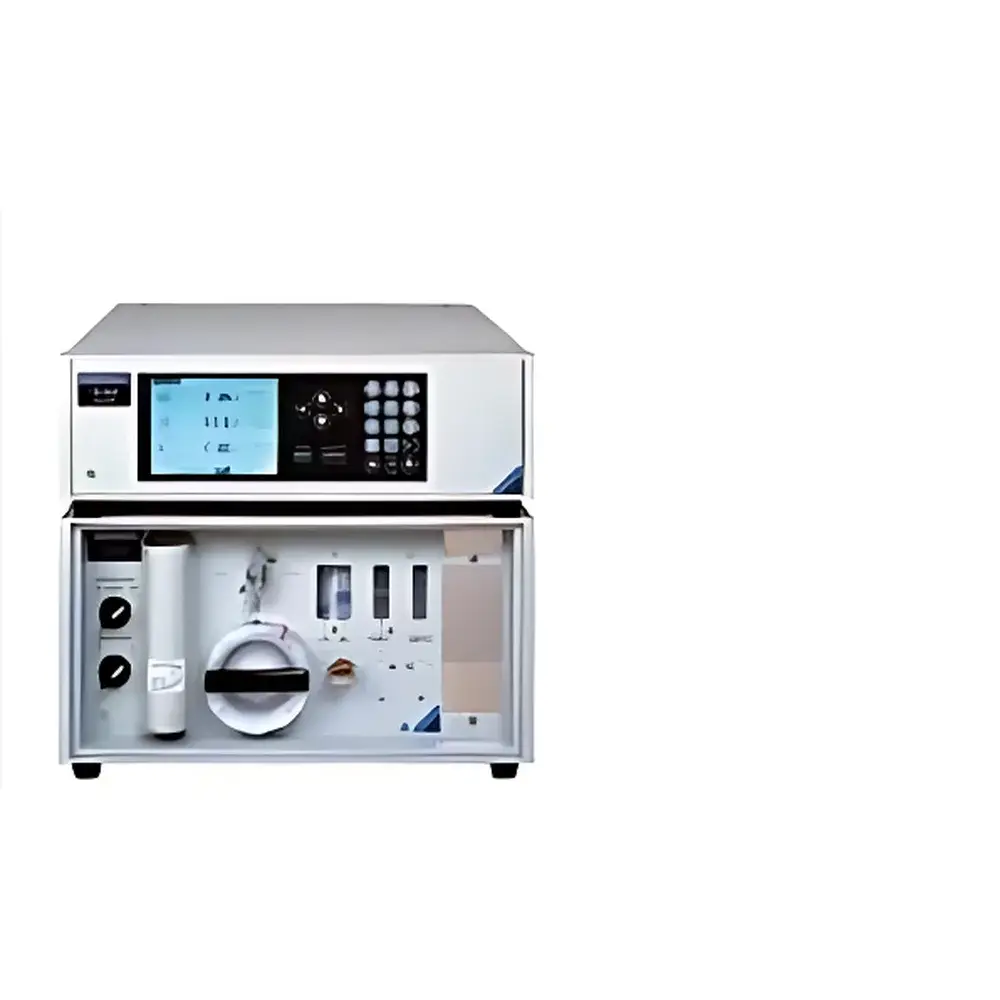
HORIBA VA-3000/VS-3000 Multi-Gas Analyzer
| Brand | HORIBA |
|---|---|
| Origin | Japan |
| Model | VA-3000 (Analyzer Unit) / VS-3000 (Sampling System) |
| Detection Principles | NDIR, CLA, MPA, Electrochemical, Zirconia |
| Measurable Gases | CO, CO₂, NOₓ, SO₂, CH₄, C₂H₄, N₂O, O₂ |
| Accuracy | ±0.5% F.S. (repeatability), ±1.0% F.S. (linearity), ±2.0% F.S./week (drift) |
| Response Time | T90 ≤ 30 s (single component) |
| Analog Outputs | 0–1 V DC, 4–20 mA (optional) |
| Communication | RS-232C |
| Operating Temperature | 0–40 °C |
| Power Supply | AC 100–240 V, 50/60 Hz |
| Dimensions (VA-3000) | 430 × 132 × 550 mm (W×H×D) |
| Weight (VA-3000) | ~20 kg |
| Compliance | Designed for ISO/IEC 17025-aligned operation, compatible with EPA Method TO-15 & ASTM D6348 preconditions |
Overview
The HORIBA VA-3000/VS-3000 Multi-Gas Analyzer is a modular, high-fidelity analytical platform engineered for continuous, simultaneous quantification of up to eight key gaseous components—including CO, CO₂, NOₓ, SO₂, CH₄, C₂H₄, N₂O, and O₂—in environmental monitoring, combustion process control, emissions verification, and laboratory research applications. Unlike conventional single-gas analyzers, the VA-3000 integrates multiple detection technologies—Non-Dispersive Infrared (NDIR), Chemiluminescence Analysis (CLA), Magnetic Pressure Analysis (MPA), electrochemical cells, and zirconia-based oxygen sensing—within a compact 19-inch rack-mountable chassis. This architecture enables true multi-parameter analysis without cross-interference, leveraging gas-specific optical absorption bands (NDIR), catalytic oxidation-luminescence coupling (CLA), paramagnetic susceptibility (MPA), redox potential (electrochemical), and oxygen ion conductivity (zirconia). The system is designed for compliance-critical environments requiring trace-level sensitivity (down to 20 ppm for NOₓ), wide dynamic range (up to 100 vol% for CO₂ or CH₄), and long-term stability under unattended operation.
Key Features
- Modular sensor architecture: Up to three independent measurement modules can be installed simultaneously in the VA-3000 analyzer unit, supporting flexible configuration for site-specific gas matrices.
- Multi-technology detection: NDIR for CO, CO₂, CH₄, N₂O, and SO₂; CLA for NOₓ (NO + NO₂); MPA and zirconia/electrochemical sensors for O₂—each selected per application requirements and regulatory constraints.
- Extended dynamic range: Programmable 4- to 8-segment range selection per gas; optional 20× span expansion available for NDIR channels (subject to optical path length constraints).
- High metrological integrity: Repeatability ±0.5% F.S., linearity ±1.0% F.S. (≤10× span), zero and span drift ≤±2.0% F.S./week (zirconia and electrochemical O₂ sensors: ±1.0% F.S./day).
- Rapid response and low maintenance: T90 ≤30 s for single-component analysis; warm-up time as low as 20 minutes (NDIR/zirconia), enabling efficient daily calibration cycles.
- Robust sampling interface: VS-3000 series sampling units (VS-3001 to VS-3004) provide conditioned, dry sample extraction at 0.5 L/min (analytical flow) with corrosion-resistant wetted materials (PTFE, PVDF, SUS316, FKM) and integrated bypass/zero-gas routing.
Sample Compatibility & Compliance
The VA-3000/VS-3000 system is validated for use with clean, non-corrosive, non-explosive gas streams meeting defined physical and chemical thresholds: sample temperature within ambient range; dew point ≤5 °C (NDIR/CLA) or ≤60 °C (VS-3000 series); particulate loading <0.1 mg/m³; pressure fluctuation ±980 Pa; absence of halogenated hydrocarbons, H₂S, NH₃, or Cl₂ unless pre-treated. For zirconia O₂ measurement, stoichiometric coexistence of H₂O and O₂ is required when reducing gases (CO, H₂, THC) are present—ensuring sensor longevity and avoiding erroneous low-O₂ bias. The platform supports method-defined workflows aligned with EPA Methods 6C, 7E, 10, and TO-15; ASTM D6348 (for volatile organic compound interference assessment); and ISO 12039 (for flue gas CO/CO₂). All analog and serial outputs are configurable for integration into SCADA, DCS, or LIMS platforms compliant with 21 CFR Part 11 audit-trail requirements when paired with HORIBA’s optional data acquisition software.
Software & Data Management
Standard RS-232C serial interface enables direct connection to host PCs for real-time parameter monitoring, remote configuration, and firmware updates. Analog outputs (0–1 V DC or isolated 4–20 mA) support legacy PLC integration without protocol translation. HORIBA-supplied PC software provides time-synchronized multi-channel data logging, user-defined alarm thresholds (high/low, rate-of-change), automatic zero/span scheduling, calibration certificate generation (including uncertainty budgets), and export to CSV or Excel-compatible formats. Raw sensor diagnostics—including lamp intensity (NDIR), PMT voltage (CLA), cell impedance (electrochemical), and heater temperature (zirconia)—are accessible for predictive maintenance. Data files retain embedded timestamps, operator ID, and instrument configuration metadata—supporting GLP/GMP documentation practices and ISO/IEC 17025 traceability requirements.
Applications
- Continuous emissions monitoring systems (CEMS) for thermal power plants, cement kilns, and waste incinerators—measuring regulated pollutants (NOₓ, SO₂, CO) and process gases (O₂, CO₂) in accordance with EU BREF and US EPA 40 CFR Part 60.
- Engine exhaust testing laboratories performing transient cycle analysis (e.g., WLTC, FTP-75), where simultaneous CO/CO₂/NOₓ/O₂ quantification enables precise lambda and combustion efficiency calculation.
- Biogas upgrading facilities monitoring CH₄ purity, CO₂ removal efficiency, and trace contaminants (H₂S, siloxanes) upstream of membrane or PSA units.
- Indoor air quality (IAQ) research stations tracking CO₂-driven ventilation demand, CO from faulty heating appliances, and N₂O as a tracer for microbial activity in controlled-environment chambers.
- Calibration gas production facilities verifying blend accuracy across multi-component reference standards using primary NDIR and CLA methods.
FAQ
What gas detection technologies are integrated into the VA-3000 platform?
The VA-3000 supports five distinct measurement principles: Non-Dispersive Infrared (NDIR) for CO, CO₂, CH₄, N₂O, and SO₂; Chemiluminescence Analysis (CLA) for NOₓ; Magnetic Pressure Analysis (MPA) for O₂; electrochemical cells for low-range O₂; and zirconia-based sensors for high-temperature O₂ applications.
Can the system measure ammonia (NH₃) or hydrogen sulfide (H₂S)?
NH₃ and H₂S are not supported by standard VA-3000 modules. Custom sensor development or external pre-concentration/treatment modules may be evaluated on a project basis—contact HORIBA Technical Support with detailed sample composition and concentration profiles.
How is calibration performed, and what gases are required?
Zero calibration uses certified nitrogen or synthetic air; span calibration requires certified gas mixtures traceable to NIST or equivalent national standards. Multi-point calibration is recommended for CLA and extended-range NDIR channels. Automatic calibration sequences can be scheduled via software.
Is the system suitable for outdoor installation?
The VA-3000 analyzer unit is rated for indoor use only (0–40 °C, ≤90% RH non-condensing). For field deployment, it must be housed in a climate-controlled enclosure. The VS-3000 sampling units are similarly intended for sheltered mounting but feature IP54-rated enclosures when configured with optional accessories.
Does the system comply with cybersecurity standards for industrial networks?
The base RS-232C interface is serial-only and inherently isolated. For Ethernet-enabled data acquisition or remote access, HORIBA offers optional secure gateway modules supporting TLS 1.2 encryption and role-based authentication—deployable in alignment with IEC 62443-3-3.







