
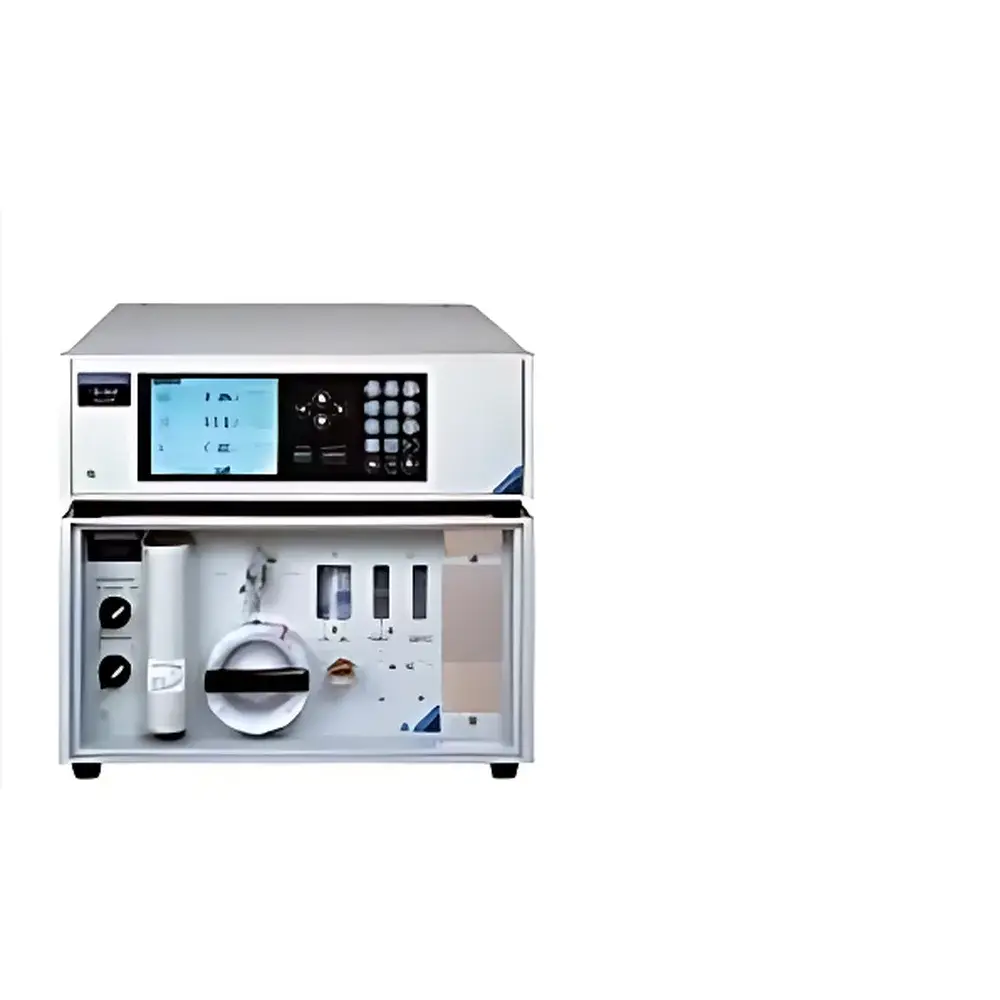
HORIBA VA-3000/VS-3000 Multi-Gas Analyzer
| Brand | HORIBA |
|---|---|
| Origin | Japan |
| Model | VA-3000/VS-3000 |
| Repeatability | ±0.5% of Full Scale |
| Response Time | T90 ≤ 30 s |
| Stability | ±2.0% of Full Scale per Week |
| Detection Principles | NDIR, CLA, MPA, Electrochemical (Galvanic), Zirconia |
| Gas Compatibility | CO, CO₂, NOₓ, SO₂, CH₄, N₂O, C₂H₄, O₂ |
| Max Internal Sensor Modules | 3 |
| Analog Outputs | DC 0–1 V / 4–20 mA (optional) |
| Communication Interface | RS-232C |
| Operating Temperature | 0–40 °C |
| Power Supply | AC 100–240 V, 50/60 Hz |
| Weight (VA-3000) | ~20 kg |
| Enclosure | 19-inch rack-mountable chassis |
Overview
The HORIBA VA-3000/VS-3000 Multi-Gas Analyzer is a modular, laboratory-grade and field-deployable gas analysis platform engineered for high-accuracy, multi-component measurement in environmental monitoring, combustion process control, emissions compliance verification, and energy research applications. It integrates multiple detection technologies—including Non-Dispersive Infrared (NDIR), Chemiluminescence Analysis (CLA), Magnetic Pressure Analysis (MPA), electrochemical (galvanic cell), and zirconia-based oxygen sensing—within a single compact 19-inch rack-mountable analyzer unit (VA-3000) and configurable sampling system (VS-3000 series). This architecture enables simultaneous or sequential quantification of up to three gases from a broad spectrum of analytes: CO, CO₂, NOₓ (NO + NO₂), SO₂, CH₄, N₂O, C₂H₄, and O₂. The system operates on the principle of selective molecular absorption (NDIR), catalytic oxidation-induced light emission (CLA), magnetic susceptibility differential (MPA), redox current generation (electrochemical), and oxygen ion conduction across stabilized zirconia (zirconia sensor), ensuring physicochemically grounded traceability for each measured species.
Key Features
- Modular sensor architecture supporting up to three interchangeable detection modules in one VA-3000 main unit—enabling flexible configuration for site-specific gas matrices without hardware replacement.
- Multi-technology compatibility: NDIR for CO, CO₂, CH₄, SO₂, and N₂O; CLA for NOₓ with sub-ppm sensitivity; MPA for O₂; galvanic and zirconia cells for robust O₂ measurement under varying redox conditions.
- Wide dynamic range coverage: Programmable span selection across up to 4 or 8 user-selectable ranges per gas (e.g., CO: 0–100 ppm to 0–100 vol%; NOₓ: 0–20 ppm to 0–5000 ppm), with optional extended-range configurations offering up to 20× or 100× span ratios depending on detection method.
- High metrological performance: Repeatability ±0.5% FS, linearity ±1.0% FS (≤10× span), zero and span drift ≤±2.0% FS/week (NDIR, CLA, MPA, zirconia); ±1.0% FS/day for galvanic O₂ sensors.
- Rapid response: T90 ≤ 30 seconds from sample inlet for single-gas measurement, with warm-up times optimized per technology (20–60 minutes).
- Standard analog outputs (0–1 V, 4–20 mA) and RS-232C serial interface for integration into SCADA, DCS, or custom data acquisition systems; optional software-supported logging and calibration management.
Sample Compatibility & Compliance
The VA-3000/VS-3000 system requires conditioned sample gas meeting strict physical and chemical specifications to ensure analytical integrity and sensor longevity. Sample flow rate must be maintained at ~0.5 L/min; temperature must remain within ambient range (0–40 °C); moisture content must not exceed 5 °C dew point (for NDIR/CLA) or 60 °C dew point (for VS-3000 sampling variants); particulate loading must be <0.1 mg/m³; and pressure fluctuations must stay within ±980 Pa. Corrosive, combustible, or explosive gases—including Cl₂, NH₃, H₂S, HCl, and unfiltered hydrocarbons—are excluded unless pre-treated via HORIBA-recommended conditioning systems (e.g., catalytic converters, Nafion dryers, particulate filters). For zirconia O₂ sensors, coexistence of H₂O and O₂ is mandatory when reducing gases (CO, H₂, THC) are present, per stoichiometric constraint: [THC] + [CO] + [H₂] < [H₂O] + [O₂]. All configurations comply with general requirements for ISO 14001-aligned monitoring infrastructure and support audit-ready documentation for EPA Method 7E, EN 15267, and JIS B 7982 applications. Optional firmware and software packages may be configured to meet FDA 21 CFR Part 11 data integrity requirements upon validation.
Software & Data Management
HORIBA provides dedicated PC-based configuration and data handling software compatible with Windows OS environments. The application supports real-time parameter monitoring, remote calibration initiation, automatic zero/span scheduling, and time-stamped event logging—including alarm triggers, module swaps, and sensor diagnostics. Raw analog outputs are directly recordable by third-party DAQ systems, while digital RS-232C output delivers ASCII-formatted frames containing concentration values, status flags, and timestamp metadata. Calibration history, sensor life tracking, and drift compensation coefficients are stored internally and exportable as CSV or XML files. When deployed in regulated environments (e.g., continuous emissions monitoring systems—CEMS), the software architecture supports GLP/GMP-aligned audit trails, electronic signatures, and role-based access control—subject to customer-specific qualification protocols.
Applications
- Regulatory stack emissions monitoring (power plants, incinerators, cement kilns) compliant with EU IED, US EPA 40 CFR Part 60, and China’s GB 13223.
- R&D-scale combustion optimization and catalyst evaluation in hydrogen-fueled engines, syngas reactors, and carbon capture pilot units.
- Biogas quality assurance (CH₄/CO₂/O₂/N₂O) in anaerobic digestion facilities and landfill gas recovery sites.
- Industrial furnace atmosphere control (e.g., heat treatment, sintering) requiring precise O₂ and CO profiling.
- Urban air quality research stations measuring ambient NOₓ, SO₂, and greenhouse gases (CO₂, CH₄, N₂O) with high temporal resolution.
- Calibration gas verification and reference standard transfer in national metrology institutes and accredited laboratories.
FAQ
What detection technologies are integrated into the VA-3000 platform?
The VA-3000 supports five core detection principles: Non-Dispersive Infrared (NDIR), Chemiluminescence Analysis (CLA), Magnetic Pressure Analysis (MPA), electrochemical (galvanic cell), and zirconia-based oxygen sensing—each selected based on target gas, required sensitivity, and matrix interference profile.
Can the same VA-3000 unit measure both low-ppm NOₓ and high-percentage O₂ simultaneously?
Yes—by installing a CLA module for NOₓ and a zirconia or MPA module for O₂ in the same chassis. However, cross-module gas routing must be managed via external valving or sequential sampling to prevent interference.
Is the system suitable for wet, hot flue gas without external conditioning?
No. The VA-3000 requires cooled, dried, and filtered sample gas. The VS-3000 series sampling units provide heated transport lines and condensate traps but do not replace full extractive conditioning (e.g., chiller + permeation dryer + particle filter).
How is calibration traceability maintained?
Calibration is performed using NIST-traceable certified gas standards. The system records calibration date, gas lot number, operator ID, and post-calibration residuals—exportable for QA/QC review and regulatory submission.
Does HORIBA offer application-specific pre-conditioning solutions?
Yes. HORIBA provides validated gas conditioning packages—including catalytic converters for CO/NO conversion, heated sample lines, PTFE-lined filters, and acid gas scrubbers—tailored to specific industrial sample matrices and regulatory test methods.
Related Products







