
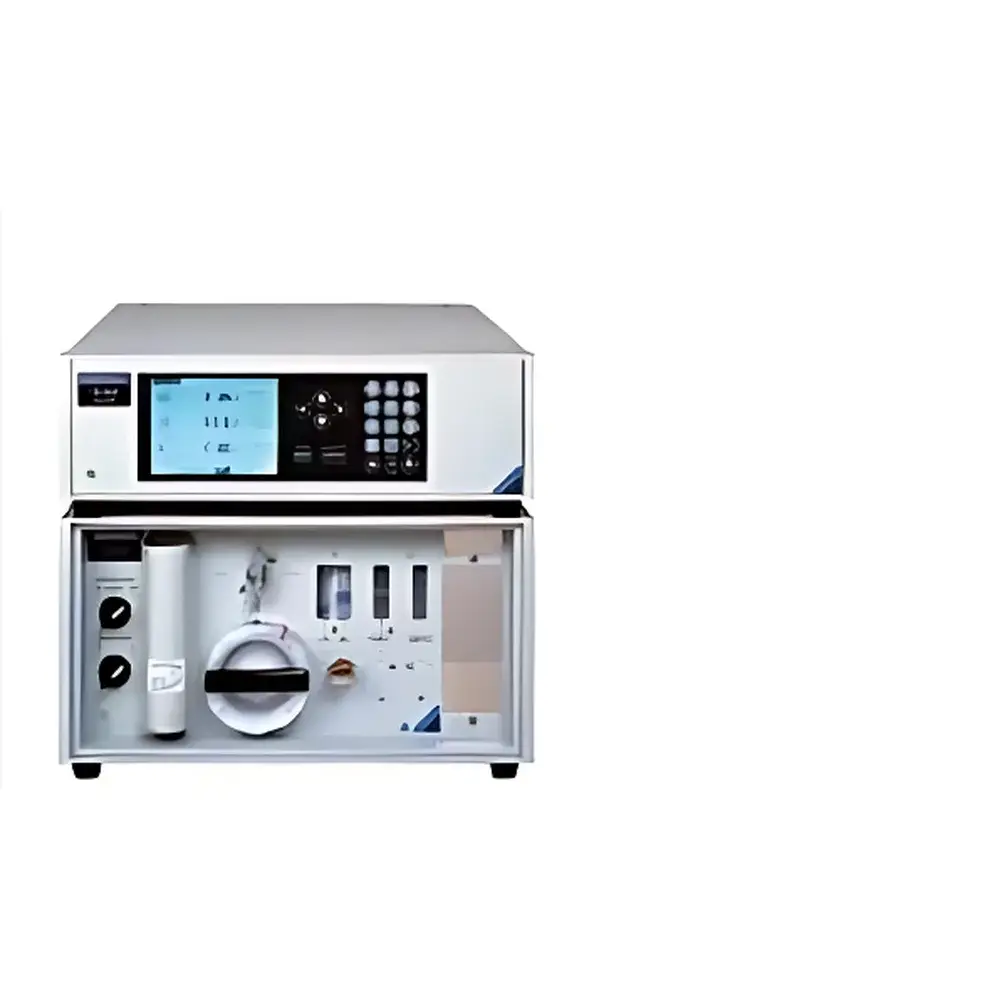
HORIBA VA-3000/VS-3000 Multi-Gas Analyzer System
| Brand | HORIBA |
|---|---|
| Origin | Japan |
| Model | VA-3000 (Analyzer Unit) / VS-3000 (Sampling System) |
| Repeatability | ±0.5% of Full Scale |
| Response Time | T90 ≤ 30 s |
| Stability | ±2.0% of Full Scale per Week |
| Detection Principles | NDIR, CLA, MPA, Electrochemical (Galvanic), Zirconia |
| Gas Compatibility | CO, CO₂, NOₓ, SO₂, CH₄, N₂O, O₂, C₂H₄ (optional), Cl₂ (optional) |
| Analog Outputs | DC 0–1 V / 4–20 mA (optional) |
| Digital Interface | RS-232C |
| Operating Temperature | 0–40 °C |
| Power Supply | AC 100–240 V, 50/60 Hz |
| Analyzer Dimensions | 430 × 132 × 550 mm (W×H×D) |
| Weight | ~20 kg |
| Sampling Unit Dimensions (VS-3004) | 430 × 221 × 550 mm |
| Weight | ~20 kg |
Overview
The HORIBA VA-3000/VS-3000 Multi-Gas Analyzer System is a modular, high-precision benchtop gas analysis platform engineered for continuous, real-time measurement of multiple gaseous components in environmental monitoring, combustion process control, emissions compliance verification, and R&D applications. It integrates three distinct analytical technologies—Non-Dispersive Infrared (NDIR), Chemiluminescence Analysis (CLA), and Magnetic Pressure Analysis (MPA)—alongside electrochemical (galvanic) and zirconia-based oxygen sensors within a single 19-inch rack-mountable architecture. The VA-3000 analyzer unit accepts up to three interchangeable sensor modules, enabling configurable multi-component detection without hardware duplication. Its design adheres to fundamental physical measurement principles: NDIR relies on Beer-Lambert absorption spectroscopy at characteristic mid-IR wavelengths; CLA quantifies NOₓ via ozone-induced chemiluminescent photon emission; MPA exploits paramagnetic susceptibility differences for O₂; while galvanic and zirconia cells operate on electrochemical potential gradients across selective membranes or solid electrolytes. This hybrid methodology ensures trace-level sensitivity, broad dynamic range, and robust cross-interference mitigation—critical for regulatory-grade flue gas and ambient air analysis.
Key Features
- Modular sensor architecture supporting up to three simultaneous gas measurements (e.g., CO + CO₂ + NOₓ, or CH₄ + SO₂ + O₂) with field-replaceable NDIR, CLA, MPA, galvanic, or zirconia modules
- Wide selectable concentration ranges per gas: e.g., CO (0–100 ppm to 0–100 vol%), CO₂ (0–100 ppm to 0–100 vol%), NOₓ (0–20 ppm to 0–5000 ppm), SO₂ (0–200 ppm to 0–10 vol%), O₂ (0–5 vol% to 0–100 vol%)
- Extended dynamic range capability: up to 20× full-scale ratio (optional) for NDIR channels; up to 100× for CLA—achievable via programmable multi-range scaling and dual-sensor configuration for same-species redundancy
- High metrological performance: repeatability ±0.5% FS, linearity ±1.0% FS (≤10× range), zero/span drift ≤±2.0% FS/week (NDIR/CLA/MPA/zirconia); ±1.0% FS/day for galvanic O₂
- Fast response: T90 ≤ 30 s from sample inlet under standard flow (0.5 L/min), validated per ISO 12039 and EN 15267 protocols
- Standard RS-232C interface and analog outputs (0–1 V, 4–20 mA) for integration into SCADA, DCS, or data acquisition systems; optional software support for automated calibration logging and audit trail generation
Sample Compatibility & Compliance
The VA-3000/VS-3000 system requires conditioned sample gas meeting strict physicochemical specifications: flow rate 0.5 L/min ±10%, temperature ambient (0–40 °C), dew point ≤5 °C (for NDIR/CLA) or ≤60 °C (for VS-3000 sampling units), particulate loading 50 ppm SO₃, >6 ppm NO₂), explosive, or flammable constituents. For zirconia O₂ measurement, coexistence of H₂O and O₂ must satisfy the thermodynamic constraint H₂ + CO + THC < H₂O + O₂ to prevent sensor degradation. The system complies with key international standards governing emissions monitoring—including ISO 12039 (stationary source CO/CO₂/SO₂/NOₓ), EN 14181 (QAL3 performance verification), and EPA Method 3A (O₂)—and supports GLP/GMP-aligned operation through configurable data integrity controls. All analog and digital outputs are traceable to NIST-certified reference gases, and calibration intervals align with ASTM D6522 and ISO 14001 requirements.
Software & Data Management
The VA-3000 operates with HORIBA’s proprietary PC-based configuration and data acquisition software, supporting Windows OS environments. The software enables remote parameter setup (range selection, zero/span calibration points, alarm thresholds), real-time waveform visualization, and time-stamped CSV export of all analog channel outputs. Calibration events—including manual zero/span, auto-zero cycles, and multi-point span verification—are logged with operator ID, timestamp, and before/after deviation values, satisfying FDA 21 CFR Part 11 requirements for electronic records when paired with user-access controls and audit trail activation. Raw sensor signals undergo linearization and temperature/pressure compensation algorithms embedded in firmware, ensuring measurement consistency across ambient fluctuations. Data archiving supports long-term trend analysis for QA/QC reporting, stack testing documentation, and regulatory submission packages compliant with EU IED and US Clean Air Act Title V frameworks.
Applications
- Continuous emissions monitoring systems (CEMS) for coal-, gas-, and biomass-fired boilers, incinerators, and cement kilns
- Research and development of low-emission combustion technologies, catalytic converters, and carbon capture pilot plants
- Indoor air quality (IAQ) assessment in laboratories, cleanrooms, and controlled-environment facilities
- Biogas composition analysis (CH₄, CO₂, H₂S, O₂) in anaerobic digestion and landfill gas recovery operations
- Process safety monitoring in chemical synthesis, semiconductor fabrication, and hydrogen production lines
- Environmental compliance verification for municipal waste treatment, steelmaking, and glass manufacturing facilities
FAQ
What gas species can be measured simultaneously on a single VA-3000 unit?
Up to three gases may be measured concurrently using compatible sensor modules—for example, CO (NDIR), NOₓ (CLA), and O₂ (zirconia). Custom configurations including SO₂, CH₄, N₂O, and C₂H₄ are available upon consultation.
Is the system suitable for high-moisture or corrosive flue gas streams?
Direct sampling is not recommended. The VS-3000 series sampling units provide integrated heated filtration, condensate removal, and material-compatible wet/dry conditioning (SUS316, PTFE, PVDF) to meet EN 15267-3 conditioning requirements prior to VA-3000 inlet.
How is calibration traceability maintained?
Calibration uses NIST-traceable certified gas mixtures. The system stores calibration history, drift correction coefficients, and uncertainty budgets per channel, enabling ISO/IEC 17025-compliant uncertainty estimation reports.
Can the analyzer operate unattended for extended periods?
Yes. With scheduled auto-zero functionality, stable thermal management (<±0.5 °C internal oven control), and weekly drift compensation algorithms, the VA-3000 achieves ≥30 days between manual interventions under typical industrial conditions.
Does HORIBA provide application-specific pre-conditioning guidance?
Yes. As a Tier-1 gas analysis OEM with >50 years of emissions instrumentation experience, HORIBA offers engineering-level consultation—including sample probe selection, filter specification, dilution ratio optimization, and interference mitigation strategies—tailored to site-specific stack geometry and gas matrix composition.







