
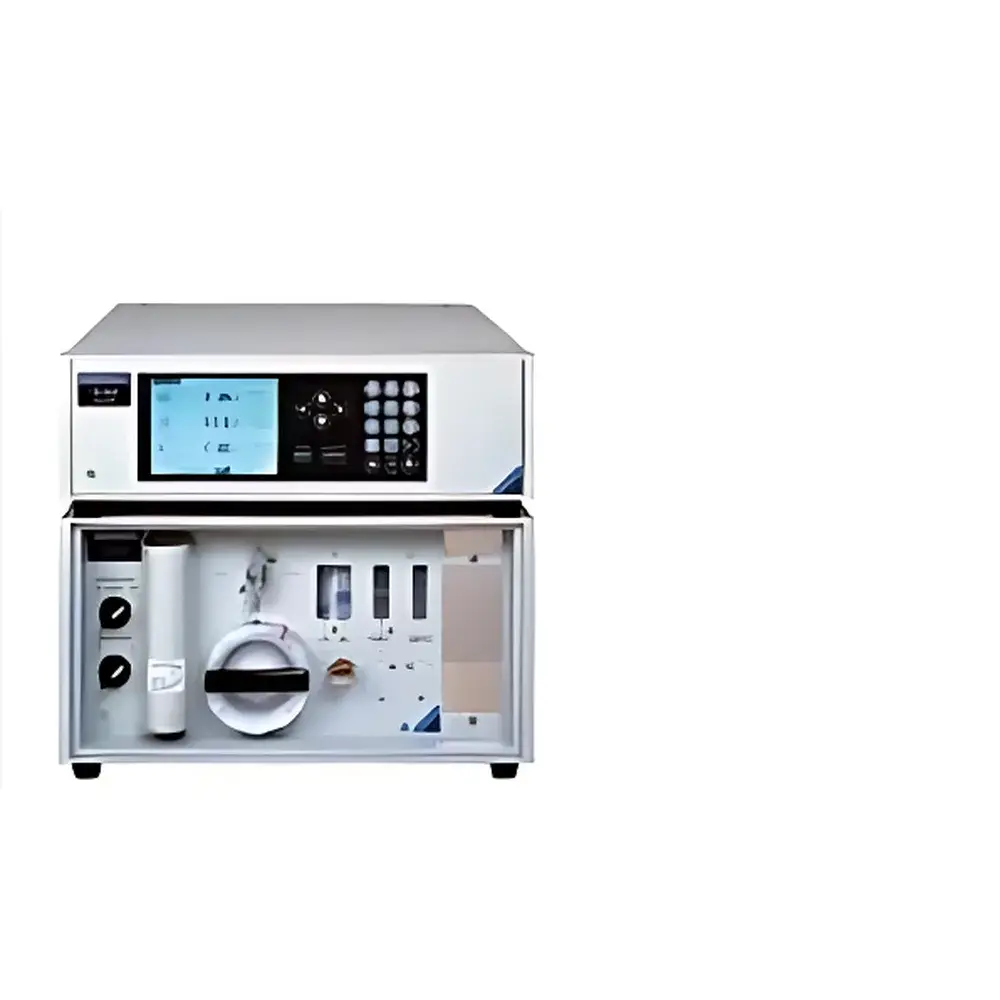
HORIBA VA-3000/VS-3000 Multi-Gas Analyzer System
| Brand | HORIBA |
|---|---|
| Origin | Japan |
| Model | VA-3000 / VS-3000 |
| Instrument Type | Online Continuous Emission Monitor (CEM) |
| Detection Principle | NDIR, CLA, MPA, Electrochemical, Zirconia |
| Measurable Gases | CO, CO₂, NOₓ, SO₂, CH₄, N₂O, C₂H₄, O₂ |
| Minimum Detectable Range | 1–5 ppm |
| Repeatability | ±0.5% of Full Scale (FS) |
| Resolution | 0.1 ppm |
| Response Time (T90) | ≤30 s |
| Zero Drift | ±2.0% FS/week |
| Warm-up Time | 20–60 min (varies by sensor type) |
| Analog Output | DC 0–1 V / 4–20 mA |
| Digital Interface | RS-232C |
| Sample Flow Rate | ~0.5 L/min |
| Operating Environment | 0–40°C, RH <90%, non-condensing |
| Power Supply | AC 100–240 V, 50/60 Hz |
| VA-3000 Dimensions | 430 × 132 × 550 mm (W×H×D) |
| Weight | ~20 kg |
| VS-3000 Sampling Unit Options | VS-3001 to VS-3004 (modular configurations) |
Overview
The HORIBA VA-3000/VS-3000 Multi-Gas Analyzer System is an engineered solution for continuous, high-fidelity measurement of trace and major gas components in environmental monitoring, industrial process control, and research applications. Built upon HORIBA’s decades of expertise in optical and electrochemical gas sensing, the system integrates multiple detection technologies—including Non-Dispersive Infrared (NDIR), Chemiluminescence Analysis (CLA), Magnetic Pressure Analysis (MPA), electrochemical cells, and zirconia-based oxygen sensors—into a single, compact 19-inch rack-mount platform. Its modular architecture allows up to three sensor modules to be installed within the VA-3000 analyzer unit, enabling simultaneous or sequential analysis of up to eight target gases (e.g., CO, CO₂, NOₓ, SO₂, CH₄, N₂O, C₂H₄, O₂) without cross-interference. The system operates on a dry-sampling principle, with the VS-3000 series sampling units providing temperature-controlled, particulate- and moisture-conditioned sample introduction. Designed for compliance-critical environments, it supports long-term stability requirements defined in ISO 12039, EN 15267, and EPA Methods 6C, 7E, and 10.
Key Features
- Multi-Technology Sensor Integration: Combines NDIR (for CO, CO₂, CH₄, N₂O, SO₂), CLA (for NOₓ), MPA (for O₂), electrochemical (for low-range O₂), and zirconia (for high-temperature O₂) in one chassis—eliminating need for separate analyzers.
- Modular Scalability: VA-3000 accommodates up to three interchangeable sensor modules; optional dual-sensor configuration for same gas (e.g., two NDIR CO modules) extends dynamic range up to 20:1 (standard) or 100:1 (CLA mode).
- Wide & Configurable Measurement Ranges: Programmable span selection across multiple decades—e.g., CO: 0–100 ppm to 0–100 vol%; NOₓ: 0–20 ppm to 0–5000 ppm; O₂: 0–5 vol% to 0–100 vol%—with automatic range switching based on concentration thresholds.
- High Metrological Performance: Repeatability ±0.5% FS, linearity ±1.0% FS (≤10:1 range ratio), zero drift ±2.0% FS/week (NDIR/CLA/MPA/zirconia), and ±1.0% FS/day (electrochemical O₂).
- Rugged Sampling Interface: VS-3000 series units (VS-3001–VS-3004) feature corrosion-resistant wetted materials (SUS316L, PTFE, PVDF, FKM), heated sample lines, and integrated particulate filtration (<0.1 mg/m³), meeting stringent stack-gas conditioning requirements per ISO 16146.
- Robust Data Infrastructure: Standard RS-232C serial interface and analog outputs (0–1 V / 4–20 mA) enable seamless integration with DCS, SCADA, and data acquisition systems; supports Modbus RTU via optional converter.
Sample Compatibility & Compliance
The VA-3000/VS-3000 system is validated for use with ambient air, flue gas, biogas, syngas, and laboratory-generated calibration mixtures—provided sample conditions meet defined operational limits. Critical constraints include: sample temperature at analyzer inlet ≤40°C; dew point ≤5°C (VS-3000 dry-sampling ensures this); particulate loading 1 ppm, SO₃ >50 ppm, NO₂ >6 ppm). For zirconia O₂ sensors, coexistence of H₂O and O₂ is mandatory when reducing gases (CO, H₂, THC) are present—governed by the stoichiometric inequality: [THC] + [CO] + [H₂] < [H₂O] + [O₂]. Applications involving NH₃ or high-concentration H₂ require prior consultation and custom catalyst or scrubber integration. The system complies with electromagnetic compatibility (EMC) standards IEC 61326-1 and safety standard IEC 61010-1. It is suitable for deployment in Class 1 Div 2 hazardous locations when configured with appropriate purging or isolation accessories.
Software & Data Management
HORIBA provides dedicated configuration and data logging software compatible with Windows OS, supporting real-time parameter monitoring, multi-channel trend visualization, and automated report generation per EU Directive 2010/75/EU (IED) Annex VIII requirements. All configuration changes, calibration events, and alarm triggers are timestamped and stored with user ID attribution—enabling full audit trail functionality aligned with FDA 21 CFR Part 11 and ISO/IEC 17025 data integrity expectations. Raw analog outputs can be acquired using third-party DAQ hardware (e.g., National Instruments USB-6009), while RS-232C enables ASCII-based command/response communication for custom SCADA integration. Calibration routines support single-point zero/span verification, multi-point linearity checks, and automated drift compensation algorithms activated during scheduled maintenance windows. Data export formats include CSV, XML, and PDF, with optional cloud synchronization via secure HTTPS API (requires HORIBA Cloud Gateway add-on).
Applications
- Regulatory Emissions Monitoring: Continuous measurement of CO, NOₓ, SO₂, and O₂ in cement kilns, waste incinerators, and power plant stacks per EN 14181 QAL1/QAL2 certification protocols.
- Biogas & Landfill Gas Analysis: Simultaneous quantification of CH₄, CO₂, H₂S (via optional sensor), and O₂ to optimize anaerobic digestion efficiency and flare management.
- Combustion Optimization: Real-time O₂ and CO feedback for boiler tuning, minimizing excess air and unburnt carbon losses in industrial furnaces.
- Greenhouse Gas Research: High-stability N₂O and CH₄ detection at sub-ppm levels in atmospheric monitoring stations and soil flux chambers.
- Process Safety & Leak Detection: Low-range CO and hydrocarbon monitoring in hydrogen production facilities, semiconductor cleanrooms, and battery manufacturing lines.
- Academic & Method Development: Flexible platform for validating new gas-phase reaction kinetics, catalyst performance, and sensor cross-sensitivity studies under controlled gas matrices.
FAQ
What detection technologies are supported in the VA-3000 analyzer unit?
The VA-3000 supports five core technologies: Non-Dispersive Infrared (NDIR) for CO, CO₂, CH₄, N₂O, and SO₂; Chemiluminescence Analysis (CLA) for NOₓ; Magnetic Pressure Analysis (MPA) for O₂; electrochemical cells for low-concentration O₂; and zirconia sensors for high-temperature O₂ applications.
Can the system measure ammonia (NH₃) or ethylene (C₂H₄)?
C₂H₄ is supported via NDIR module (subject to spectral interference assessment); NH₃ measurement requires a custom tunable diode laser (TDLAS) module—available through HORIBA’s engineering services group upon technical review.
How is zero and span calibration performed?
Calibration uses certified gas standards introduced via the VS-3000’s dedicated calibration port (RC1/8 fitting); automated zero correction is possible using nitrogen or synthetic air, while span adjustment employs certified multi-gas blends traceable to NIST or BIPM standards.
Is the system compliant with EPA or EU emissions reporting requirements?
Yes—the VA-3000/VS-3000 meets performance specifications outlined in EPA Methods 6C (SO₂), 7E (NOₓ), and 10 (CO), and is certified to EN 15267-3 for QAL1 approval when paired with appropriate VS-3000 sampling configuration and documented QA/QC procedures.
What maintenance intervals are recommended?
Optical path cleaning and detector verification every 6 months; NDIR source lamp replacement every 24 months; electrochemical sensor replacement every 12–18 months depending on exposure history; full system performance verification (QAL2) annually per EN 14181.







