
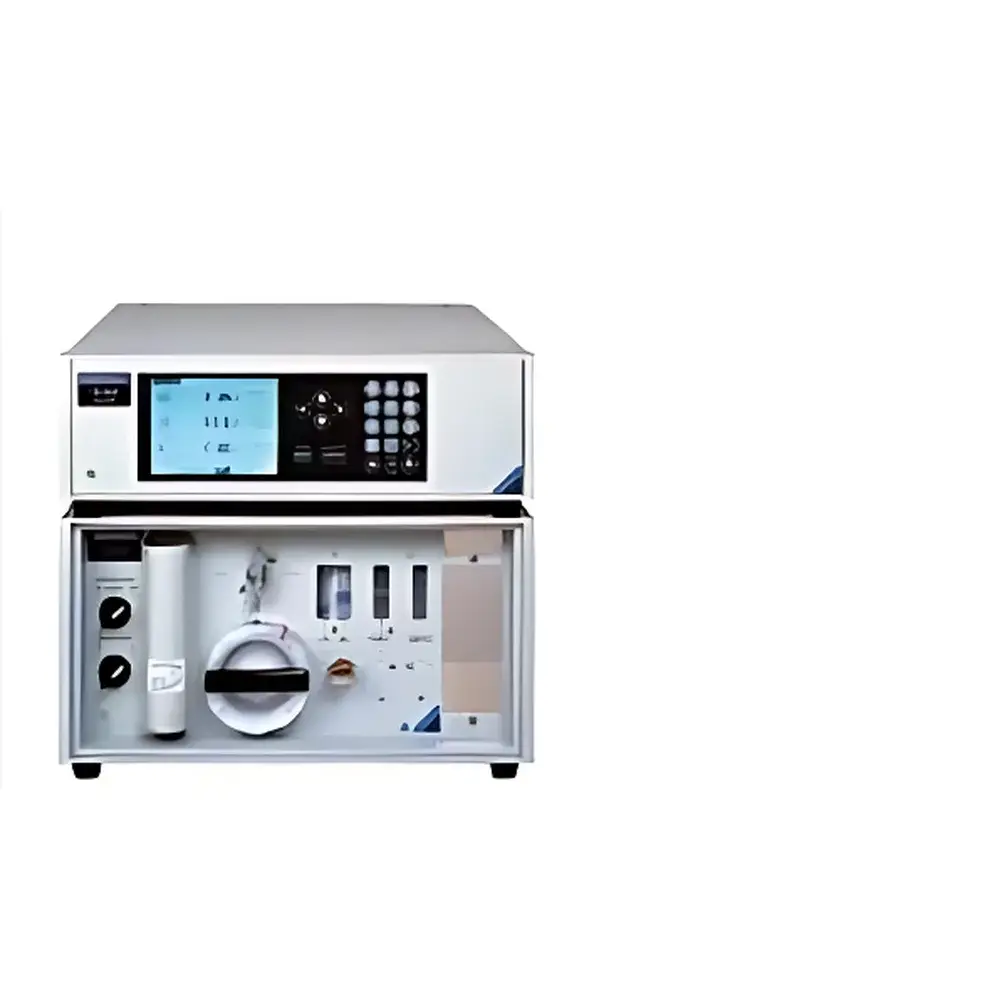
HORIBA VA-3000 / VS-3000 Multi-Parameter Gas Analyzer
| Brand | HORIBA |
|---|---|
| Origin | Japan |
| Model | VA-3000 / VS-3000 |
| Measurement Principles | NDIR (Non-Dispersive Infrared), CLD (Chemiluminescence Detection), Paramagnetic, Electrochemical, Zirconia, Magnetic Pressure |
| Measured Gases | CO, CO₂, CH₄, NO, NO₂, NOₓ, N₂O, SO₂, O₂ |
| Warm-up Time | ≤20 min (NDIR modules) |
| Module Capacity | Up to 3 sensor modules per 19″ rack unit |
| Compliance | Designed for ISO 14001-aligned monitoring, EPA Method-compliant configurations available, supports GLP/GMP data integrity requirements |
Overview
The HORIBA VA-3000 / VS-3000 Multi-Parameter Gas Analyzer is an engineered platform for simultaneous, high-fidelity measurement of up to nine gaseous components in ambient air, flue gas, and process streams. Built upon modular architecture, it integrates interchangeable analytical units—primarily Non-Dispersive Infrared (NDIR), Chemiluminescence Detection (CLD), and oxygen-specific sensors (paramagnetic, electrochemical, zirconia, and magnetic pressure)—within a compact 19-inch rack-mountable chassis. Unlike fixed-function analyzers, the VA-3000 enables configurable multi-gas analysis without external signal conditioning or third-party integration, reducing system complexity and calibration overhead. Its core design targets laboratories and field-deployed environmental monitoring stations requiring regulatory-grade traceability, rapid deployment, and spatial efficiency. The analyzer operates on fundamental spectroscopic and reaction-based principles: NDIR modules quantify gases via absorption at characteristic infrared wavelengths; CLD modules detect NO and NO₂ through ozone-mediated chemiluminescent emission; oxygen modules leverage physical properties—magnetic susceptibility, electrochemical potential, or ion conductivity in stabilized zirconia—to deliver stable, low-drift measurements.
Key Features
- Modular Sensor Architecture: Supports up to three independent analytical modules (e.g., NDIR for CO/CO₂/SO₂/CH₄/N₂O, CLD for NO/NOₓ with catalytic converter, and paramagnetic or zirconia O₂ sensor) within a single 19″ rack unit—enabling custom gas panel configuration without hardware duplication.
- Reduced Warm-up Time: NDIR modules achieve operational stability in ≤20 minutes post-power-on—approximately one-third the warm-up duration of legacy NDIR systems—due to optimized thermal management and proprietary chopper motor design.
- Chopper Motor Innovation: HORIBA-developed solid-state chopper eliminates mechanical shafts and rotational instability, ensuring precise, repeatable modulation of infrared beams across dual-beam optical paths. This design minimizes spectral drift and extends optical component lifetime beyond 10 years under continuous operation.
- Vibration Resilience: Integrated mass-flow sensing and adaptive flow control compensate for mechanical perturbations, maintaining laminar sample delivery and measurement integrity during mobile deployments or facility relocations.
- Space-Efficient Form Factor: Entire analyzer—including sampling unit, gas conditioning, and up to three sensor modules—fits on a standard benchtop or within a 1U–3U 19″ rack, eliminating dedicated instrument cabinets in constrained R&D labs or remote monitoring shelters.
Sample Compatibility & Compliance
The VA-3000/VS-3000 accepts conditioned sample gas streams across a wide range of matrices: ambient air (EPA TO-15 compliant sampling), diluted flue gas (ISO 10849, EN 15267-3), and laboratory-generated calibration mixtures. Sample inlet pressure is maintained at 100–120 kPa with integrated pressure regulation; dew point is controlled to <5 °C via Peltier-cooled condensate traps. All NDIR modules comply with ISO 4037-3 for linearity verification and meet ASTM D6522-22 criteria for NOₓ measurement uncertainty (<±2.0% FS/week zero/ span drift). Oxygen modules conform to ISO 7504 for paramagnetic sensors and ISO 12032 for electrochemical types. System-level validation supports GLP and GMP audit trails, including electronic signature-capable software logging per FDA 21 CFR Part 11 when paired with optional HORIBA LabSolutions™ software.
Software & Data Management
HORIBA’s LabSolutions™ Gas Analysis Suite provides real-time visualization, automated calibration scheduling, and raw spectral data export (CSV, HDF5). The software implements configurable alarm thresholds, trend-based diagnostics (e.g., mirror contamination alerts), and batch report generation aligned with ISO/IEC 17025 documentation requirements. All measurement events—including zero/span checks, module swaps, and firmware updates—are timestamped and user-attributed, forming an immutable audit trail. Remote access via TLS-encrypted HTTPS enables secure off-site monitoring without exposing internal network infrastructure. Data export formats support direct ingestion into LIMS platforms and EPA ERT (Electronic Reporting Tool) submissions.
Applications
- Continuous emissions monitoring (CEMS) for thermal power plants, cement kilns, and waste incinerators—configured with CLD + NDIR + O₂ modules for NOₓ, CO, CO₂, and excess O₂ compliance reporting.
- R&D of low-carbon combustion technologies—measuring transient CH₄ slip, N₂O formation, and CO/CO₂ ratios during catalyst testing under dynamic load conditions.
- Urban air quality networks—deploying compact VA-3000 units in rooftop enclosures for real-time CO, NO₂, and O₃ precursor tracking (via NO/NO₂ conversion).
- Calibration laboratory reference systems—utilizing dual-NDIR modules for cross-validation of gas standards traceable to NIST SRMs.
- Mobile source testing—integrated into vehicle chassis dynamometer exhaust trains for WLTP/RDE cycle analysis of regulated and non-regulated species (e.g., N₂O, CH₄).
FAQ
What gas species can be measured simultaneously on a single VA-3000 unit?
Up to nine gases: CO, CO₂, CH₄, NO, NO₂, NOₓ (calculated), N₂O, SO₂, and O₂—subject to module selection and physical space constraints (max 3 modules per unit).
Does the VA-3000 support automatic zero and span calibration?
Yes—programmable auto-calibration sequences are supported using external gas standards; all calibration events are logged with operator ID and timestamp.
Can the system be integrated into existing SCADA or DCS environments?
Yes—via Modbus TCP/IP, OPC UA, or 4–20 mA analog outputs (configurable per channel); digital communication supports full parameter read/write capability.
Is the analyzer suitable for outdoor installation?
The VA-3000 is designed for indoor or sheltered environments (IP20); for permanent outdoor deployment, HORIBA recommends the VS-3000 variant with enhanced thermal enclosure and weatherproof housing (IP54 rated).
How is measurement traceability maintained across module changes?
Each sensor module carries embedded calibration certificates with unique serial numbers; LabSolutions™ enforces version-controlled calibration files tied to module firmware revision and installation date.







