
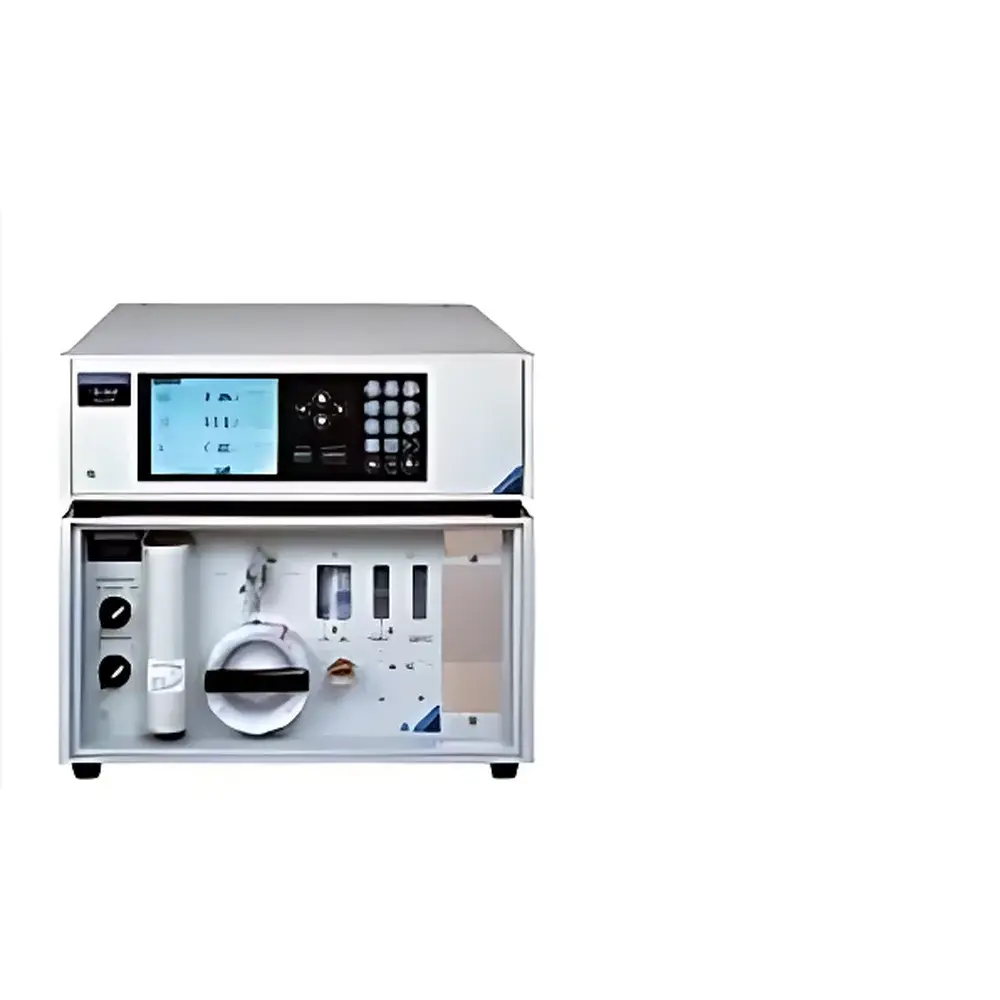
HORIBA VA-3000/VS-3000 Series Multi-Component Gas Analyzer
| Brand | HORIBA |
|---|---|
| Origin | Japan |
| Model | VA-3000 / VS-3000 |
| Instrument Type | Online Analyzer |
| Detection Principle | NDIR, CLA, MPA, Electrochemical (Galvanic), Zirconia |
| Measurable Gases | CO, CO₂, NOₓ, SO₂, CH₄, N₂O, C₂H₄, O₂ |
| Minimum Range | 1–5 ppm |
| Repeatability | ±0.5% F.S. |
| Resolution | 0.1 ppm |
| Response Time | T₉₀ ≤ 30 s |
| Zero Drift | ±2.0% F.S./week |
| Warm-up Time | 20–60 min (depending on sensor type) |
| Analog Output | 0–1 V DC or 4–20 mA (optional) |
| Communication Interface | RS-232C |
| Sample Flow Rate | ~0.5 L/min |
| Operating Environment | 0–40 °C, ≤90% RH |
| Power Supply | AC 100–120 V or 200–240 V, 50/60 Hz |
| Dimensions (VA-3000) | 430 × 132 × 550 mm (W×H×D) |
| Weight (VA-3000) | ~20 kg |
| Enclosure | 19-inch rack-mountable chassis |
Overview
The HORIBA VA-3000/VS-3000 Series Multi-Component Gas Analyzer is an online, modular gas analysis platform engineered for high-precision, multi-species quantification in demanding environmental monitoring, industrial emission control, and energy R&D applications. It integrates multiple detection technologies—including Non-Dispersive Infrared (NDIR), Chemiluminescence Analysis (CLA), Magnetic Pressure Analysis (MPA), electrochemical (galvanic cell), and zirconia-based oxygen sensing—within a single compact 19-inch rack-mountable chassis. The system architecture supports up to three interchangeable sensor modules per VA-3000 analyzer unit, enabling simultaneous or sequential measurement of up to eight regulated and emerging gases: CO, CO₂, NOₓ (NO + NO₂), SO₂, CH₄, N₂O, C₂H₄, and O₂. Its design reflects HORIBA’s decades-long specialization in trace gas metrology, emphasizing long-term stability, calibration integrity, and adaptability to evolving regulatory requirements under ISO 14001, EPA Method 6C/7E/10, and EN 15267-certified monitoring frameworks.
Key Features
- Modular sensor architecture: Supports NDIR (CO, CO₂, CH₄, N₂O, SO₂), CLA (NOₓ), MPA (O₂), galvanic (O₂), and zirconia (O₂) modules—each independently configurable and swappable without system downtime.
- Dynamic range flexibility: Standard 4-step range selection per gas; optional extended-range configurations achieve up to 20× span ratio for NDIR and 100× for CLA—enabling seamless coverage from sub-ppm ambient monitoring to percent-level process gas analysis.
- High metrological performance: Repeatability ±0.5% F.S., linearity ±1.0% F.S. (≤10× span), zero drift ≤±2.0% F.S./week (zirconia and galvanic O₂: ±1.0% F.S./day), ensuring compliance with GLP and routine QA/QC protocols.
- Robust sample conditioning: VS-3000 series sampling units provide temperature-controlled, dry-sampling (dew point ≤5 °C), particulate-filtered (<0.1 mg/m³), and corrosion-resistant flow paths using PTFE, PVDF, SUS316, and FKM wetted materials.
- Standardized interfaces: RS-232C serial communication for remote configuration and data logging; analog outputs (0–1 V or 4–20 mA) compatible with DCS/SCADA systems; all signals non-isolated by default (isolated options available).
- Regulatory-ready operation: Designed for continuous emissions monitoring systems (CEMS) and ambient air quality networks requiring audit-trail-capable calibration records, leak-check logs, and zero/span verification timestamps aligned with US EPA 40 CFR Part 60 and EU Directive 2010/75/EU.
Sample Compatibility & Compliance
The VA-3000/VS-3000 system accepts gaseous samples within defined physical and chemical constraints to preserve sensor longevity and measurement fidelity. Acceptable sample conditions include: temperature at ambient (0–40 °C), moisture content ≤5 °C dew point, particulate loading 50 ppm), explosive, or flammable components. For zirconia O₂ sensors, coexistence of H₂O and O₂ is mandatory when reducing gases (CO, H₂, THC) are present—governed by the stoichiometric inequality: [THC] + [CO] + [H₂] < [H₂O] + [O₂]. Applications involving NH₃ or C₂H₄ require custom catalyst or interference-compensation modules, subject to pre-deployment validation per ISO 12039 and ASTM D6522. All VA-3000 units comply with IEC 61000-6-2 (immunity) and IEC 61000-6-4 (emissions), and meet CE marking requirements for industrial instrumentation.
Software & Data Management
While the VA-3000 operates autonomously via front-panel LCD interface (320×240 pixel monochrome display), HORIBA provides optional PC-based software (HORIBA GA-Manager) for comprehensive instrument control, real-time trend visualization, automated calibration scheduling, and regulatory report generation. The software supports CSV export, time-stamped event logging (including zero/span events, alarm triggers, and module swaps), and user-access-level management (operator, engineer, administrator). Data integrity conforms to FDA 21 CFR Part 11 principles where electronic records are employed—enabling audit trails, electronic signatures, and secure password-protected configuration changes. Raw analog outputs and RS-232C ASCII streams are fully parseable by third-party SCADA platforms (e.g., Ignition, Siemens Desigo, Honeywell Experion) using standard Modbus RTU or custom ASCII frame parsing.
Applications
The VA-3000/VS-3000 serves mission-critical roles across sectors requiring multi-gas accountability and regulatory traceability. Key use cases include continuous stack emission monitoring (CEM) for thermal power plants and waste incinerators; fugitive methane (CH₄) and nitrous oxide (N₂O) quantification in biogas upgrading and landfill gas recovery; combustion optimization via real-time O₂/CO/NOₓ feedback in industrial boilers; ambient air quality stations measuring urban CO/NO₂/SO₂; and laboratory-scale catalytic reaction studies tracking transient species (e.g., CO oxidation, NO reduction) with second-level temporal resolution. Its modularity also supports mobile monitoring platforms and OEM integration into OEM emission control units (ECUs) for marine engines and stationary reciprocating engines compliant with IMO Tier III and EU Stage V standards.
FAQ
What detection technologies are supported, and how are they selected per application?
The VA-3000 accommodates NDIR (for CO, CO₂, CH₄, N₂O, SO₂), CLA (for NOₓ), MPA (for O₂), galvanic (for low-concentration O₂), and zirconia (for high-temperature or high-purity O₂). Selection depends on required sensitivity, cross-interference tolerance, sample matrix, and regulatory method alignment—e.g., CLA is mandated for NOₓ per EPA Method 7E.
Can the same analyzer measure both low-ppm ambient gases and high-% process gases?
Yes—via programmable multi-range capability. A single CO channel can be configured across ranges from 0–10 ppm (ambient air) to 0–25 vol% (flue gas), with automatic range switching or manual selection based on process logic.
Is the system suitable for unattended, long-term field deployment?
Yes—designed for continuous operation with weekly zero/span checks, drift-compensated algorithms, and diagnostics for flow, pressure, temperature, and sensor health—all accessible remotely via RS-232C or analog status outputs.
How is calibration traceability maintained?
Calibration uses NIST-traceable certified gases; the system logs date/time, operator ID, standard concentration, measured value, and deviation—exportable for internal QA review or regulatory submission.
What support is available for complex sample matrices (e.g., syngas, digester gas)?
HORIBA provides application-specific pretreatment recommendations—including heated sample lines, condensate traps, chemical scrubbers, and catalytic converters—and offers engineering consultation for method validation per ISO 12039 or customer-defined protocols.







