
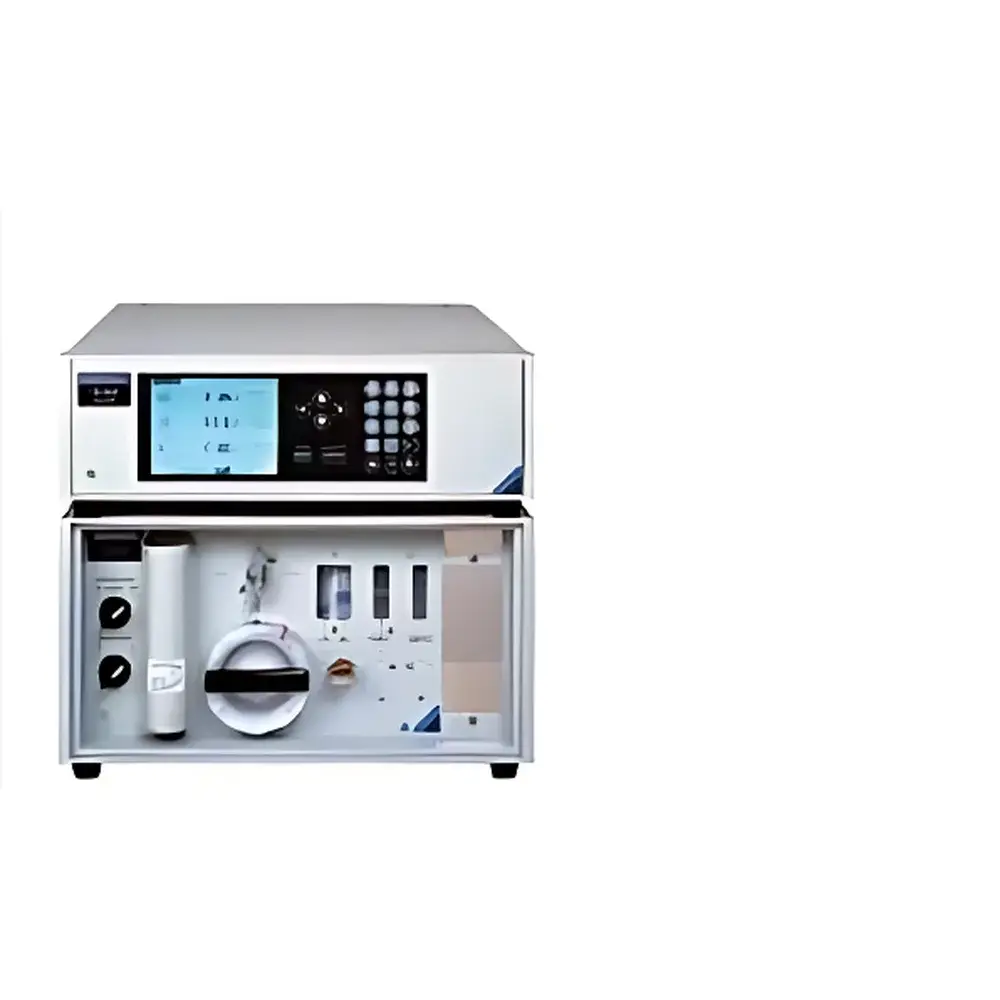
HORIBA VA-3000/VS-3000 Series Multi-Gas Infrared Analyzer
| Brand | HORIBA |
|---|---|
| Origin | Japan |
| Model | VA-3000 / VS-3000 |
| Instrument Type | Online Gas Analyzer |
| Detection Principle | NDIR (CO, CO₂, CH₄, N₂O, SO₂), CLA (NOₓ), MPA / Electrochemical / Zirconia (O₂) |
| Measuring Range | 1–5 ppm (minimum span) to 100 vol% (max, gas-dependent) |
| Repeatability | ±0.5% FS |
| Resolution | 0.1 ppm |
| Response Time | T90 ≤ 30 s |
| Zero Drift | ±2.0% FS/week |
| Span Drift | ±2.0% FS/week |
| Warm-up Time | 20–60 min (sensor-dependent) |
| Analog Output | DC 0–1 V / 4–20 mA (optional) |
| Digital Interface | RS-232C |
| Sample Flow Rate | ~0.5 L/min |
| Operating Environment | 0–40 °C, RH < 90% |
| Power Supply | AC 100–120 V or 200–240 V, 50/60 Hz |
| Weight | ~20 kg (VA-3000), ~14–20 kg (VS-3001–VS-3004) |
Overview
The HORIBA VA-3000/VS-3000 Series is a modular, online multi-gas infrared analyzer engineered for high-precision, long-term stability in continuous emission monitoring (CEM), industrial process control, environmental research, and energy-sector applications. Built upon HORIBA’s decades of expertise in optical gas sensing, the system integrates multiple detection technologies—including Non-Dispersive Infrared (NDIR) for CO, CO₂, CH₄, N₂O, and SO₂; Chemiluminescence Analysis (CLA) for NOₓ; and Magnetic Pressure (MPA), electrochemical, or zirconia-based sensors for O₂—within a compact 19-inch rack-mount chassis. Its core architecture supports up to three independently configurable sensor modules per VA-3000 analyzer unit, enabling simultaneous, real-time quantification of up to six gas species without cross-interference. The instrument operates on fundamental spectroscopic absorption principles (for NDIR), chemiluminescent photon emission kinetics (for NOₓ), and paramagnetic or electrochemical transduction (for O₂), ensuring trace-level sensitivity down to 1–5 ppm while maintaining full-scale accuracy across dynamic concentration ranges spanning five orders of magnitude.
Key Features
- Modular sensor architecture: Supports up to three interchangeable, field-replaceable modules (NDIR, CLA, MPA, electrochemical, or zirconia) in a single VA-3000 analyzer housing.
- Wide dynamic range capability: Programmable multi-range spans (e.g., 0–100 ppm to 0–100 vol% for CO₂); optional extended-range configurations achieve up to 20× span ratio for NDIR and 100× for CLA.
- High metrological performance: Repeatability ±0.5% FS, linearity ±1.0% FS (≤10× span), zero and span drift ≤±2.0% FS/week (NDIR/CLA/MPA/zirconia) or ≤±1.0% FS/day (electrochemical O₂).
- Rapid response: T90 ≤ 30 seconds from sample inlet under standard flow conditions (0.5 L/min), validated per ISO 12039 and EPA Method 6C protocols.
- Robust sampling integration: Compatible with VS-3000-series sample conditioning units (VS-3001 to VS-3004), featuring heated, dry-sampling pathways, corrosion-resistant wetted materials (SUS, PTFE, PVDF, FKM), and particulate filtration (<0.1 mg/m³).
- Comprehensive signal output: Standard analog outputs (0–1 V, 4–20 mA) and RS-232C serial interface support seamless integration into SCADA, DCS, and data acquisition systems compliant with IEC 61131-3 and Modbus RTU (via optional converter).
Sample Compatibility & Compliance
The VA-3000/VS-3000 system is designed for use with clean, dry, non-corrosive, non-explosive sample streams meeting strict conditioning specifications: sample temperature at ambient, moisture content ≤5 °C dew point, particulate loading 50 ppm), NO₂ (>6 ppm), or reducing gases exceeding stoichiometric thresholds (e.g., CO + H₂ + THC < H₂O + O₂). For zirconia O₂ sensors, coexistence of H₂O and O₂ is mandatory to prevent sensor degradation. The analyzer complies with key international standards including ISO 12039 (stationary source emissions—determination of CO, CO₂, CH₄, NOₓ), EN 15267 (QAL1 certification framework), and supports audit-ready operation under GLP and GMP environments. Data integrity is reinforced by timestamped analog outputs and RS-232C logging—compatible with FDA 21 CFR Part 11-compliant software platforms when deployed with HORIBA’s optional data management suite.
Software & Data Management
The VA-3000 includes embedded firmware supporting real-time concentration calculation, automatic zero/span calibration scheduling, and diagnostic flagging for sensor health, flow deviation, and temperature excursion. Raw analog outputs allow direct connection to third-party PLCs or chart recorders. When paired with HORIBA’s proprietary PC-based configuration and analysis software (supplied separately), users gain access to advanced features including multi-point calibration curve management, drift compensation algorithms, batch export of time-stamped CSV files, and customizable alarm thresholds with relay output activation. All communication adheres to ASCII-based command protocols over RS-232C, enabling interoperability with laboratory information management systems (LIMS) and enterprise environmental monitoring platforms. Audit trails—including calibration events, parameter changes, and fault logs—are retained in non-volatile memory and exportable for regulatory review.
Applications
This analyzer serves mission-critical roles across regulated and research-intensive domains: continuous monitoring of flue gas from thermal power plants (CO, NOₓ, SO₂, O₂), biogas upgrading facilities (CH₄, CO₂, H₂S proxy via CO), landfill gas collection systems (CH₄, CO₂, N₂O), semiconductor fab exhaust abatement (CO, NF₃ proxy), and indoor air quality validation labs (CO₂, CO). Its modular flexibility also supports R&D applications such as catalytic converter efficiency testing, combustion optimization studies, and greenhouse gas flux measurement in eddy covariance systems. The VS-3000 sampling units enable deployment in harsh industrial settings—including cement kilns, waste incinerators, and chemical reactors—where particulate-laden, high-humidity, or mildly corrosive streams require active conditioning prior to analysis.
FAQ
What gas species can be measured simultaneously?
Up to three gas components can be measured concurrently using the VA-3000’s triple-module configuration—for example, CO (NDIR), NOₓ (CLA), and O₂ (zirconia)—with additional combinations possible via VS-3000 sampling compatibility.
Is the analyzer suitable for EPA or EU regulatory compliance?
Yes—when configured with QAL1-certified modules and integrated with VS-3000 sample conditioning, the system meets requirements of EPA Methods 3A, 6C, and 7E, as well as EN 14181 and EN 15267 for automated monitoring systems.
Can the instrument measure NH₃ or C₂H₄?
NH₃ and C₂H₄ are not supported by standard NDIR/CLA modules; custom sensor development or alternative spectroscopic approaches (e.g., FTIR) would be required—contact HORIBA Technical Support for feasibility assessment.
What maintenance intervals are recommended?
Zero/span calibration is advised every 7 days for regulatory applications; optical path cleaning and filter replacement every 3–6 months depending on sample cleanliness; annual verification of sensor linearity and drift against NIST-traceable standards.
Does the system support remote diagnostics or firmware updates?
Remote diagnostics are enabled via RS-232C-connected host PCs running HORIBA software; firmware updates require local physical access and are performed using signed binary packages distributed through HORIBA’s secure customer portal.







