
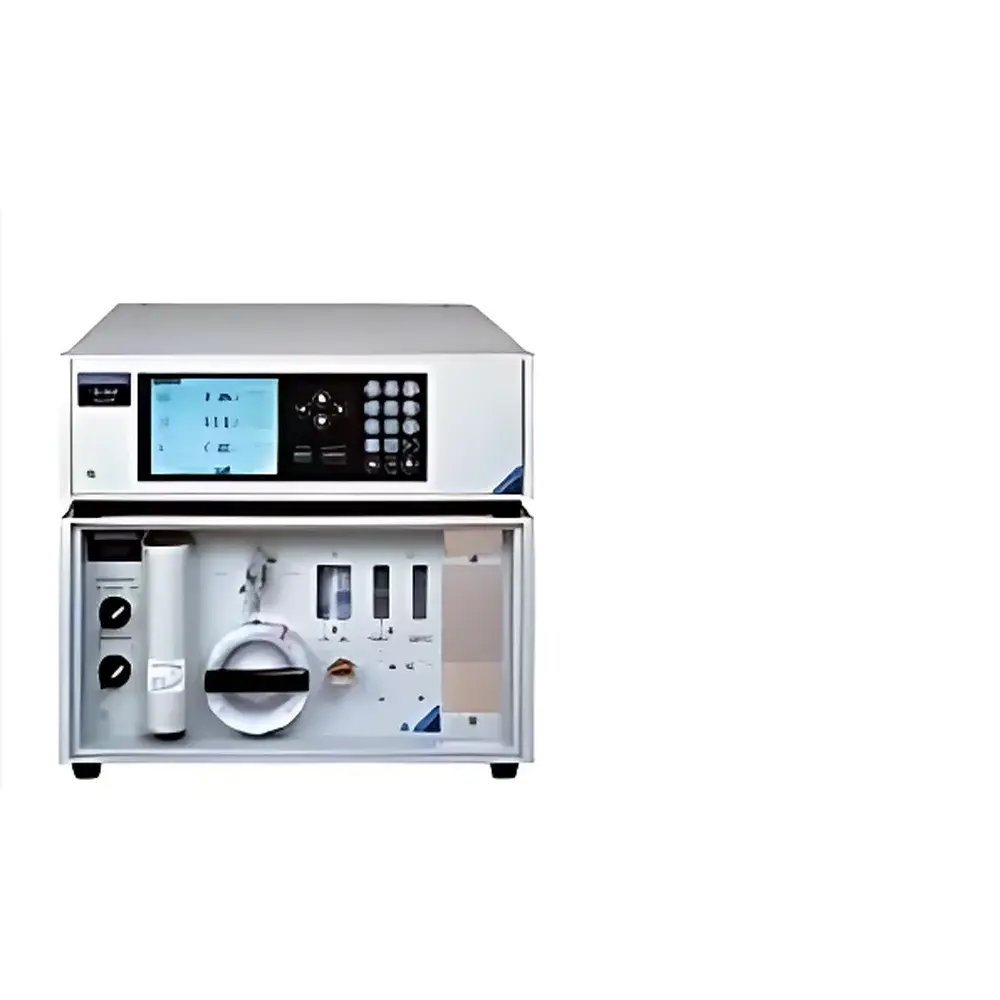
HORIBA VA-3000/VS-3000 Series NDIR-Based Multi-Component Infrared Gas Analyzer
| Brand | HORIBA |
|---|---|
| Origin | Japan |
| Model | VA-3000 / VS-3000 |
| Instrument Type | Online Gas Analyzer |
| Detection Principle | Non-Dispersive Infrared (NDIR), Chemiluminescence (CLA), Magnetic Pressure (MPA), Electrochemical (Galvanic), Zirconia Oxide |
| Detectable Gases | CO, CO₂, NOₓ, SO₂, CH₄, N₂O, C₂H₄, O₂ |
| Minimum Range | 1–5 ppm |
| Repeatability | ±0.5% F.S. |
| Linearity | ±1.0% F.S. (≤10× span) |
| Zero Drift | ±2.0% F.S./week (NDIR/CLA/MPA/ZrO₂) |
| Span Drift | ±2.0% F.S./week (NDIR/CLA/MPA/ZrO₂) |
| Response Time | T₉₀ ≤ 30 s (single component, inlet to output) |
| Resolution | 0.1 ppm (for trace-level ranges) |
| Analog Output | DC 0–1 V (non-isolated), DC 4–20 mA (optional) |
| Digital Interface | RS-232C |
| Sample Flow Rate | ~0.5 L/min |
| Warm-up Time | ~20 min (NDIR/ZrO₂), ~40 min (MPA), ~60 min (CLA/Galvanic) |
| Operating Environment | 0–40 °C, ≤90% RH |
| Power Supply | AC 100–120 V or 200–240 V, 50/60 Hz |
| Power Consumption | ~200 VA (VA-3000), ~250–450 VA (VS-3001–VS-3004) |
| Dimensions (VA-3000) | 430 mm W × 132 mm H × 550 mm D |
| Weight (VA-3000) | ~20 kg |
| Enclosure | 19-inch rack-mountable chassis |
Overview
The HORIBA VA-3000/VS-3000 Series is a modular, online multi-component gas analyzer engineered for high-precision, long-term stability in continuous emission monitoring (CEM), industrial process control, environmental research, and energy sector applications. Built upon non-dispersive infrared (NDIR) spectroscopy as the primary detection principle—with optional chemiluminescence (CLA), magnetic pressure (MPA), electrochemical (galvanic), and zirconia-based oxygen sensing modules—the system delivers trace-to-percent-level quantification of key gases including CO, CO₂, NOₓ, SO₂, CH₄, N₂O, C₂H₄, and O₂. Its architecture supports up to three interchangeable sensor modules within a single 19-inch analyzer unit (VA-3000), enabling flexible configuration without hardware duplication. The system is designed to meet stringent regulatory measurement requirements under ISO 12039, EN 15267, EPA Method 10, and ASTM D6522—particularly where simultaneous, independent quantification of multiple species is mandated. Unlike fixed-range analyzers, the VA-3000 implements programmable span scaling and dynamic range extension (up to 20× standard range with optional configuration), allowing one instrument to cover applications from ambient air quality monitoring (e.g., 0–100 ppm CO) to high-concentration flue gas analysis (e.g., 0–100 vol% CO₂).
Key Features
- Modular sensor architecture: Supports up to three independently configurable detection modules (NDIR, CLA, MPA, galvanic, or zirconia) in a single analyzer chassis.
- Multi-gas capability: Simultaneous or sequential analysis of CO, CO₂, NOₓ, SO₂, CH₄, N₂O, C₂H₄, and O₂ without cross-interference—validated per IEC 61298-2 for gas-specific selectivity.
- High metrological performance: Repeatability ±0.5% F.S., linearity ±1.0% F.S. (≤10× span), zero drift ≤±2.0% F.S./week (NDIR/CLA/MPA/ZrO₂), and response time T₉₀ ≤30 s from sample inlet to digital output.
- Dynamic range optimization: Configurable 4- to 8-segment span tables; NDIR offers up to 20× extended range (subject to optical path length constraints); CLA enables 100× span ratio (min. 50 ppm when max span >2000 ppm).
- Ruggedized sampling interface: VS-3000 series sampling units (VS-3001–VS-3004) feature corrosion-resistant wetted materials (SUS, PTFE, PVDF, FKM), heated/dried sample conditioning (5 °C dew point), and flow-controlled extraction (1.5–5.0 L/min) with dual-stream capability.
- Regulatory-ready outputs: Standard RS-232C serial interface and analog outputs (0–1 V, 4–20 mA) compliant with SCADA and DCS integration; supports audit-trail-capable data logging when paired with HORIBA’s optional software suite.
Sample Compatibility & Compliance
The VA-3000/VS-3000 system requires conditioned sample gas meeting strict physical and chemical specifications: moisture content ≤5 °C saturation, particulate loading 50 ppm, NO₂ >6 ppm), explosive, or flammable components. For NDIR-based CO measurement in N₂O-rich streams, an optional catalytic converter module is required if CO exceeds 10 ppm to prevent spectral interference. Zirconia O₂ sensors mandate coexistence of H₂O and O₂ in stoichiometric balance relative to reducing gases (CO + H₂ + THC < H₂O + O₂); failure to satisfy this condition accelerates sensor degradation. All configurations comply with electromagnetic compatibility (EMC) per EN 61326-1 and safety standards IEC 61010-1. The system supports GLP/GMP-aligned operation through configurable calibration scheduling, electronic signature-capable calibration logs, and 21 CFR Part 11–compatible software options (available separately).
Software & Data Management
The VA-3000 includes embedded firmware supporting real-time concentration calculation, automatic zero/span validation, and alarm-triggered event logging. Raw analog and digital outputs are compatible with third-party SCADA systems via Modbus RTU (RS-232C) or analog I/O. HORIBA’s optional VA-Link software provides full remote configuration, time-synchronized multi-channel data acquisition, statistical trend analysis (e.g., 7-day drift tracking), and export to CSV/Excel formats. Calibration records include operator ID, timestamp, reference gas lot number, and pre/post-calibration deviation reports—structured to support FDA 21 CFR Part 11 audit trails when deployed with validated Windows OS environments. Data retention is configurable up to 30 days onboard; external storage via USB or network interface is supported in advanced configurations.
Applications
- Continuous Emission Monitoring Systems (CEMS) for thermal power plants, cement kilns, and waste incinerators—measuring regulated pollutants (CO, NOₓ, SO₂, CH₄) per EU Directive 2010/75/EU and U.S. EPA 40 CFR Part 60.
- Carbon capture and utilization (CCU) facilities, where simultaneous CO₂ purity verification (0–100 vol%) and trace CO/CH₄ monitoring (<1 ppm) ensure pipeline-grade specification compliance.
- Automotive R&D labs conducting exhaust gas analysis across transient engine cycles, leveraging rapid T₉₀ response and multi-species synchronization.
- Biogas upgrading plants requiring real-time O₂ (0–25 vol%), CH₄ (0–100 vol%), CO₂ (0–100 vol%), and H₂S (via optional CLA add-on) measurement for membrane separation control.
- Indoor air quality (IAQ) and cleanroom validation, utilizing low-range NDIR channels (0–100 ppm CO₂, 0–5 ppm CO) with certified repeatability and minimal drift.
FAQ
What detection principles are available in the VA-3000/VS-3000 platform?
NDIR (CO, CO₂, CH₄, SO₂, N₂O), chemiluminescence (NOₓ), magnetic pressure (O₂), electrochemical (O₂), and zirconia oxide (O₂). Module selection is determined by target gas, concentration range, and interference environment.
Can the same analyzer measure both low-ppm and high-percentage concentrations?
Yes—via programmable multi-span tables and optional extended-range optics. For example, a single NDIR module can be configured for 0–100 ppm CO (trace mode) and 0–25 vol% CO (process mode), with automatic range switching triggered by user-defined thresholds.
Is the system suitable for unattended, long-term field deployment?
Yes—designed for continuous operation with weekly zero/span verification intervals, temperature-stabilized optical benches, and robust enclosure rated for 0–40 °C ambient operation. Optional uninterruptible power supply (UPS) integration and remote diagnostics further enhance field reliability.
How is cross-sensitivity addressed for gases like CO and CO₂ in mixed streams?
NDIR modules use narrow-band optical filters and reference wavelength compensation; HORIBA provides application-specific interference correction coefficients derived from NIST-traceable gas mixtures and documented in the instrument’s type approval reports.
Does the system support regulatory compliance reporting (e.g., EPA, EU-MCP)?
Yes—when configured with appropriate sampling (VS-3000), calibration protocols, and VA-Link software, it meets data integrity, record retention, and QA/QC reporting requirements outlined in EN 14181 and EPA Performance Specification 2 (PS-2) for CO/CO₂ analyzers.







