
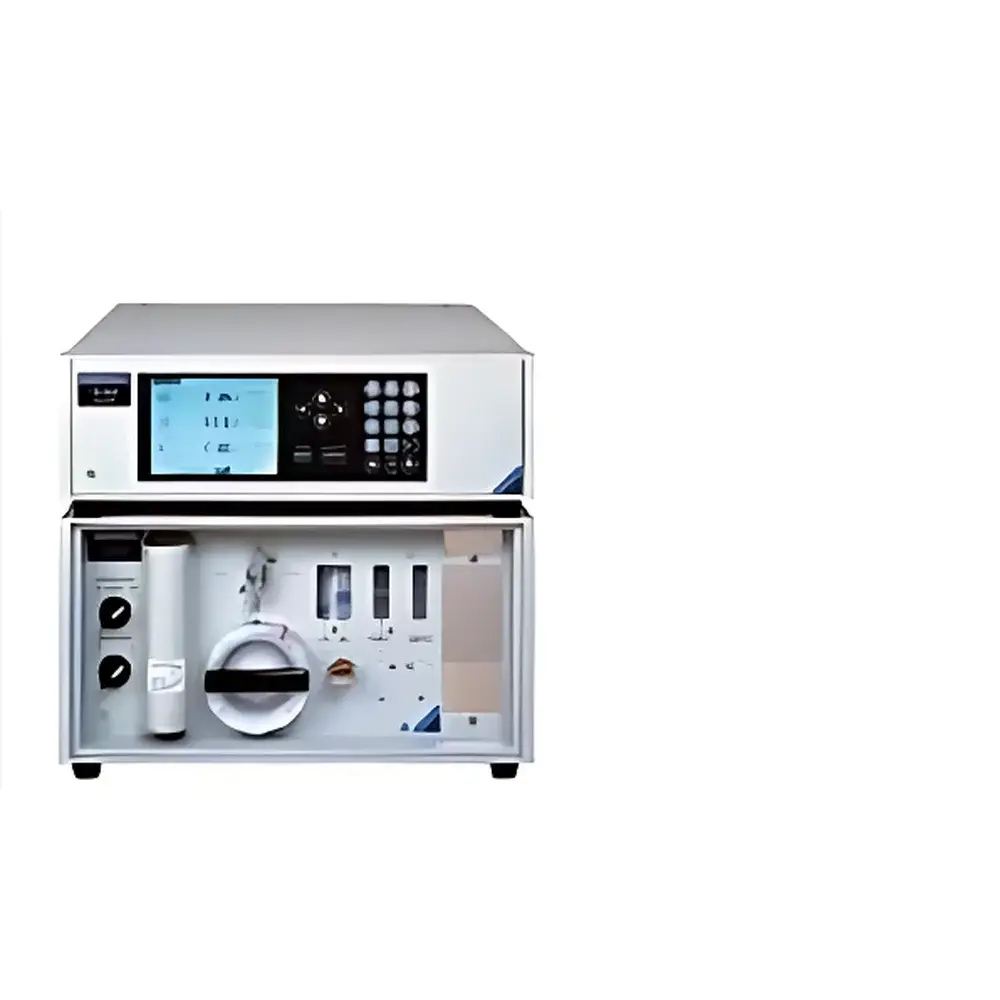
HORIBA VA-3000/VS-3000 Series NDIR & CLA-Based Multi-Gas Analyzer
| Brand | HORIBA |
|---|---|
| Origin | Japan |
| Model | VA-3000 (Analyzer Unit) / VS-3000 (Sampling System) |
| Detection Principle | Non-Dispersive Infrared (NDIR), Chemiluminescence (CLA), Magnetic Pressure (MPA), Electrochemical (Galvanic Cell), Zirconia Oxide (ZrO₂) |
| Measured Gases | CO, CO₂, NOₓ, SO₂, CH₄, N₂O, C₂H₄, O₂ |
| Accuracy | ±0.5% F.S. (Repeatability), ±1.0% F.S. (Linearity), ±2.0% F.S./week (Zero/Span Drift) |
| Response Time | T90 ≤ 30 s (single-component mode) |
| Analog Outputs | DC 0–1 V / 4–20 mA (optional) |
| Digital Interface | RS-232C |
| Operating Temperature | 0–40 °C |
| Humidity | ≤90% RH |
| Power Supply | AC 100–120 V or 200–240 V, 50/60 Hz |
| VA-3000 Dimensions | 430 × 132 × 550 mm (W×H×D) |
| Weight | ~20 kg |
| VS-3000 Sampling Units | VS-3001 to VS-3004 (modular configurations for NDIR/CLA/MPA/electrochemical/zirconia sensors) |
| Flow Rate | 0.5 L/min (sample inlet), 1.5–5.0 L/min (extraction) |
| Materials | SUS, PTFE, PVDF, FKM, glass |
Overview
The HORIBA VA-3000/VS-3000 Series is a modular, multi-technology gas analysis platform engineered for high-precision, multi-component trace gas monitoring in environmental, industrial emissions, and energy research applications. Unlike single-principle analyzers, the VA-3000 integrates complementary detection methodologies—Non-Dispersive Infrared (NDIR) for CO, CO₂, CH₄, N₂O, and SO₂; Chemiluminescence (CLA) for NOₓ; Magnetic Pressure Analysis (MPA) and electrochemical (galvanic cell) or zirconia-based sensors for O₂—within a single 19-inch rack-mountable analyzer unit. This architecture enables simultaneous, independent quantification of up to three gas species using interchangeable sensor modules, eliminating cross-interference and preserving measurement integrity across dynamic concentration ranges. The system’s core design philosophy centers on analytical flexibility without compromise: each module operates with dedicated optical paths, thermal stabilization, and signal processing optimized for its target analyte and physical detection principle. Its compliance-ready architecture supports continuous operation under ISO 14001-aligned ambient monitoring protocols and meets foundational requirements for EPA Method 6C (SO₂), Method 7E (NOₓ), and EN 15267-certified emissions monitoring systems.
Key Features
- Modular sensor architecture supporting up to three independently configurable detection modules (NDIR, CLA, MPA, electrochemical, or zirconia) in one VA-3000 chassis
- Wide dynamic range capability: up to 20:1 span ratio (optional) for NDIR channels; up to 100:1 for CLA-based NOₓ measurement via programmable multi-range scaling
- High metrological stability: repeatability ±0.5% F.S., linearity ±1.0% F.S. (≤10× span), zero/span drift ≤±2.0% F.S./week (NDIR/CLA/MPA/zirconia); ±1.0% F.S./day for galvanic O₂ sensors
- Rapid response performance: T90 ≤ 30 seconds from sample inlet under single-gas conditions; T95 ≤ 45 seconds
- Integrated sampling interface via VS-3000 series—four model variants (VS-3001 to VS-3004) tailored to specific sensor combinations and sample conditioning requirements (e.g., heated/dry sampling, corrosion-resistant wet-gas handling)
- Robust sample conditioning: VS-3000 units feature PTFE/PVDF/FKM-wetted parts, adjustable flow control (0.5 L/min delivery), and condensate management compliant with ISO 8573-1 Class 4 moisture limits
- Standard RS-232C serial interface and analog outputs (0–1 V, 4–20 mA) enable seamless integration into SCADA, DCS, and data acquisition systems
Sample Compatibility & Compliance
The VA-3000/VS-3000 platform is validated for use with clean, dry, non-corrosive, non-explosive sample streams meeting defined physicochemical constraints: sample temperature within ambient range (0–40 °C), dew point ≤5 °C, particulate loading 10 ppm CO require optional catalytic conversion upstream to prevent interference. Zirconia O₂ sensors mandate coexistence of H₂O and O₂ in stoichiometric balance relative to reducing gases (CO + H₂ + THC < H₂O + O₂) to avoid sensor degradation—a condition verified per ASTM D6216 Annex A3. All configurations support GLP/GMP-aligned operation when paired with HORIBA’s optional audit-trail-enabled software (compliant with FDA 21 CFR Part 11 data integrity requirements). Calibration traceability follows NIST-traceable standards, and full-system verification aligns with ISO/IEC 17025 calibration laboratory practices.
Software & Data Management
HORIBA provides proprietary PC-based configuration and data logging software compatible with Windows OS environments. The application supports real-time waveform display, multi-channel trend logging (≥1 year at 1-second intervals), automated calibration scheduling, and user-defined alarm thresholds with email/SNMP notification. Raw analog and digital outputs are timestamped with millisecond precision and stored in CSV/SQLite formats suitable for third-party statistical process control (SPC) or environmental reporting tools (e.g., EPA CDX, EEA E-PRTR). Audit logs record all operator actions—including parameter changes, calibration events, and module swaps—with immutable timestamps and user authentication. Optional firmware updates maintain alignment with evolving regulatory test methods, including EN 14181 QAL2/QAL3 validation procedures.
Applications
- Continuous emissions monitoring (CEMS) for combustion sources (boilers, incinerators, cement kilns) measuring CO, NOₓ, SO₂, CO₂, and O₂ per EU Directive 2010/75/EU and U.S. 40 CFR Part 60
- Biogas quality control in anaerobic digestion facilities—simultaneous CH₄, CO₂, H₂S (via optional add-on), and O₂ analysis for safety-critical inerting
- Urban air quality networks requiring low-ppb NOₓ detection alongside CO and CO₂ gradients for traffic emission modeling
- R&D laboratories studying catalyst efficiency, fuel reforming kinetics, or greenhouse gas fluxes—leveraging modular reconfiguration for method development
- Indoor air quality (IAQ) assessment in smart buildings, where compact footprint (VA-3000 depth: 550 mm) and multi-gas capability reduce infrastructure complexity
- Calibration gas blending verification and reference standard generation under ISO 6142 guidelines
FAQ
What gas detection technologies are integrated into the VA-3000 platform?
The VA-3000 combines NDIR (for CO, CO₂, CH₄, N₂O, SO₂), CLA (for NOₓ), magnetic pressure analysis (MPA), electrochemical (galvanic cell), and zirconia oxide (ZrO₂) sensing—each implemented as field-replaceable modules.
Can the same VA-3000 unit measure both low-ppm NOₓ and high-% CO₂ simultaneously?
Yes. CLA modules provide sub-ppm NOₓ sensitivity (0–20 ppm range), while NDIR modules support CO₂ measurement from 0–100 ppm to 0–100 vol%, with automatic range switching and span validation.
Is the system suitable for humid or corrosive flue gas applications?
Only when paired with the appropriate VS-3000 sampling variant (e.g., VS-3004 with PVDF/PTFE wetted materials and heated sample lines) and optional conditioning accessories (chillers, permeation dryers, acid scrubbers).
How is calibration traceability maintained across multiple modules?
Each module accepts certified calibration gases traceable to NIST or BIPM standards; calibration certificates include uncertainty budgets per ISO/IEC 17025, and software enforces mandatory calibration interval tracking.
Does the VA-3000 meet regulatory requirements for legally enforceable emissions reporting?
When configured with EN 15267-3 certified modules, installed per EN 14181, and operated under documented QA/QC procedures, the system satisfies Type Approval requirements for European CEMS and comparable U.S. PS-11 equivalency pathways.
Related Products







