
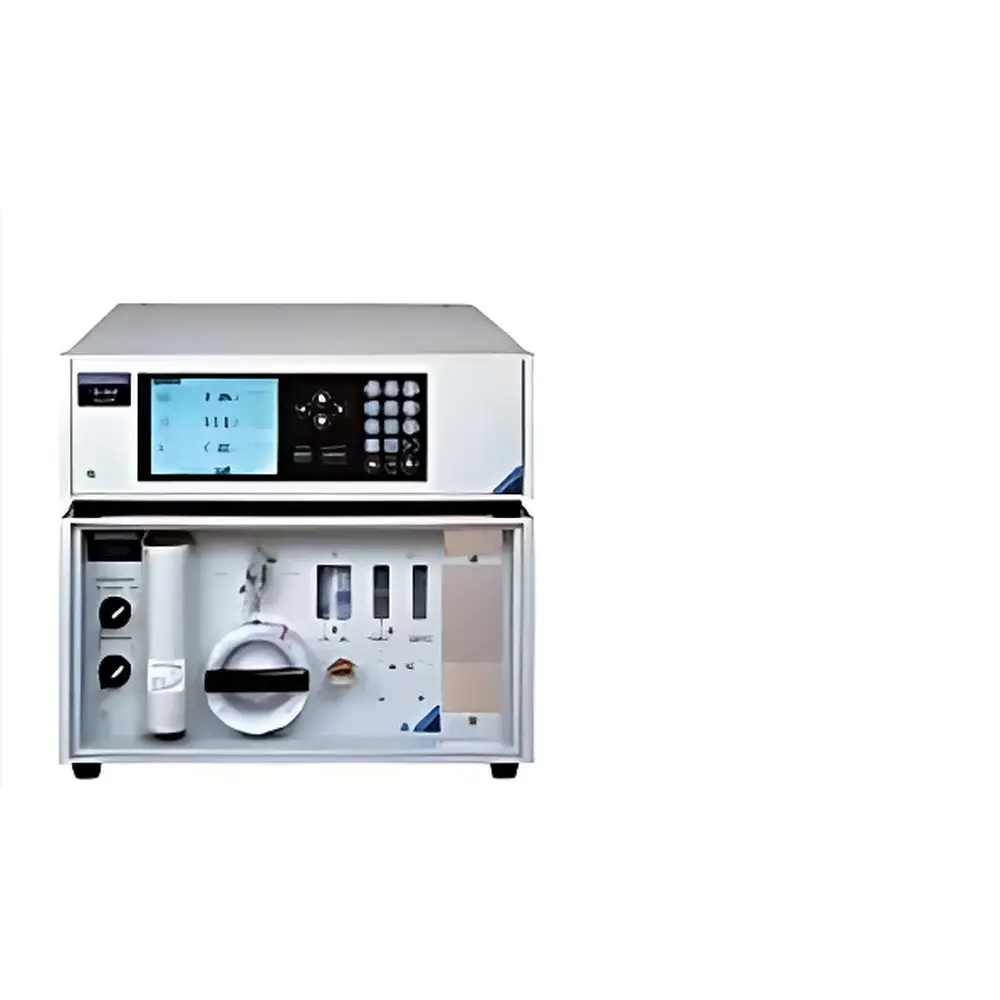
HORIBA VA-3000/VS-3000 Series NDIR & CLA-Based Multi-Gas Online Analyzer
| Brand | HORIBA |
|---|---|
| Origin | Japan |
| Model | VA-3000 / VS-3000 |
| Instrument Type | Online Gas Analyzer |
| Detection Principle | Non-Dispersive Infrared (NDIR) / Chemiluminescence (CLA) / Magnetic Pressure (MPA) / Electrochemical (Galvanic) / Zirconia Oxide |
| Detectable Gases | CO, CO₂, NOₓ, SO₂, CH₄, N₂O, C₂H₄, O₂ |
| Minimum Range | 1–5 ppm |
| Repeatability | ±0.5% FS |
| Linearity | ±1.0% FS (±1.5% FS for >10× span ratio) |
| Zero Drift | ±2.0% FS/week (±1.0% FS/day for galvanic O₂) |
| Span Drift | ±2.0% FS/week |
| Response Time | T₉₀ ≤ 30 s (single-component mode) |
| Resolution | 0.1 ppm |
| Analog Outputs | DC 0–1 V / 4–20 mA (optional) |
| Digital Interface | RS-232C |
| Sample Flow Rate | 0.5 L/min |
| Warm-up Time | 20–60 min (dependent on sensor type) |
| Operating Environment | 0–40 °C, RH < 90%, non-condensing |
| Power Supply | AC 100–120 V or 200–240 V, 50/60 Hz |
| Power Consumption | ~200 VA (VA-3000), ~250–450 VA (VS-3000 variants) |
| Enclosure | 19-inch rack-mount (430 × 132 × 550 mm, ~20 kg) |
Overview
The HORIBA VA-3000/VS-3000 Series is a modular, high-precision online gas analyzer engineered for continuous, multi-component measurement in environmental monitoring, industrial emissions control, energy research, and process safety applications. Built upon proven physical detection principles—including Non-Dispersive Infrared (NDIR) spectroscopy for CO, CO₂, CH₄, N₂O, and SO₂; Chemiluminescence Analysis (CLA) for NOₓ; Magnetic Pressure (MPA) for O₂; electrochemical (galvanic) cells; and zirconia-based potentiometric sensing—the system delivers trace-level accuracy across dynamically scalable concentration ranges. Its architecture supports up to three interchangeable sensor modules within a single 19-inch analyzer unit (VA-3000), enabling simultaneous or sequential analysis of up to eight target gases without cross-interference. The VA-3000 operates in conjunction with the VS-3000 series sampling subsystems—VS-3001 through VS-3004—which provide conditioned, dry, particle-free sample introduction via heated or ambient-path sampling lines compliant with ISO 12039, EN 15267, and EPA Method 6C/7E requirements. Designed for long-term unattended operation, the platform meets GLP-aligned data integrity expectations through hardware-stabilized optical paths, temperature-compensated detectors, and factory-calibrated span/zero references traceable to NIST-certified standards.
Key Features
- Modular sensor architecture: Supports NDIR, CLA, MPA, galvanic, and zirconia O₂ modules in any combination—up to three per VA-3000 chassis.
- Dynamic range flexibility: Configurable multi-segment full-scale ranges (e.g., 0–100 ppm to 0–100 vol% for CO₂); optional 20× span ratio on NDIR channels (subject to optical path length constraints).
- High metrological stability: Zero drift ≤ ±2.0% FS/week (±1.0% FS/day for galvanic O₂); repeatability ≤ ±0.5% FS; linearity ≤ ±1.0% FS within 10× span.
- Rapid response: T₉₀ ≤ 30 seconds for single-gas measurement under standard sample conditions (0.5 L/min, 25 °C, dry).
- Robust sampling interface: VS-3000 series units integrate PTFE/PVDF wetted materials, stainless steel manifolds, and integrated particulate filtration (<0.1 mg/m³), meeting IEC 61000-6-2 EMC and IP20 industrial enclosure requirements.
- Standard digital & analog I/O: RS-232C serial port for configuration and real-time data streaming; isolated or non-isolated 0–1 V and 4–20 mA outputs configurable per channel.
- Comprehensive warm-up management: Automatic thermal stabilization routines ensure stable baseline acquisition—20 minutes for NDIR/zirconia, 40–60 minutes for CLA/galvanic modules.
Sample Compatibility & Compliance
The VA-3000/VS-3000 system is validated for use with clean, dry, non-corrosive, non-explosive gas streams conforming to ISO 8573-1 Class 4 for particulates and ISO 8573-3 Class 3 for moisture (≤5 °C dew point). Sample gas must be free of H₂S, Cl₂, NH₃, HF, and other halogenated or sulfur-bearing compounds unless pre-conditioned via HORIBA-recommended catalytic scrubbers or thermal converters. For zirconia O₂ measurement, coexistence of H₂O and O₂ is mandatory when reducing gases (CO, H₂, THC) are present—per stoichiometric constraint: [THC] + [CO] + [H₂] < [H₂O] + [O₂]. All configurations comply with CE marking directives (2014/30/EU EMC, 2014/35/EU LVD), and support audit-ready operation under FDA 21 CFR Part 11 when paired with HORIBA’s optional secure logging software (not included). System design aligns with EN 14181 QAL1/QAL2 requirements for automated emission monitoring systems (CEMS).
Software & Data Management
While the VA-3000 operates autonomously via front-panel LCD (320 × 240 pixels) and push-button interface, it interfaces seamlessly with HORIBA’s proprietary PC-based configuration and data acquisition software (sold separately). This application enables remote parameter setup, multi-channel calibration scheduling, real-time trend visualization, and export of time-stamped CSV/Excel datasets with metadata (sensor ID, range, date/time, status flags). All analog outputs retain millivolt/mA linearity certified per IEC 61298-1, and digital communications follow ASCII protocol with checksum validation. For integration into SCADA or DCS environments, Modbus RTU over RS-232 (via optional converter) is supported. Audit trails—including calibration events, zero/span adjustments, and module swaps—are timestamped and stored internally for ≥30 days, satisfying basic GLP record retention criteria.
Applications
- Continuous emissions monitoring (CEMS) for combustion sources (boilers, incinerators, cement kilns) per EPA Performance Specification 2, EN 14181, and China HJ 75–2017.
- Biogas quality control in anaerobic digesters—simultaneous CH₄, CO₂, H₂S (via optional add-on), and O₂ quantification.
- Greenhouse gas flux studies (N₂O, CH₄, CO₂) in eddy covariance towers and soil chamber systems.
- Process gas analysis in hydrogen production, syngas conditioning, and fuel cell R&D labs.
- Indoor air quality (IAQ) and workplace exposure monitoring for CO, CO₂, and NO₂ in smart building BMS integrations.
- Calibration gas verification and reference standard generation in metrology laboratories.
FAQ
What detection technologies are integrated in the VA-3000 platform?
The VA-3000 accommodates five core analytical methods: NDIR (for CO, CO₂, CH₄, SO₂, N₂O), CLA (for NO, NO₂, total NOₓ), MPA (for O₂), galvanic electrochemical (for low-range O₂), and zirconia oxide (for high-temperature O₂). Module selection is user-configurable at time of order.
Can the same instrument measure both ppm-level NOₓ and %-level CO₂?
Yes—by installing a CLA module for NOₓ (0–20 ppm to 0–5000 ppm) and an NDIR module for CO₂ (0–100 ppm to 0–100 vol%), the VA-3000 achieves seamless dual-range operation without hardware modification.
Is automatic zero/span calibration supported?
Manual zero and span calibration using certified reference gases is standard. Optional auto-calibration manifolds (not included) can be integrated with external solenoid valves and gas cabinets for unattended periodic verification.
What sample conditioning is required upstream of the VS-3000?
A heated sample probe (optional), particulate filter (<0.1 µm), and refrigerated or permeation dryer (to ≤5 °C dew point) are strongly recommended. Acid gas removal (e.g., NaOH scrubber for SO₂/NO₂) may be needed depending on stack chemistry.
Does HORIBA provide application-specific pre-conditioning guidance?
Yes—HORIBA’s Application Engineering team offers free pre-installation consultation, including sampling system schematics, interference mitigation strategies, and compliance pathway mapping for regional regulatory frameworks (EU, US, CN, JP).







