
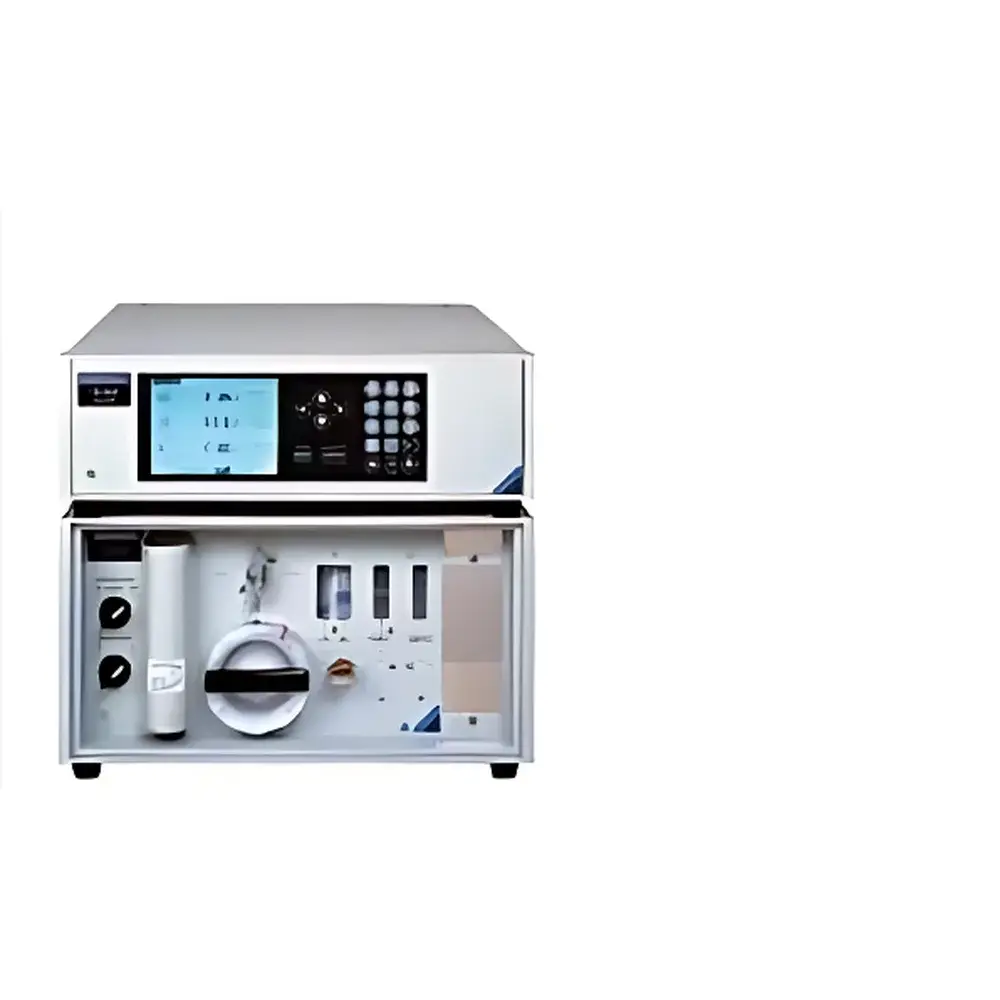
HORIBA VA-3000/VS-3000 Series NDIR & CLA Multi-Gas Analyzer
| Brand | HORIBA |
|---|---|
| Origin | Japan |
| Model | VA-3000 / VS-3000 |
| Instrument Type | Online Gas Analyzer |
| Detection Principle | Non-Dispersive Infrared (NDIR) and Chemiluminescence (CLA) |
| Target Gases | CO, CO₂, CH₄, NOₓ, SO₂, N₂O, O₂, C₂H₄ |
| Minimum Range | CH₄ 0–5 ppm |
| Repeatability | ±0.5% of Full Scale |
| Resolution | 0.01 ppm |
| Response Time | T₉₀ ≤ 30 s |
| Zero Drift | ±2.0% of Full Scale per week |
| Warm-up Time | ~20 min (NDIR), ~60 min (CLA/MPA) |
| Analog Output | 0–1 V DC or 4–20 mA (optional) |
| Communication Interface | RS-232C |
| Sample Flow Rate | 0.5 L/min |
| Operating Environment | 0–40 °C, RH ≤ 90% |
| Power Supply | AC 100–120 V or 200–240 V, 50/60 Hz |
| Dimensions (VA-3000) | 430 mm W × 132 mm H × 550 mm D |
| Weight (VA-3000) | ~20 kg |
| Enclosure | 19-inch rack-mountable chassis |
Overview
The HORIBA VA-3000/VS-3000 Series is a modular, online multi-gas analyzer engineered for high-precision, long-term stability in continuous environmental monitoring, industrial emissions compliance, and advanced energy research applications. Utilizing dual detection principles—Non-Dispersive Infrared (NDIR) spectroscopy for CO, CO₂, CH₄, SO₂, and N₂O, and Chemiluminescence Analysis (CLA) for NOₓ—the system delivers trace-level sensitivity with robust interference rejection. The VA-3000 serves as the analytical core unit, while the VS-3000 series (VS-3001 to VS-3004) provides configurable sampling conditioning—including heated/dry sample handling, particulate filtration, and corrosion-resistant flow paths using PTFE, PVDF, SUS, and FKM components—to meet stringent ISO 14644 cleanroom-compatible or EPA Method 6C/7E field-deployment requirements. Its architecture supports up to three interchangeable sensor modules within a single 19-inch rack-mount chassis, enabling flexible gas panel configuration without hardware duplication.
Key Features
- Modular Sensor Architecture: Supports simultaneous integration of up to three independent detection modules (NDIR, CLA, MPA, electrochemical O₂, or zirconia O₂) in one VA-3000 unit—reducing footprint, calibration overhead, and cross-channel interference.
- Wide Dynamic Range Capability: Programmable multi-range scaling allows coverage from sub-ppm (e.g., CH₄ 0–5 ppm) to percent-level (e.g., CO₂ 0–100 vol%) concentrations; optional extended range mode achieves up to 20× full-scale ratio for NDIR and 100× for CLA.
- High Metrological Stability: Certified repeatability of ±0.5% FS, linearity of ±1.0% FS (≤10× span), and zero/span drift of ≤±2.0% FS/week (NDIR/CLA/zirconia) or ≤±1.0% FS/day (electrochemical O₂), meeting ISO 12039 and EN 15267-3 performance criteria for certified CEMS.
- Low-Interference Design: NDIR optical path incorporates temperature-stabilized reference cells and dual-wavelength compensation; CLA module includes ozone generator optimization and NO₂ converter efficiency verification per EPA 40 CFR Part 60 Appendix A–4.
- Rugged Sampling Integration: VS-3000 sampling units offer dry-pump-free, 5°C dew-point-controlled extraction (VS-3001/3002) or catalytic conditioning (VS-3003/3004), compliant with ISO 8573-1 Class 2 particulate/moisture specifications.
- Regulatory-Ready Interfaces: Standard RS-232C serial port and analog outputs (0–1 V or 4–20 mA) support integration into SCADA, DCS, and EPA-certified data acquisition systems; optional software enables audit-trail logging compliant with FDA 21 CFR Part 11 and EU Annex 11.
Sample Compatibility & Compliance
The VA-3000/VS-3000 system accommodates complex sample matrices typical of flue gas, biogas, ambient air, landfill emissions, and hydrogen fuel cell exhaust. Sample conditioning meets ISO 14644-1 Class 5 particulate limits (<0.1 mg/m³), moisture control to 5°C saturation (VS-3001/3002) or 60°C saturation (VS-3003/3004), and pressure tolerance of ±980 Pa. Corrosion resistance is ensured via fluoropolymer (PTFE/PVDF) wetted parts and stainless-steel manifolds. For reducing gas environments (e.g., syngas containing CO/H₂), zirconia O₂ sensors require stoichiometric coexistence of H₂O and O₂ to prevent sensor degradation—validated per ASTM D6299 and IEC 62282-3-100. All configurations comply with CE marking (EMC Directive 2014/30/EU, LVD Directive 2014/35/EU) and are suitable for installation in Zone 2 hazardous locations when paired with approved barrier systems.
Software & Data Management
HORIBA’s proprietary GasLab™ software provides real-time concentration visualization, automated zero/span validation scheduling, drift correction algorithms, and multi-point calibration curve management. Data export supports CSV, Excel, and XML formats for integration with LIMS or enterprise analytics platforms. Audit trails record operator actions, calibration events, and parameter changes with time-stamped, user-authenticated entries—fully traceable for GLP/GMP and ISO/IEC 17025 accreditation. Optional OPC UA server enables secure, firewall-compliant connectivity to Industry 4.0 infrastructure. Firmware updates preserve measurement integrity through cryptographic signature verification and rollback-safe versioning.
Applications
- Continuous Emissions Monitoring Systems (CEMS) for thermal power plants, cement kilns, and waste incinerators per EPA PS-1/PS-2 and EN 14181 QAL1/QAL2 protocols.
- Biogas upgrading and landfill gas quality control (CH₄/CO₂/O₂/N₂O ratio optimization).
- Hydrogen production and fuel cell R&D—real-time CO and CO₂ impurity tracking at ppb–ppm levels.
- Indoor air quality (IAQ) and urban ambient monitoring networks requiring multi-pollutant correlation (NOₓ + O₃ + CO + CO₂).
- Pharmaceutical cleanroom environmental monitoring per ISO 14644-2 and USP .
- Automotive exhaust aftertreatment development (SCR, GPF, and three-way catalyst testing).
FAQ
What detection principles are used in the VA-3000/VS-3000 series?
The system combines Non-Dispersive Infrared (NDIR) absorption spectroscopy for CO, CO₂, CH₄, SO₂, and N₂O, and Chemiluminescence Analysis (CLA) for NO and NO₂. Optional modules include Magnetic Pressure Analysis (MPA), electrochemical, and zirconia-based O₂ sensing.
Can the analyzer measure NH₃ or C₂H₄?
NH₃ is not supported by standard NDIR or CLA modules due to spectral overlap and reactivity; C₂H₄ is detectable via NDIR but requires custom calibration and interference correction—consult HORIBA Application Engineering for feasibility assessment and method validation.
How is zero and span calibration performed?
Automated or manual calibration uses certified gas standards introduced via dedicated RC1/8 inlet ports. The system supports multi-point calibration curves and stores up to 10 calibration histories with timestamped metadata for regulatory reporting.
What are the warm-up time requirements for different sensor types?
NDIR modules stabilize in ~20 minutes; CLA and MPA require ~60 minutes; electrochemical O₂ sensors reach operational readiness in ~40 minutes; zirconia O₂ modules need ~20 minutes—verified per ISO 21258 Annex B.
Is the system compatible with EPA or EU regulatory reporting frameworks?
Yes. When configured with validated sampling (VS-3003/3004), certified calibration gases, and GasLab™ audit logging, the VA-3000/VS-3000 meets EPA Performance Specification 2 (PS-2) for NOₓ, PS-3 for SO₂, and EN 15267-3 for QAL1 certification under EU Industrial Emissions Directive (IED) 2010/75/EU.
Related Products







