
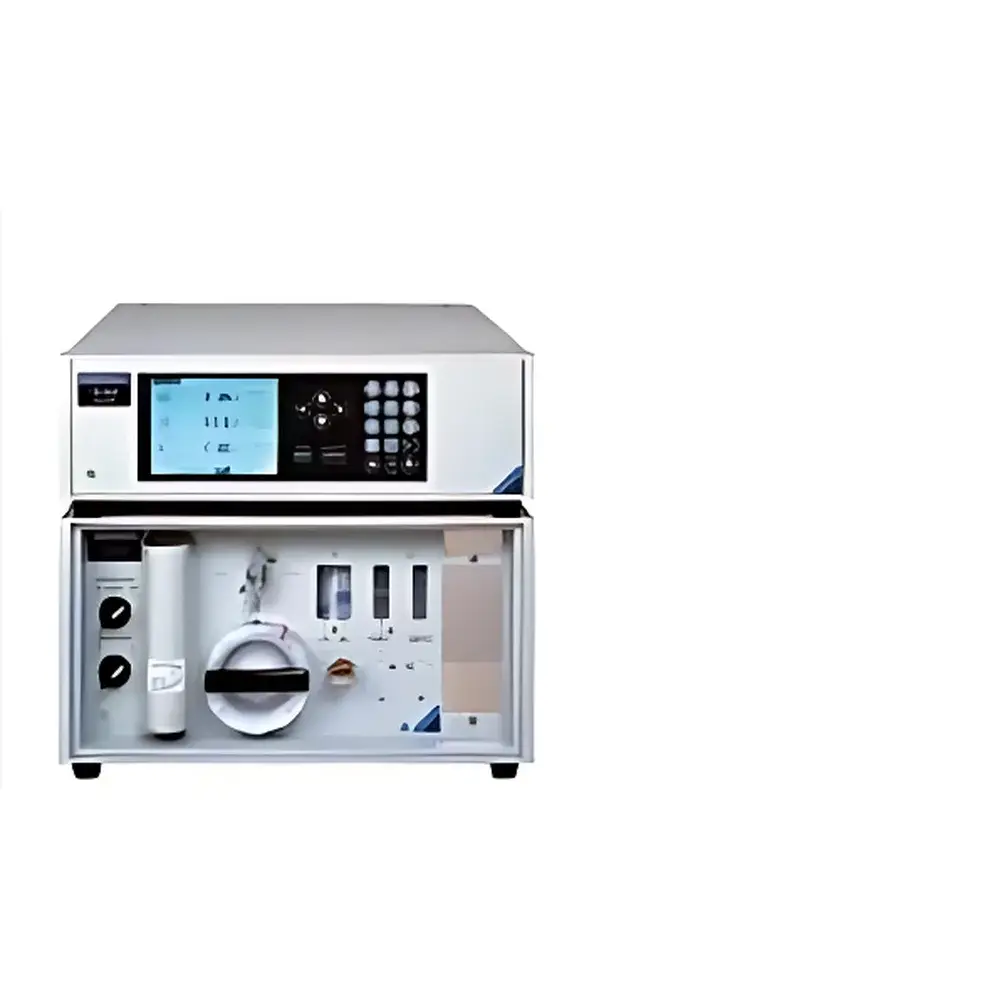
HORIBA VA-3000/VS-3000 Series NDIR & CLA Multi-Gas Analyzer
| Brand | HORIBA |
|---|---|
| Origin | Japan |
| Model | VA-3000 / VS-3000 |
| Instrument Type | Online Gas Analyzer |
| Detection Principle | Non-Dispersive Infrared (NDIR) and Chemiluminescence (CLA) |
| Target Gases | CO, CO₂, NOₓ, SO₂, CH₄, N₂O, C₂H₄, O₂ |
| Minimum Detectable Range | 1–5 ppm |
| Repeatability | ±0.5% of Full Scale |
| Resolution | 0.1 ppm |
| Response Time (T90) | ≤30 s |
| Zero Drift | ±2.0% of Full Scale per week |
| Warm-up Time | ~20 min (NDIR), ~60 min (CLA/MPA) |
| Analog Output | DC 0–1 V or 4–20 mA (optional) |
| Communication Interface | RS-232C |
| Sample Flow Rate | ~0.5 L/min |
| Operating Environment | 0–40 °C, ≤90% RH |
| Power Supply | AC 100–120 V or 200–240 V, 50/60 Hz |
| Dimensions (VA-3000) | 430 mm (W) × 132 mm (H) × 550 mm (D) |
| Weight | ~20 kg |
Overview
The HORIBA VA-3000/VS-3000 Series is a modular, online multi-gas analyzer engineered for high-precision, real-time measurement of trace and major gas components in environmental monitoring, industrial emissions control, energy research, and combustion process optimization. Utilizing dual detection principles—Non-Dispersive Infrared (NDIR) spectroscopy for CO, CO₂, CH₄, N₂O, SO₂, and C₂H₄, and Chemiluminescence Analysis (CLA) for NOₓ—the system delivers selective, interference-resistant quantification across wide dynamic concentration ranges. The VA-3000 analyzer unit accommodates up to three interchangeable sensor modules in a compact 19-inch rack-mount chassis, enabling flexible configuration for simultaneous or sequential analysis of up to three gas species. When paired with the VS-3000 series sampling interface (VS-3001 to VS-3004), the platform supports conditioned sample introduction—including heated, dry, and filtered flow paths—ensuring stability and accuracy under demanding field conditions. Designed and manufactured in Japan by HORIBA, a global leader in gas analysis since 1955, the VA/VS-3000 complies with foundational metrological requirements for continuous emission monitoring systems (CEMS) and laboratory-grade gas metrology.
Key Features
- Modular architecture supporting up to three independent sensor modules (NDIR, CLA, MPA, electrochemical, or zirconia O₂) in a single VA-3000 chassis
- Wide selectable measurement ranges: from sub-ppm (e.g., 0–20 ppm NO) to percent-level (e.g., 0–100 vol% CO₂), with up to 20× dynamic range expansion available via optional multi-module stacking
- High metrological performance: repeatability ±0.5% FS, linearity ±1.0% FS (≤10× span), zero drift ±2.0% FS/week (NDIR/CLA/zirconia), and response time T90 ≤30 s (single-component mode)
- Dedicated sampling interfaces (VS-3001–VS-3004) with corrosion-resistant wetted materials (SUS, PTFE, PVDF, FKM) and programmable flow control (0.5 L/min analytical flow, 1.5–5.0 L/min extraction)
- Integrated analog outputs (0–1 V, 4–20 mA) and RS-232C serial interface for direct integration into SCADA, DCS, or data acquisition systems
- Self-contained warm-up and stabilization protocols: <20 min for NDIR, ~60 min for CLA and magnetic pressure O₂ (MPA) modules
Sample Compatibility & Compliance
The VA/VS-3000 system is validated for use with clean, dry, non-corrosive, non-explosive sample streams meeting defined conditioning criteria: sample temperature within ambient range, moisture content ≤5 °C dew point, particulate loading 10 ppm CO), an optional catalyst module mitigates spectral interference. Oxygen measurement options include paramagnetic (MPA), electrochemical (fuel-cell), and zirconia cell technologies—each with distinct operational constraints regarding reducing gas exposure (e.g., CO/H₂ coexistence requires stoichiometric O₂/H₂O balance per ISO 14034 guidance). While not certified to EN 15267 or EPA PS-1/PS-2 out-of-the-box, the system’s design basis aligns with ISO 12039 (CO/CO₂), ISO 6974 (CH₄), ISO 11568 (NOₓ), and ASTM D6522 (chemiluminescent NOₓ), facilitating third-party validation for regulatory CEMS applications.
Software & Data Management
The VA-3000 operates without proprietary operating system dependencies and communicates via ASCII-based RS-232C protocol using standard command-response syntax (e.g., “READ?”, “ZERO”, “SPAN”). Raw analog outputs enable direct connection to PLCs or chart recorders, while HORIBA-supplied PC software (Windows-compatible, no runtime license required) provides time-stamped data logging, calibration history tracking, and basic trend visualization. All calibration events—including zero/span adjustments and manual verification points—are timestamped and stored in non-volatile memory. Though native 21 CFR Part 11 compliance is not embedded, the system supports external audit-trail solutions via serial log capture and can be integrated into GLP/GMP-aligned workflows when deployed with validated instrument qualification (IQ/OQ/PQ) documentation and change-controlled calibration procedures.
Applications
- Continuous emissions monitoring (CEMS) at thermal power plants, waste incinerators, and cement kilns
- Biogas composition analysis (CH₄, CO₂, H₂S*, O₂, H₂) in anaerobic digestion facilities (*requires optional H₂S module)
- Automotive exhaust R&D—transient NOₓ, CO, and CO₂ profiling during engine dynamometer testing
- Indoor air quality (IAQ) and cleanroom monitoring for CO, CO₂, and N₂O in healthcare and semiconductor fabrication
- Fugitive emission detection and leak quantification in petrochemical and LNG infrastructure
- Carbon capture utilization and storage (CCUS) process stream verification (CO₂ purity >99%, trace impurity screening)
FAQ
What detection principles are used for different gases?
CO, CO₂, CH₄, N₂O, SO₂, and C₂H₄ are measured by NDIR absorption at characteristic mid-infrared wavelengths; NO and NO₂ are quantified via CLA following catalytic conversion; O₂ is determined by paramagnetic (MPA), electrochemical, or zirconia-based sensing depending on module selection.
Can the same VA-3000 unit measure both low-ppm and high-% concentrations simultaneously?
Yes—by installing multiple modules of the same technology (e.g., two NDIR CO modules with 0–100 ppm and 0–25 vol% ranges), the system achieves seamless auto-ranging across up to five decades of concentration, subject to optical path length and detector saturation limits.
Is the system suitable for unattended operation in outdoor enclosures?
When installed in climate-controlled cabinets (0–40 °C, ≤90% RH, vibration-isolated), with VS-3000 sampling hardware configured for heated sample lines and particulate filtration, the VA/VS-3000 meets IEC 61326-1 immunity requirements for industrial environments.
How is calibration performed and how often is it required?
Zero calibration uses certified N₂ or synthetic air; span calibration employs traceable gas standards (e.g., NO in N₂, CO₂ in air). Under stable conditions, zero checks every 24 h and full span verification weekly are recommended per ISO 17025 and EPA Method 205 guidelines.
Does HORIBA provide application support for complex gas matrices?
Yes—HORIBA’s Application Engineering team offers pre-installation gas matrix assessment, sample conditioning schematics, interference mitigation strategies (e.g., scrubber trains, catalytic converters), and method-specific validation protocols aligned with ISO/IEC 17025 laboratory accreditation frameworks.







