
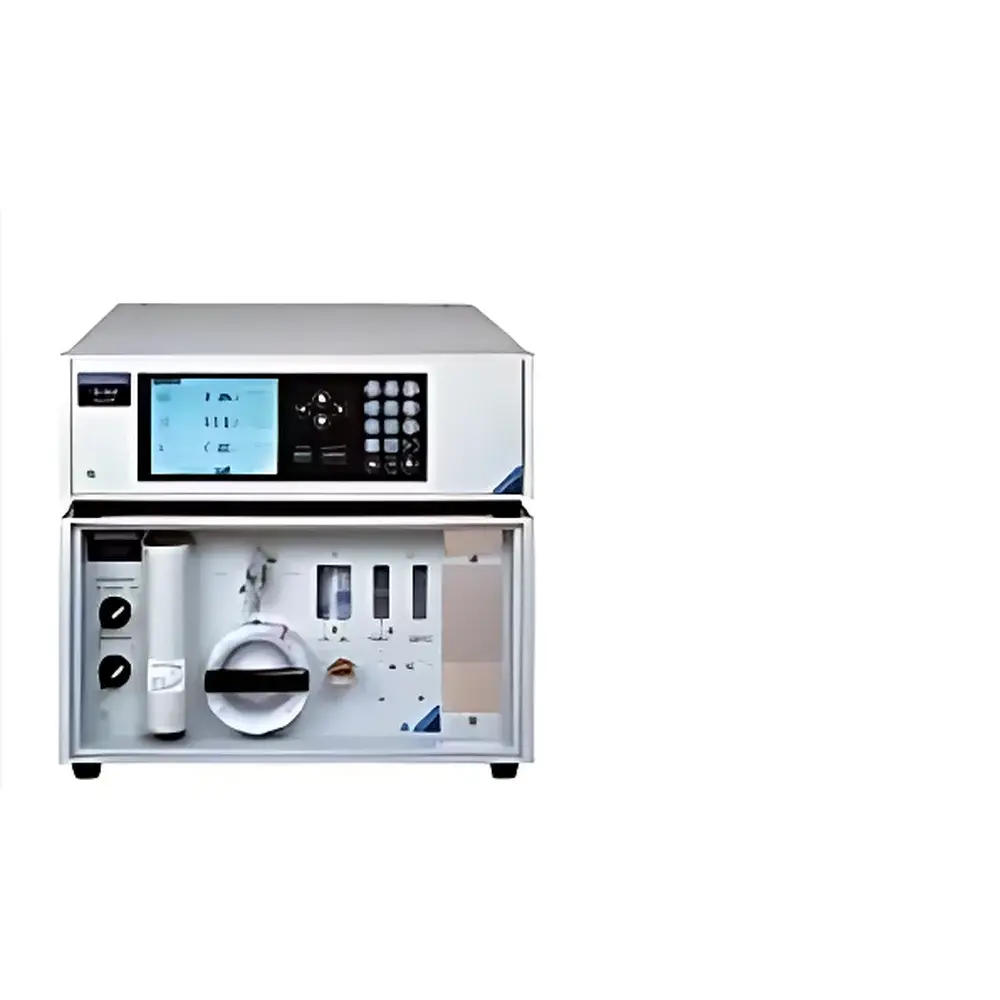
HORIBA VA-3000/VS-3000 Series NDIR & CLA Multi-Gas Analyzer
| Brand | HORIBA |
|---|---|
| Origin | Japan |
| Model | VA-3000 / VS-3000 |
| Instrument Type | Online Gas Analyzer |
| Detection Principle | Non-Dispersive Infrared (NDIR) and Chemiluminescence (CLA) |
| Measurable Gases | CO, CO₂, NOₓ, SO₂, CH₄, N₂O, C₂H₄, O₂ |
| Minimum Detectable Range | 1–5 ppm |
| Repeatability | ±0.5% of Full Scale |
| Resolution | 0.1 ppm |
| Response Time (T90) | ≤30 s |
| Zero Drift | ±2.0 ppm per week (NDIR/CLA), ±1.0% per day (electrochemical O₂) |
Overview
The HORIBA VA-3000/VS-3000 Series is a modular, high-precision online multi-gas analyzer engineered for continuous emission monitoring (CEM), environmental air quality surveillance, industrial process control, and research-grade gas quantification. It integrates two complementary analytical principles—Non-Dispersive Infrared (NDIR) spectroscopy for CO, CO₂, CH₄, N₂O, SO₂, and C₂H₄; and Chemiluminescence Analysis (CLA) for NOₓ—with optional paramagnetic (MPA), electrochemical (fuel cell), or zirconia-based detection for O₂. This hybrid architecture enables simultaneous, independent measurement of up to three gas components within a single 19-inch rack-mount chassis (VA-3000), while the companion VS-3000 series sampling system provides conditioned, stable sample delivery across diverse operational environments—from stack gas ducts to ambient air stations.
Designed for long-term stability and regulatory compliance, the VA-3000 meets foundational performance criteria aligned with ISO 12039 (CO/CO₂ in flue gas), EN 15267 (QAL1 certification framework), and US EPA Method 10/3A/7E. Its optical path design minimizes cross-sensitivity through spectral filtering and temperature-stabilized detectors, while dual-beam referencing compensates for lamp aging and window fouling—critical for unattended operation over extended intervals.
Key Features
- Modular sensor architecture: Up to three independent detection modules (NDIR, CLA, MPA, electrochemical, or zirconia) can be installed in one VA-3000 analyzer unit—enabling customizable multi-component configurations without external multiplexing.
- Dynamic range flexibility: NDIR channels support up to 4 programmable span ranges per gas (e.g., 0–100 ppm, 0–1,000 ppm, 0–5,000 ppm, 0–100 vol%); CLA offers up to 8 selectable spans with maximum ratio of 100:1, ensuring accurate quantification from trace to percent-level concentrations.
- High metrological integrity: Repeatability ≤ ±0.5% FS, linearity ≤ ±1.0% FS (within 10× span), zero drift ≤ ±2.0 ppm/week (NDIR/CLA), and response time T90 ≤ 30 s (from sample inlet).
- Robust sample conditioning: The VS-3000 sampling manifold delivers precise flow control (0.5 L/min to analyzer), integrated particulate filtration (<0.1 mg/m³), dew point management (≤5 °C saturation), and corrosion-resistant wetted materials (SUS316L, PTFE, PVDF, FKM).
- Comprehensive connectivity: Standard RS-232C interface; optional 4–20 mA analog outputs (non-isolated); digital communication supports MODBUS RTU and custom ASCII protocols for integration into SCADA, DCS, or LIMS platforms.
- Regulatory-ready diagnostics: Built-in self-test routines, calibration log tracking, and event-triggered data stamping support GLP/GMP audit trails and 21 CFR Part 11-compliant data integrity workflows when paired with HORIBA’s certified software suite.
Sample Compatibility & Compliance
The VA-3000/VS-3000 system is validated for use with clean, dry, non-corrosive, non-explosive sample streams meeting defined physicochemical constraints: sample temperature = ambient; moisture content ≤ 5 °C dew point; particulate loading < 0.1 mg/m³; absolute pressure variation ≤ ±980 Pa; absence of H₂S, Cl₂, NH₃, HF, or halogenated hydrocarbons unless specified with optional catalytic scrubbers. For O₂ measurement via zirconia or electrochemical cells, coexistence of H₂O and O₂ must satisfy the thermodynamic constraint: [THC] + [CO] + [H₂] < [H₂O] + [O₂], to prevent sensor poisoning or erroneous low readings. All configurations comply with IEC 61000-6-2/6-4 (EMC), UL 61010-1 (safety), and CE marking requirements for industrial instrumentation.
Software & Data Management
HORIBA’s proprietary WinGAS software provides full instrument configuration, real-time waveform visualization, multi-point calibration management, and automated report generation (PDF/CSV). It enforces user role-based access control (admin/operator), maintains immutable audit logs for all parameter changes and calibration events, and supports electronic signatures per FDA 21 CFR Part 11 Annex 11 guidelines. Raw analog outputs and serial data streams are timestamped with millisecond resolution and synchronized to UTC via NTP-compatible clock sources. Data export includes configurable averaging intervals (1 s to 1 h), spike rejection filters, and linearization coefficients traceable to NIST-traceable reference standards.
Applications
- Continuous Emission Monitoring Systems (CEMS) for thermal power plants, cement kilns, and waste incinerators—compliant with EU Directive 2010/75/EU (IED) and US EPA 40 CFR Part 60 Subpart Da/Db.
- Ambient air quality networks measuring urban CO, NO₂, and CH₄ under national monitoring programs (e.g., China’s CNEMC, U.S. EPA AQS).
- Biogas upgrading facilities requiring simultaneous CH₄/CO₂/O₂ analysis for membrane separation efficiency optimization.
- Automotive R&D labs performing exhaust aftertreatment catalyst evaluation using fast-response NOₓ and CO dynamics.
- Pharmaceutical cleanroom environmental monitoring where low-level CO and CO₂ serve as indicators of HVAC integrity and occupancy patterns.
FAQ
What gases can be measured simultaneously in one VA-3000 unit?
Up to three gases may be measured concurrently—selected from CO, CO₂, NOₓ, SO₂, CH₄, N₂O, C₂H₄, and O₂—depending on the combination of installed sensor modules.
Is calibration required before each measurement cycle?
No. The VA-3000 supports scheduled automatic zero/span checks using external calibration gas ports; manual calibration is only required during initial setup or after maintenance.
Can the system measure NH₃ or H₂S?
Not natively. NH₃ and H₂S require specialized electrochemical or tunable diode laser (TDLAS) modules; consult HORIBA Application Engineering for custom integration pathways.
What is the warm-up time for full specification accuracy?
NDIR modules achieve thermal equilibrium in ~20 minutes; CLA requires ~60 minutes; electrochemical O₂ sensors stabilize within ~40 minutes.
How does the system handle interference from water vapor or CO₂ in NOₓ measurement?
The CLA module includes a built-in NO₂-to-NO converter and ozone generator with selective scrubbing to eliminate quenching effects; optional Nafion dryers and CO₂ removal cartridges are available in the VS-3000 sampling train.
Related Products







