
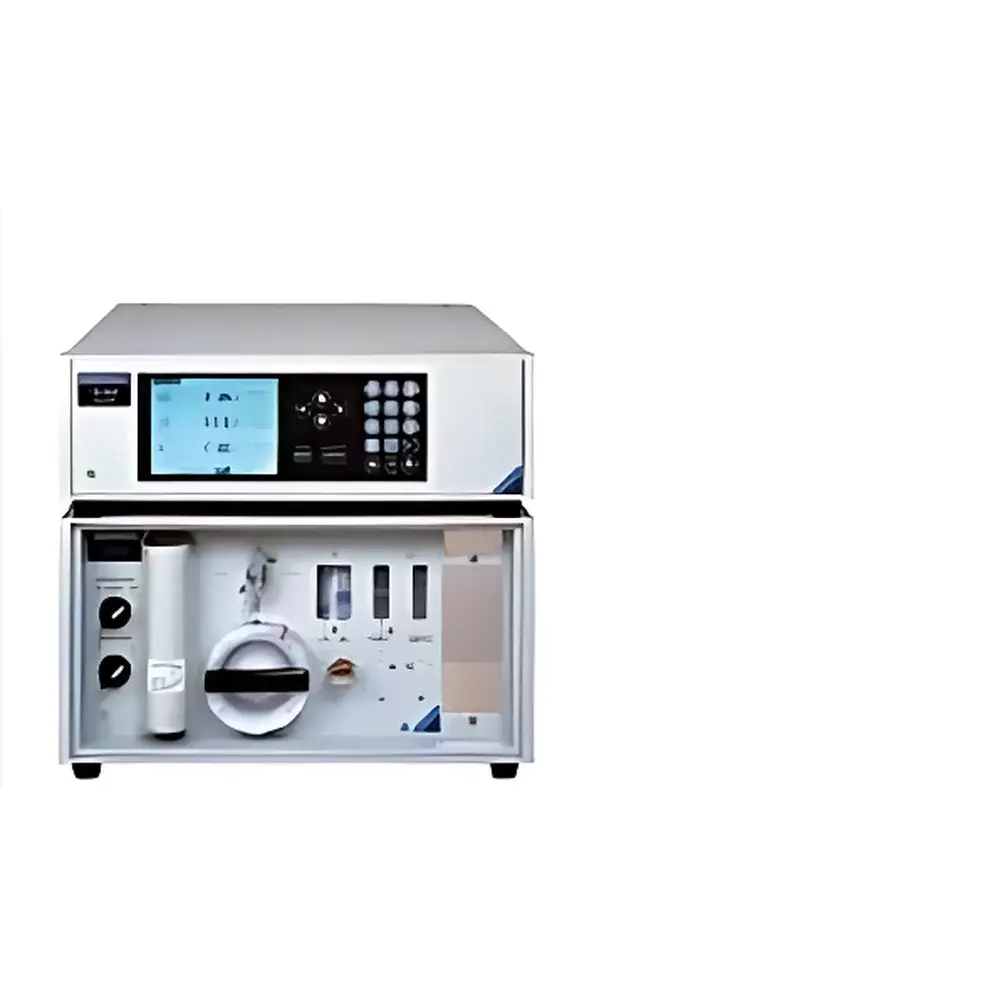
HORIBA VA-3000 / VS-3000 Series NDIR & CLA Multi-Gas Analyzer
| Brand | HORIBA |
|---|---|
| Origin | Japan |
| Model | VA-3000 / VS-3000 |
| Instrument Type | In-situ Continuous Emission Monitoring (CEM) System |
| Detection Principle | Non-Dispersive Infrared (NDIR), Chemiluminescence (CLA), Magnetic Pressure (MPA), Electrochemical (Galvanic), Zirconia Oxide |
| Target Gases | CO, CO₂, NOₓ, SO₂, CH₄, N₂O, C₂H₄, O₂ |
| Minimum Detectable Range | 1–5 ppm |
| Repeatability | ±0.5% FS |
| Linearity | ±1.0% FS (≤10× span) |
| Zero Drift | ±2.0% FS/week (NDIR/CLA/MPA/ZrO₂) |
| Span Drift | ±2.0% FS/week (NDIR/CLA/MPA/ZrO₂) |
| Response Time | T₉₀ ≤ 30 s (single-component mode, from analyzer inlet) |
| Resolution | 0.1 ppm (for ppm-range gases) |
| Analog Outputs | DC 0–1 V (non-isolated), DC 4–20 mA (optional) |
| Digital Interface | RS-232C |
| Sample Flow Rate | 0.5 L/min (analyzer) |
| Operating Temperature | 0–40 °C |
| Relative Humidity | ≤90% RH (non-condensing) |
| Power Supply | AC 100–120 V or 200–240 V, 50/60 Hz |
| Power Consumption | ~200 VA (VA-3000) |
| Dimensions (VA-3000) | 430 mm W × 132 mm H × 550 mm D |
| Weight (VA-3000) | ~20 kg |
| Enclosure | 19-inch rack-mountable chassis |
Overview
The HORIBA VA-3000 / VS-3000 Series is a modular, multi-technology gas analysis platform engineered for continuous, high-reliability measurement of trace and major gaseous components in industrial emissions, ambient air, combustion processes, and energy research applications. Built upon HORIBA’s decades of expertise in optical and electrochemical gas sensing, the system integrates multiple detection principles—including Non-Dispersive Infrared (NDIR) spectroscopy for CO, CO₂, CH₄, N₂O, and SO₂; Chemiluminescence Analysis (CLA) for NOₓ; Magnetic Pressure (MPA) and electrochemical (galvanic or zirconia-based) methods for O₂—within a single, compact 19-inch rack-mountable architecture. The VA-3000 analyzer unit accommodates up to three interchangeable sensor modules, enabling simultaneous or sequential monitoring of up to six independent gas species without cross-interference. Its design prioritizes long-term stability, minimal maintenance, and compliance with international regulatory frameworks governing emission reporting and environmental quality assessment.
Key Features
- Modular sensor architecture: Supports up to three independently configurable modules—NDIR (CO, CO₂, CH₄, N₂O, SO₂), CLA (NO, NO₂, NOₓ), MPA (O₂), galvanic cell (O₂), or zirconia oxide (O₂)—in one chassis.
- Wide dynamic range capability: Programmable multi-span configuration allows coverage from sub-ppm (e.g., 1–5 ppm for CO) to percent-level concentrations (e.g., 0–100 vol% for CO₂ or CH₄), with optional extended range ratios up to 20:1 (NDIR) or 100:1 (CLA).
- High metrological performance: Repeatability of ±0.5% Full Scale (FS), linearity of ±1.0% FS (≤10× span), and zero/span drift stability of ≤±2.0% FS/week for NDIR/CLA/MPA/zirconia sensors—meeting stringent requirements for EPA Method 10, EN 15267, and ISO 12039 validation protocols.
- Robust sample conditioning integration: The companion VS-3000 series sampling units (VS-3001–VS-3004) provide temperature-controlled, dry sampling (dew point ≤5 °C), particulate filtration (<0.1 mg/m³), and corrosion-resistant wetted materials (SUS, PTFE, PVDF, FKM) compatible with flue gas, biogas, and syngas streams.
- Standardized digital and analog I/O: RS-232C serial interface for bidirectional communication and remote configuration; dual analog outputs (0–1 V and optional 4–20 mA) support seamless integration into DCS, SCADA, and PLC-based monitoring infrastructures.
- Low warm-up time and operational readiness: NDIR and zirconia modules achieve stable operation within 20 minutes; CLA and MPA modules require ≤60 minutes—optimized for unattended, 24/7 deployment in CEM and QA/QC environments.
Sample Compatibility & Compliance
The VA-3000/VS-3000 system is validated for use with clean, dry, non-corrosive, non-explosive sample streams meeting defined physical and chemical constraints: sample temperature at ambient conditions; moisture content ≤5 °C dew point (VS-3000 dry sampling ensures this); particulate loading 50 ppm), NO₂ (>6 ppm), halogens, or reactive hydrocarbons exceeding stoichiometric thresholds (e.g., THC + CO + H₂ < H₂O + O₂ for zirconia O₂ sensors). It conforms to key regulatory and quality standards including ISO/IEC 17025 for testing laboratories, EN 14181 for automated measuring systems, and supports audit-ready data integrity under FDA 21 CFR Part 11 when paired with validated third-party data acquisition software. Optional catalyst units are available for N₂O measurement in CO-rich environments.
Software & Data Management
While the VA-3000 operates as a standalone hardware analyzer with local LCD display (320 × 240 pixels), its RS-232C interface enables full parameter control, real-time data logging, and calibration event tracking via HORIBA-supplied PC software or user-developed applications. The system outputs timestamped concentration values, status flags (e.g., fault codes, flow alarm), and diagnostic metrics (lamp intensity, detector signal-to-noise ratio, zero/span check results). All analog and digital outputs retain traceability to NIST-traceable calibration gases. When deployed in regulated environments (e.g., power plant CEMS, waste incineration facilities), the platform supports GLP/GMP-compliant audit trails—including operator ID, calibration date/time, standard gas lot number, and before/after calibration verification reports—when integrated with validated data historians.
Applications
- Continuous Emission Monitoring (CEM) for thermal power plants, cement kilns, and steel furnaces—measuring CO, NOₓ, SO₂, CO₂, and O₂ per EU Directive 2010/75/EU and U.S. EPA 40 CFR Part 60.
- Biogas and landfill gas quality control—simultaneous quantification of CH₄, CO₂, H₂S (via optional sensor), O₂, and trace siloxanes (with pre-concentration module).
- R&D in carbon capture and utilization (CCU), hydrogen combustion, and synthetic fuel synthesis—where precise stoichiometric O₂, CO, and CO₂ feedback is critical for reactor optimization.
- Ambient air quality networks requiring low-ppm NOₓ, CO, and N₂O detection with high inter-laboratory reproducibility (compliant with WHO and EU Air Quality Directive 2008/50/EC).
- Pharmaceutical and semiconductor cleanroom monitoring—verifying inert gas purity (N₂, Ar) and detecting ppm-level CO or CH₄ leaks in controlled atmospheres.
FAQ
What detection technologies are supported in the VA-3000 platform?
NDIR (for CO, CO₂, CH₄, N₂O, SO₂), CLA (for NO, NO₂, NOₓ), MPA (for O₂), galvanic electrochemical (for low-range O₂), and zirconia oxide (for high-temperature or wide-range O₂).
Can the same VA-3000 unit measure both CO and NOₓ simultaneously?
Yes—by installing one NDIR module (CO) and one CLA module (NOₓ) in the same chassis, with independent optical paths and signal processing.
Is automatic zero/span calibration supported?
The system accepts external zero (N₂ or synthetic air) and span (certified gas mixture) inputs via dedicated RC1/8 fittings; automated sequence execution requires external solenoid valve manifold and controller.
What is the maximum allowable H₂ concentration when using the zirconia O₂ sensor?
Total reducing gas load (CO + H₂ + THC) must satisfy the thermodynamic constraint: CO + H₂ + THC < H₂O + O₂; typical safe limits are CO ≤5000 ppm and H₂ ≤1000 ppm in the sample stream.
Does HORIBA provide application-specific pre-conditioning guidance?
Yes—HORIBA’s Application Engineering team offers detailed sample handling schematics, filter selection matrices, condensate trap configurations, and interference mitigation strategies tailored to source-specific gas matrices (e.g., biomass boiler flue gas, anaerobic digester biogas, or catalytic reformer off-gas).







