
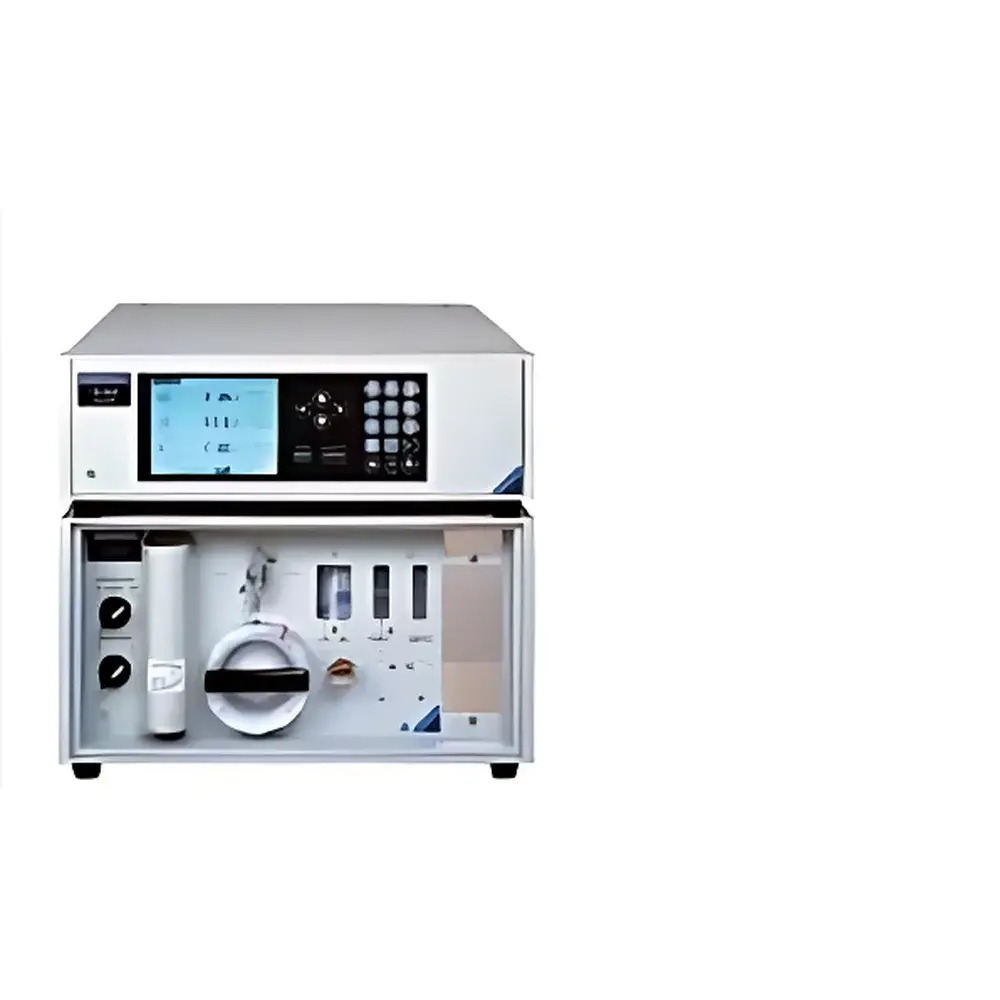
HORIBA VA-3000/VS-3000 Series NDIR & CLA Multi-Gas Continuous Emission Monitoring Analyzer
| Brand | HORIBA |
|---|---|
| Origin | Japan |
| Model | VA-3000/VS-3000 Series |
| Instrument Type | In-situ Continuous Analyzer |
| Detection Principle | Non-Dispersive Infrared (NDIR), Chemiluminescence (CLA), Magnetic Pressure (MPA), Electrochemical (Galvanic), Zirconia |
| Target Gases | CO, CO₂, NOₓ, SO₂, CH₄, N₂O, C₂H₄, O₂ |
| Minimum Detectable Range | 1–5 ppm |
| Repeatability | ±0.5% of Full Scale |
| Resolution | 0.1 ppm |
| Response Time (T90) | ≤30 s |
| Zero Drift | ±2.0% of Full Scale per Week |
| Analog Outputs | DC 0–1 V / 4–20 mA (optional) |
| Digital Interface | RS-232C |
| Operating Temperature | 0–40 °C |
| Power Supply | AC 100–120 V or 200–240 V, 50/60 Hz |
| Warm-up Time | 20–60 min (dependent on sensor type) |
| Sample Flow Rate | 0.5 L/min (analysis unit) |
Overview
The HORIBA VA-3000/VS-3000 Series is a modular, multi-technology continuous gas emission monitoring system engineered for precision, long-term stability, and operational flexibility in environmental compliance, industrial process control, and research-grade atmospheric analysis. Built upon HORIBA’s decades of expertise in optical and electrochemical gas sensing, the system integrates multiple detection principles—including Non-Dispersive Infrared (NDIR), Chemiluminescence (CLA), Magnetic Pressure (MPA), Galvanic Electrochemical, and Zirconia-based oxygen measurement—within a single 19-inch rack-mountable architecture. Each VA-3000 analyzer unit accommodates up to three interchangeable sensor modules, enabling simultaneous or sequential quantification of up to eight regulated gases (CO, CO₂, NOₓ, SO₂, CH₄, N₂O, C₂H₄, O₂) without cross-interference. The system operates on the fundamental physical principles of molecular absorption spectroscopy (NDIR), light-emission kinetics (CLA), magnetic susceptibility (MPA), and ion-conductive solid electrolyte behavior (zirconia), ensuring traceable, physics-based measurement integrity. Designed for regulatory-grade deployment, it meets functional requirements aligned with EPA Method 10, EN 15267, ISO 12039, and supports audit-ready data acquisition under GLP/GMP frameworks.
Key Features
- Modular sensor architecture: Supports up to three independently configurable modules per VA-3000 unit—enabling mixed-technology configurations (e.g., NDIR for CO/CO₂ + CLA for NOₓ + zirconia for O₂).
- Wide dynamic range capability: Programmable multi-range scaling (up to 4–8 segments per gas); optional extended dynamic range (up to 20× full-scale ratio for NDIR, 100× for CLA) via hardware configuration and calibration strategy.
- High metrological performance: Repeatability ±0.5% FS, linearity ±1.0% FS (≤10× range), zero drift ±2.0% FS/week (NDIR/CLA/MPA/zirconia), and ±1.0% FS/day for galvanic O₂ sensors.
- Fast response & low maintenance: T90 ≤ 30 s from sample inlet; warm-up time as low as 20 min (NDIR/zirconia) to 60 min (CLA/galvanic); no consumables required for NDIR or zirconia modules.
- Ruggedized sampling interface: VS-3000 series sampling units (VS-3001 to VS-3004) feature chemically resistant wetted materials (SUS316L, PTFE, PVDF, FKM), heated dry sampling (<5 °C dew point), and integrated particulate filtration (<0.1 mg/m³).
- Regulatory-compliant I/O: Standard RS-232C serial port; optional isolated 4–20 mA analog outputs; digital signal integrity maintained per IEC 61000-4 EMC standards.
Sample Compatibility & Compliance
The VA-3000/VS-3000 system is validated for use with clean, dry, non-corrosive, non-explosive sample streams meeting strict conditioning criteria: sample temperature within ambient range (0–40 °C), H₂O saturation ≤5 °C dew point, particulate load 50 ppm), NO₂ (>6 ppm), halogens, or reducing gas mixtures violating the stoichiometric constraint (THC + CO + H₂ < H₂O + O₂). For zirconia O₂ measurement, coexistence of H₂O and O₂ is mandatory to prevent sensor degradation. All configurations comply with CE marking directives (2014/30/EU, 2014/35/EU) and support traceable calibration per ISO/IEC 17025-accredited laboratories. Data handling protocols align with FDA 21 CFR Part 11 requirements when paired with HORIBA’s optional secure software suite, including electronic signatures, audit trails, and user-access controls.
Software & Data Management
The system interfaces natively with HORIBA’s proprietary Gas Analysis Software (GAS-Link™), a Windows-based application supporting real-time waveform visualization, multi-channel trend logging, automatic zero/span validation scheduling, and CSV/Excel export with timestamped metadata. GAS-Link™ implements ALARM logic for out-of-specification events, stores full calibration history with operator ID and certificate references, and generates automated compliance reports compliant with EU Directive 2010/75/EU (IED) and U.S. EPA 40 CFR Part 60 Appendix B. Optional OPC UA server integration enables seamless connection to DCS/SCADA platforms (e.g., Siemens PCS7, Emerson DeltaV) without proprietary middleware. All firmware updates are digitally signed and version-locked to ensure configuration integrity during field servicing.
Applications
- Continuous Emission Monitoring Systems (CEMS) for thermal power plants, cement kilns, waste incinerators, and chemical manufacturing facilities.
- Urban air quality monitoring networks requiring simultaneous CO, NOₓ, SO₂, and O₃ precursor (CH₄, C₂H₄) quantification.
- R&D laboratories studying catalytic converter efficiency, combustion kinetics, biogas composition, and greenhouse gas fluxes (N₂O, CH₄).
- Industrial hygiene and workplace safety programs tracking CO exposure limits in confined spaces or tunnel ventilation systems.
- Carbon capture utilization and storage (CCUS) pilot sites requiring high-accuracy CO₂ purity verification at >99.9% v/v levels.
- Calibration gas production facilities performing gravimetric certification of multi-component reference standards.
FAQ
What detection technologies are supported in a single VA-3000 unit?
The VA-3000 supports up to three independent modules using NDIR, CLA, MPA, galvanic electrochemical, or zirconia O₂ sensing—configurable in any combination.
Can the system measure NH₃ or H₂S?
NH₃ and H₂S are not supported by standard modules; custom sensor development or third-party integration may be arranged under NDA with HORIBA Engineering Support.
How is zero drift compensated during unattended operation?
Automated zero calibration cycles can be scheduled daily or weekly using certified zero gas; drift correction algorithms apply linear compensation based on historical baseline tracking.
Is explosion-proof certification available?
The base VA-3000/VS-3000 is rated for general-purpose indoor use (IP20); ATEX/IECEx-certified variants require external purge enclosures or zone-specific sampling probe integration.
What sample conditioning is required upstream of the VS-3000?
A dedicated sample probe with thermoelectric cooler, particulate filter (0.3 µm), and acid-gas scrubber (for SO₂/NO₂-rich streams) is recommended; HORIBA provides detailed pre-conditioning schematics per application profile.
Related Products







