
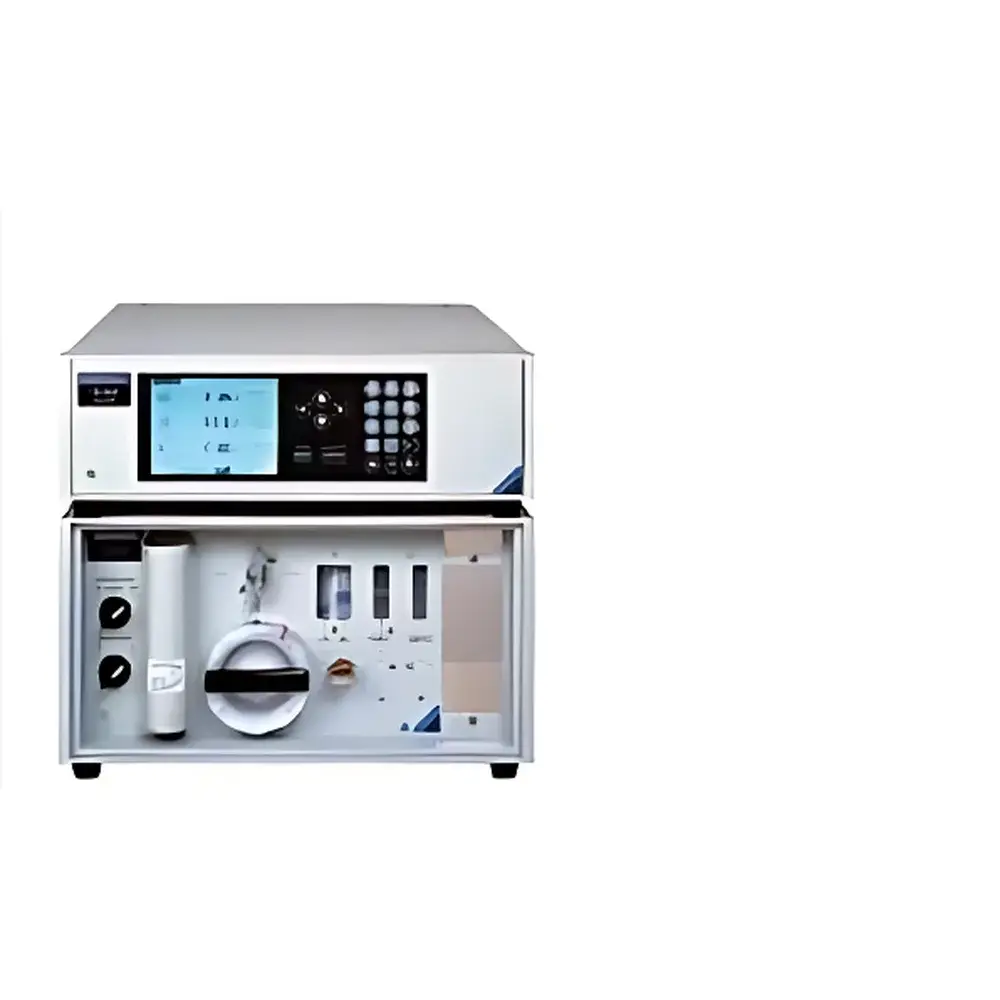
HORIBA VA-3000/VS-3000 Series NDIR & CLA Multi-Gas Online Infrared Gas Analyzer
| Brand | HORIBA |
|---|---|
| Origin | Japan |
| Model | VA-3000 / VS-3000 |
| Instrument Type | Online Analyzer |
| Detection Principle | Non-Dispersive Infrared (NDIR) / Chemiluminescence (CLA) / Magnetic Pressure (MPA) / Electrochemical (Galvanic Cell) / Zirconia Oxide (ZrO₂) |
| Target Gases | CO, CO₂, NOₓ, SO₂, CH₄, N₂O, C₂H₄, O₂ |
| Minimum Range | 1–5 ppm |
| Repeatability | ±0.5% of Full Scale (F.S.) |
| Resolution | 0.1 ppm |
| Response Time | T90 ≤ 30 s |
| Zero Drift | ±2.0% F.S./week |
| Warm-up Time | 20–60 min (gas-specific) |
| Analog Output | 0–1 V DC / 4–20 mA (non-isolated, optional) |
| Communication Interface | RS-232C |
| Sample Flow Rate | ~0.5 L/min |
| Operating Environment | 0–40 °C, ≤90% RH |
| Power Supply | AC 100–120 V or 200–240 V, 50/60 Hz |
| Weight | ~20 kg (VA-3000), ~14–20 kg (VS-3001–VS-3004) |
Overview
The HORIBA VA-3000/VS-3000 Series is a modular, multi-technology online gas analyzer engineered for high-precision, real-time measurement of trace and major gaseous components in environmental monitoring, industrial emissions control, energy research, and process safety applications. Built upon HORIBA’s decades of expertise in optical and electrochemical gas sensing, the system integrates up to three interchangeable sensor modules—each employing a distinct physical principle—within a single 19-inch rack-mount chassis. Core detection technologies include Non-Dispersive Infrared (NDIR) spectroscopy for CO, CO₂, CH₄, N₂O, and SO₂; Chemiluminescence Analysis (CLA) for NOₓ; Magnetic Pressure Analysis (MPA) for O₂; galvanic cell electrochemistry for low-range O₂; and zirconia-based potentiometric sensing for high-concentration O₂. This hybrid architecture enables simultaneous, independent quantification of up to three gases without cross-interference, eliminating the need for multiple standalone analyzers. The VA-3000 analyzer unit is designed for laboratory-grade stability and field-deployable robustness, with thermal management and optical path stabilization ensuring consistent performance under fluctuating ambient conditions. Its modular design supports rapid reconfiguration for evolving regulatory or operational requirements—critical for compliance with evolving standards such as ISO 14064, EPA Method 7E, EN 15267, and JIS B 7982.
Key Features
- Multi-Technology Modularity: Supports up to three sensor modules per VA-3000 chassis—including NDIR (CO, CO₂, CH₄, SO₂, N₂O), CLA (NO, NO₂, NOₓ), MPA (O₂), electrochemical (O₂), and zirconia (O₂)—enabling flexible, application-specific configuration.
- Wide Dynamic Range Architecture: Offers up to 4 programmable range segments per gas channel; NDIR channels support up to 10:1 range ratio (optional 20:1); CLA supports up to 100:1 (e.g., 20–2000 ppm NOₓ). Dual identical modules may be installed for extended linear span without recalibration.
- High Metrological Performance: Repeatability ±0.5% F.S., linearity ±1.0% F.S. (≤10× span), zero drift ±2.0% F.S./week (±1.0% F.S./day for electrochemical O₂), and response time T90 ≤ 30 s from sample inlet.
- Robust Sample Conditioning Integration: Compatible with VS-3000 series sampling units (VS-3001–VS-3004), featuring 5 °C dry sampling, corrosion-resistant wetted materials (SUS316, PTFE, PVDF, FKM), and flow-controlled extraction (1.5–5.0 L/min) and delivery (0.5 L/min × 2 streams).
- Regulatory-Ready Interface: Standard RS-232C serial port and analog outputs (0–1 V DC, 4–20 mA) facilitate integration into SCADA, DCS, and data acquisition systems. Optional isolated analog outputs available for enhanced noise immunity in industrial environments.
Sample Compatibility & Compliance
The VA-3000/VS-3000 system is validated for use with clean, dry, non-corrosive, non-explosive sample streams meeting strict conditioning criteria: moisture content <5 °C dew point, particulate loading <0.1 mg/m³, pressure stability within ±980 Pa, and absence of H₂S, Cl₂, NH₃, HF, or other halogenated/corrosive species. For CLA NOₓ measurement, sample must be free of ozone interference; for zirconia O₂ analysis, coexistence of H₂O and O₂ is required when reducing gases (CO, H₂, THC) are present—per thermodynamic equilibrium constraints (H₂ + CO + THC < H₂O + O₂). All configurations comply with IEC 61000-6-2 (immunity) and IEC 61000-6-4 (emissions), and support audit-ready operation under GLP and ISO/IEC 17025 frameworks. Calibration traceability follows NIST-traceable gas standards; full-scale verification intervals align with EPA PS-11 and EN 14181 QAL2 requirements.
Software & Data Management
HORIBA provides dedicated PC software (VA-Link) for instrument configuration, real-time data visualization, trend logging, alarm management, and calibration record generation. Data export is supported in CSV and Excel-compatible formats, enabling seamless import into LIMS or statistical process control (SPC) platforms. The software implements secure user-level access control (administrator/operator modes) and maintains an immutable audit trail of all parameter changes, calibration events, and system errors—fully compliant with FDA 21 CFR Part 11 electronic record and signature requirements when configured with time-stamped digital signatures and password-protected archives. Remote diagnostics via RS-232C allow for predictive maintenance alerts based on drift trends and module health indicators.
Applications
- Continuous Emissions Monitoring (CEMS): Regulatory-grade NOₓ, SO₂, CO, CO₂, and O₂ measurement from combustion sources (boilers, incinerators, cement kilns) per EPA 40 CFR Part 60, Annex A Methods 3A, 6C, 7E, and 10.
- Greenhouse Gas Research: High-sensitivity CH₄ and N₂O flux quantification in soil chambers, biogas upgrading facilities, and landfill monitoring stations.
- Energy & Hydrogen Economy: Real-time purity verification of H₂ streams (via O₂ residual detection), syngas composition analysis, and flue gas recirculation (FGR) control in hydrogen-fueled turbines.
- Industrial Hygiene & Safety: Workplace exposure monitoring for CO and CO₂ in confined spaces, fermentation tanks, and battery manufacturing cleanrooms.
- Academic & R&D Labs: Reaction kinetics studies requiring synchronized multi-gas profiling, catalytic converter efficiency testing, and atmospheric simulation chamber feedback control.
FAQ
What detection principles are supported by the VA-3000 platform?
The VA-3000 accommodates five distinct analytical technologies: Non-Dispersive Infrared (NDIR), Chemiluminescence (CLA), Magnetic Pressure (MPA), electrochemical (galvanic cell), and zirconia oxide (ZrO₂)—each optimized for specific gases and concentration ranges.
Can the same VA-3000 chassis measure both CO and NOₓ simultaneously?
Yes—by installing one NDIR module (for CO) and one CLA module (for NOₓ) in the same analyzer unit, enabling true parallel, interference-free measurement without time-multiplexing delays.
Is the system suitable for humid or corrosive stack gases?
No—the VA-3000 requires conditioned sample gas. The VS-3000 series sampling units provide integrated cooling, filtration, and material compatibility (PTFE, PVDF, SUS316) to meet strict sample prep specifications prior to analyzer inlet.
How often does the system require calibration verification?
Per EN 14181 QAL2, daily zero/span checks are recommended; full calibration verification intervals range from 7 to 30 days depending on gas matrix, regulatory jurisdiction, and historical stability data.
Does HORIBA provide application-specific pre-conditioning guidance?
Yes—HORIBA’s global Applications Engineering team offers detailed technical consultation on sample handling, filter selection, catalyst integration (e.g., for N₂O in CO-rich streams), and regulatory documentation support for site-specific deployments.
Related Products







