
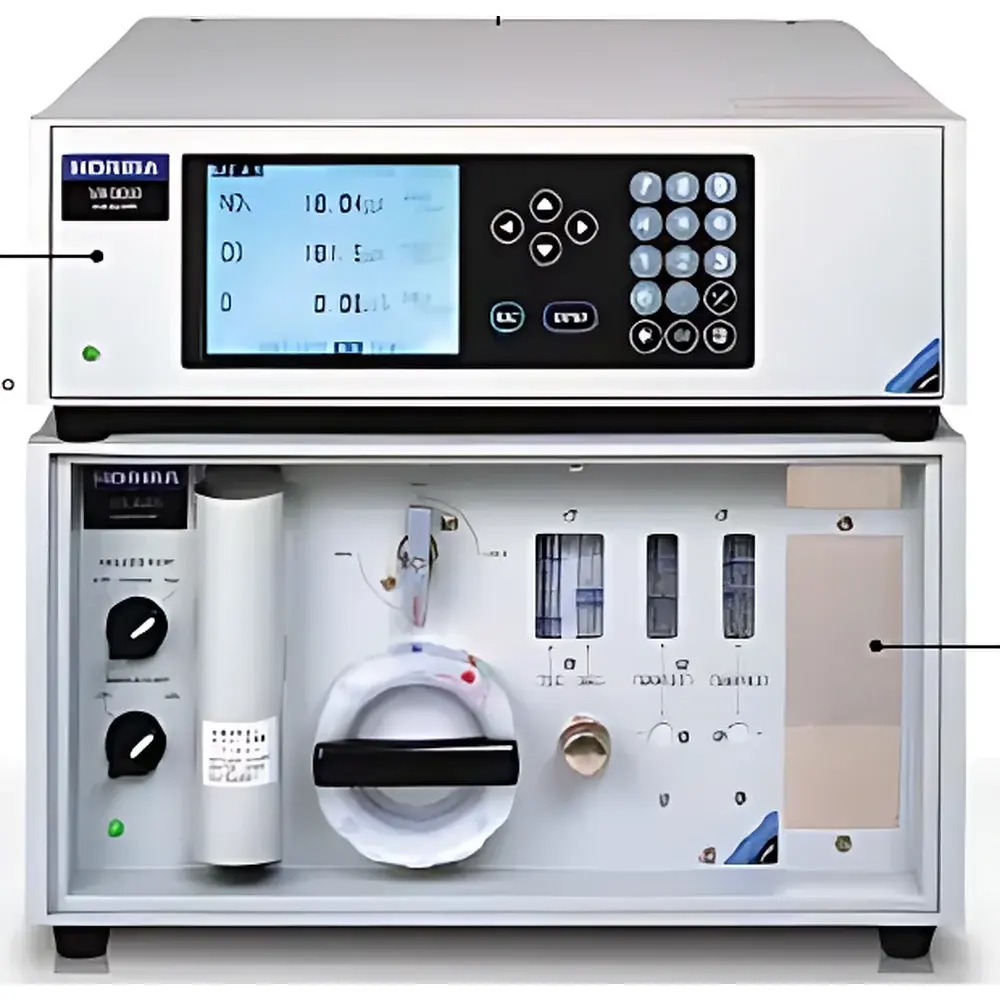
HORIBA VA/VS-3000 Multi-Gas Analyzer
| Brand | HORIBA |
|---|---|
| Origin | Japan |
| Model | VA/VS-3000 |
| Detection Principles | NDIR, Chemiluminescence (CLA), Magnetic Paramagnetic (MPA), Electrochemical (Galvanic), Zirconia |
| Zero/Span Drift | ±2.0% F.S./week (except Galvanic) |
| Repeatability | ±0.5% F.S. |
| Linearity | ±1.0% F.S. |
| Response Time (T90) | ≤30 s |
| Sample Flow Rate | 0.5 L/min (analyzer) / 1.5–5.0 L/min (preconditioning unit) |
| Measurement Ranges | CO (0–200 ppm to 0–100 vol%), CO₂ (0–100 ppm to 0–100 vol%), N₂O (0–100 ppm to 0–5000 ppm), CH₄ (0–200 ppm to 0–100 vol%), SO₂ (0–200 ppm to 0–10 vol%), NOₓ (0–20 ppm to 0–5000 ppm, CLA), O₂ (0–5 vol% to 0–25 vol%, MPA/Galvanic/Zirconia) |
| Range Switching | Up to 4 ranges (CLA: up to 8) |
| Analog Outputs | 0–1 V DC, 4–20 mA |
| Digital Interface | RS-232C |
| Warm-up Time | ~20 min (NDIR/Galvanic), ~40 min (Zirconia), ~60 min (CLA/MPA) |
| Power Supply | 100–240 VAC, 50/60 Hz |
| Power Consumption | 100–350 VA (analyzer), 250–450 VA (VS unit) |
| Display | 320 × 240 pixel LCD |
| Enclosure | 19-inch rack-mount |
| Dimensions (VA) | 430 × 132 × 500 mm (W×H×D) |
| Dimensions (VS) | 430 × 221 × 550 mm |
| Operating Environment | 0–40 °C, ≤90% RH |
| Weight | ~14–20 kg (VS unit), ~20 kg (3-component VA unit) |
| Sample Conditioning | Integrated refrigerated cooler (5 °C dew point) |
| Sample Gas Requirements | Particulates ≤0.1 mg/m³, H₂O dew point ≤60 °C, Pressure fluctuation ±980 Pa |
| Wetted Materials | SUS, PP, PVC, PVDF, PTFE, FKM, CR, Glass |
Overview
The HORIBA VA/VS-3000 Multi-Gas Analyzer is a modular, rack-mounted continuous emission monitoring system engineered for high-accuracy, multi-component gas analysis in environmental, industrial, and regulatory compliance applications. It integrates five complementary detection technologies—Non-Dispersive Infrared (NDIR), Chemiluminescence Analysis (CLA), Magnetic Paramagnetic Analysis (MPA), Electrochemical (Galvanic) sensing, and Zirconia-based oxygen measurement—within a single, interoperable platform. This architecture enables simultaneous, real-time quantification of up to eight gas species—including CO, CO₂, CH₄, N₂O, SO₂, NOₓ, O₂, and hydrocarbons—across wide dynamic concentration ranges. The system operates on standardized physical and electrochemical principles: NDIR leverages Beer-Lambert absorption at characteristic mid-infrared wavelengths; CLA detects NOₓ via light emission from NO–ozone reaction kinetics; MPA exploits the paramagnetic susceptibility of molecular oxygen; Galvanic cells generate current proportional to O₂ partial pressure; and zirconia sensors measure oxygen concentration through solid-electrolyte ionic conduction. Designed for deployment in stack monitoring, ambient air quality stations, landfill gas recovery, and combustion efficiency optimization, the VA/VS-3000 meets the foundational performance requirements for continuous emission monitoring systems (CEMS) under ISO 12039, EN 15267, and EPA Method 10/20/21.
Key Features
- Modular detector architecture: Selectable VA analyzer modules (VA-3000 series) paired with dedicated VS pre-conditioning units (VS-3001 to VS-3004) for NDIR/zirconia/galvanic, MPA, CLA, or hybrid configurations.
- Multi-range capability: Up to four programmable measurement ranges per channel (eight for CLA), enabling seamless auto-ranging across trace-level (ppm) and high-concentration (vol%) domains without manual intervention.
- Stable baseline performance: Typical zero and span drift of ±2.0% full scale per week for NDIR and zirconia channels; ±0.5% F.S. repeatability and ±1.0% F.S. linearity certified per IEC 61298-2.
- Integrated sample conditioning: VS-series units feature thermoelectric cooling to maintain sample dew point at 5 °C, particulate filtration (<0.1 mg/m³), and pressure stabilization (±980 Pa tolerance), ensuring long-term sensor integrity.
- Rack-mount 19-inch enclosure compliant with EIA-310-D standards; front-accessible service panels and hot-swappable sensor modules reduce mean time to repair (MTTR).
- Dual analog outputs (0–1 V DC and 4–20 mA) with isolated channels; RS-232C interface for remote configuration, data logging, and firmware updates.
Sample Compatibility & Compliance
The VA/VS-3000 accommodates diverse sample matrices—from flue gas and biogas to ambient air and process streams—provided inlet conditions meet defined specifications: particulate loading ≤0.1 mg/m³, water vapor dew point ≤60 °C, and static pressure variation within ±980 Pa. All wetted components are constructed from chemically inert materials including SUS316 stainless steel, PTFE, PVDF, FKM elastomers, and borosilicate glass, minimizing catalytic interference and corrosion risk during long-term exposure to acidic or oxidizing gases. The system supports compliance with international regulatory frameworks: its CLA module satisfies EPA Performance Specification 2 (PS-2) for NOₓ; NDIR channels align with ISO 4223-1 for CO/CO₂; and O₂ measurement accuracy meets ASTM D6522 for combustion analysis. Data integrity is reinforced by internal audit trails, configurable calibration logs, and timestamped event records suitable for GLP and GMP environments.
Software & Data Management
The VA/VS-3000 operates with HORIBA’s proprietary CEMS Manager software, providing intuitive configuration of measurement parameters, alarm thresholds, and range switching logic. The software supports automated zero/span calibration sequences with user-defined schedules and validation reports compliant with 21 CFR Part 11 (electronic signatures, audit trail, role-based access). Raw sensor outputs, calculated concentrations, and diagnostic flags are logged at user-selectable intervals (1–300 seconds) and exported in CSV or XML format. Integration with SCADA and DCS platforms is enabled via Modbus RTU over RS-232 or optional Ethernet gateway. All firmware updates undergo rigorous regression testing and include version-controlled checksum verification to ensure operational continuity and cybersecurity resilience.
Applications
- Continuous emission monitoring (CEMS) for thermal power plants, cement kilns, and waste incinerators—measuring regulated pollutants (SO₂, NOₓ, CO) and combustion parameters (O₂, CO₂).
- Landfill and anaerobic digester gas analysis—quantifying CH₄, CO₂, H₂S (via optional sensor), and O₂ for energy recovery optimization and fugitive emission reporting.
- Ambient air quality networks—tracking urban CO, NOₓ, and ozone precursors with sub-ppm sensitivity and low-drift stability over seasonal temperature variations.
- Industrial hygiene and workplace safety—monitoring CO, SO₂, and NOₓ in boiler rooms, tunnels, and confined spaces with fail-safe alarm outputs.
- Research-grade atmospheric chemistry studies—supporting isotopic ratio measurements (e.g., δ¹³C in CH₄) when coupled with GC-IRMS interfaces.
FAQ
What detection methods are supported by the VA/VS-3000 platform?
The system natively supports NDIR, chemiluminescence (CLA), magnetic paramagnetic (MPA), electrochemical (galvanic), and zirconia-based oxygen sensing. Detector modules are selected based on target analytes and required sensitivity.
Can the analyzer operate unattended for extended periods?
Yes—designed for continuous operation with automatic zero/span calibration, drift compensation algorithms, and robust sample conditioning. Typical maintenance interval is 3–6 months depending on sample cleanliness and operating environment.
Is the system compatible with EPA or EU regulatory reporting requirements?
The VA/VS-3000 meets technical prerequisites for EN 15267-3 QAL1 certification and EPA PS-2/PS-3 when configured with appropriate detectors and validated using reference gases traceable to NIST or BIPM standards.
How is data security and traceability ensured?
All configuration changes, calibration events, and alarm triggers are timestamped and stored in an immutable audit log. Software enforces electronic signatures, password-protected access levels, and encrypted data export per FDA 21 CFR Part 11 Annex 11 guidelines.
What are the electrical and environmental installation requirements?
The unit requires 100–240 VAC, 50/60 Hz supply and operates within 0–40 °C and ≤90% RH. Rack mounting in climate-controlled enclosures is recommended for outdoor or industrial deployments.
Related Products







