
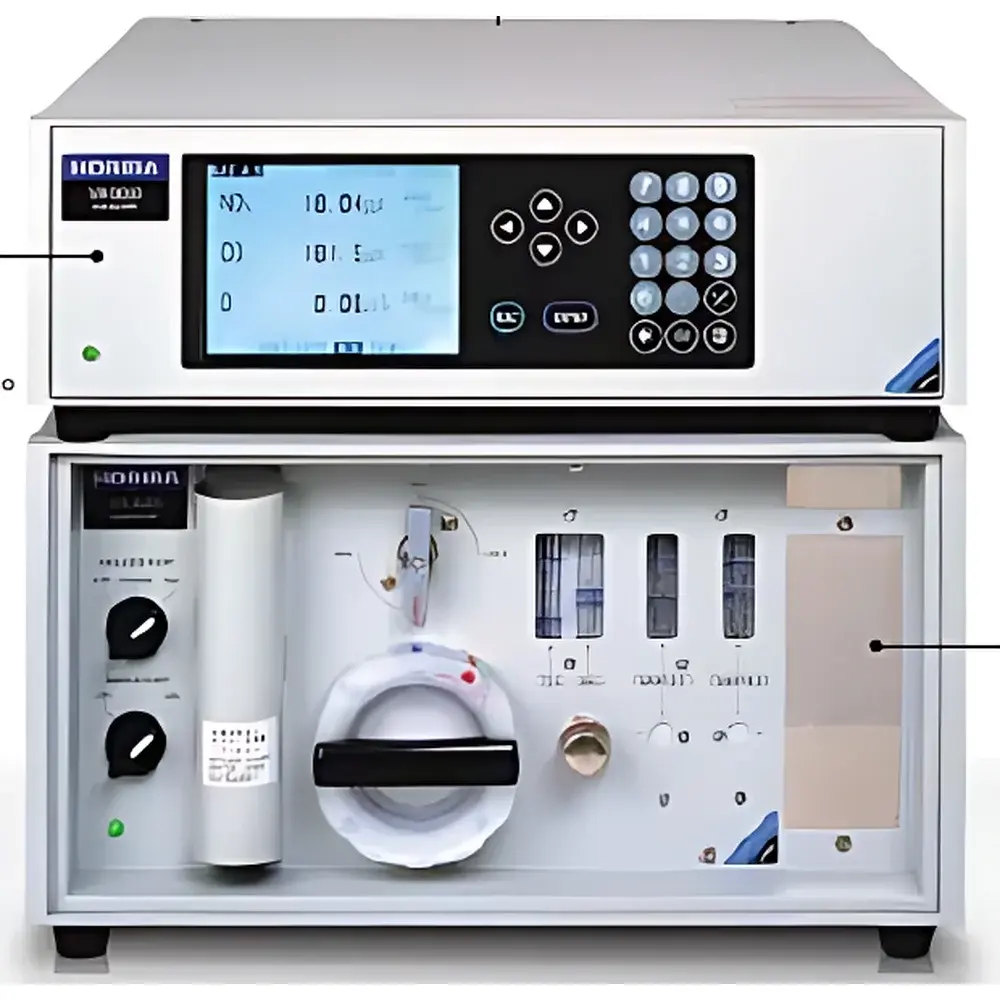
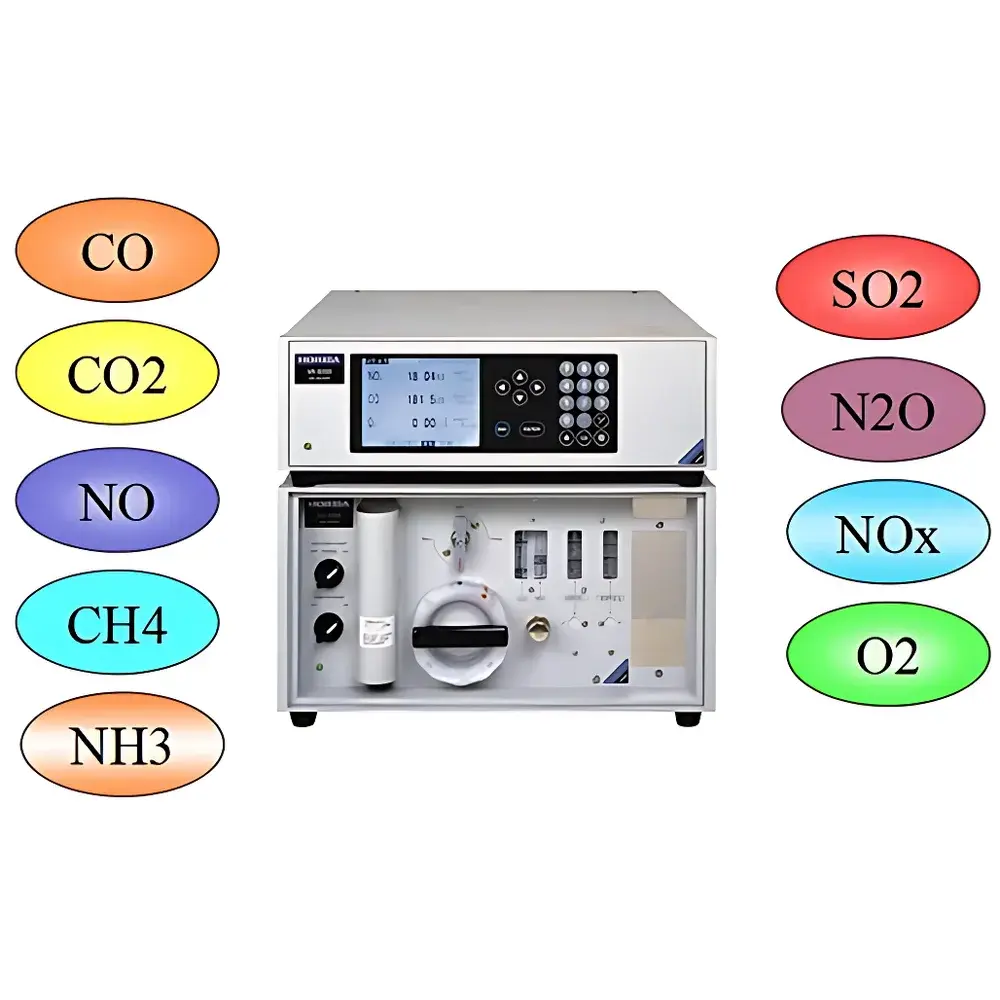
HORIBA VA-3000 Series Multi-Gas Analyzer with VS-3000 Preconditioning Unit
| Brand | HORIBA |
|---|---|
| Origin | Japan |
| Model | VA-3000, VS-3000 |
| Instrument Type | Portable / Rack-Mountable |
| Detection Targets | Multi-component (CO, CO₂, N₂O, CH₄, SO₂, NOₓ, O₂, H₂, H₂S, etc.) |
| Minimum Range | 1–20 ppm |
| Repeatability | ±0.5% F.S. |
| Resolution | 0.1 ppm |
| Response Time | T90 ≤ 30 s |
| Zero Drift | ±2.0% F.S./week (excluding galvanic cells) |
| Span Drift | ±2.0% F.S./week (excluding galvanic cells) |
| Linearity Error | ±1.0% F.S. |
| Sampling Flow Rate | 0.5 L/min (analyzer), 1.5–5.0 L/min (preconditioning unit) |
| Warm-up Time | ~20 min (NDIR, galvanic), ~40 min (zirconia), ~60 min (CLA, MPA) |
| Power Supply | 100–240 VAC, 50/60 Hz |
| Power Consumption | 100–450 VA |
| Display | 320 × 240 pixel LCD (111.2 mm × 89.38 mm) |
| Enclosure | 19-inch rack-mount chassis |
| Dimensions (VA-3000) | 430 mm (W) × 132 mm (H) × 500 mm (D) |
| Dimensions (VS-3000) | 430 mm (W) × 221 mm (H) × 550 mm (D) |
| Weight | ~14–20 kg |
| Operating Environment | 0–40 °C, ≤90% RH |
| Sample Gas Conditions | Particulates ≤0.1 mg/m³, Dew Point ≤60 °C, Pressure Fluctuation ±980 Pa |
| Wetted Materials | SUS, PP, PVC, PVDF, PTFE, FKM, CR, Glass |
Overview
The HORIBA VA-3000 Series Multi-Gas Analyzer is a modular, high-integrity continuous emission monitoring system engineered for simultaneous, real-time quantification of up to eight gaseous components in industrial stack emissions, ambient air, or process streams. It operates as a hybrid platform integrating multiple detection principles—Non-Dispersive Infrared (NDIR), Chemiluminescence Analysis (CLA), Magnetic Paramagnetic Analysis (MPA), Electrochemical (Galvanic) cells, and Zirconia-based oxygen sensing—within a single, unified control architecture. Each measurement module is physically and electronically isolated to prevent cross-interference, enabling independent calibration, maintenance, and range configuration. The VA-3000 is designed for deployment alongside the VS-3000 series sample preconditioning units, which provide active cooling (to 5 °C), particulate filtration, moisture removal, and pressure stabilization—critical for maintaining analytical fidelity under variable field conditions. Its measurement principle selection is application-driven: NDIR delivers stable, drift-resistant CO, CO₂, CH₄, and SO₂ detection; CLA provides sub-ppb sensitivity for NOₓ speciation; MPA ensures high-precision O₂ measurement without consumables; galvanic and zirconia sensors offer robust, field-proven oxygen analysis across wide concentration ranges.
Key Features
- Modular sensor architecture supporting up to eight independent gas channels—configurable per application via VS-3001 (NDIR/zirconia/galvanic), VS-3002 (MPA), VS-3003 (CLA), or VS-3004 (dual MPA+CLA) preconditioning modules.
- Multi-range capability: NDIR (1:10 standard, optional 1:20), CLA (1:100), MPA (1:10), galvanic/zirconia (1:5), enabling seamless transition from trace-level environmental monitoring to high-concentration combustion analysis.
- High metrological stability: ±0.5% F.S. repeatability, ±1.0% F.S. linearity, and <30 s T90 response across all supported analytes—validated per ISO 12039 and EN 15267-3 protocols for CEMS compliance.
- Rack-mount 19-inch enclosure with front-access service panels, integrated LCD display (320 × 240 pixels), and dual analog outputs (0–1 V DC and 4–20 mA) for PLC/DCS integration.
- Comprehensive diagnostics: onboard self-test routines, sensor health monitoring, zero/span validation logs, and warm-up status tracking—including differential warm-up profiles (20 min for NDIR, 60 min for CLA) to ensure thermal equilibrium prior to measurement initiation.
Sample Compatibility & Compliance
The VA-3000/VS-3000 system accepts sample gas streams meeting strict conditioning criteria: particulate loading ≤0.1 mg/m³, dew point ≤60 °C, and pressure variation within ±980 Pa. All wetted materials—including sample lines, filters, coolers, and sensor cells—are constructed from chemically inert, corrosion-resistant components (SUS316L, PVDF, PTFE, FKM, and borosilicate glass), ensuring long-term integrity when exposed to acidic gases (SO₂, NOₓ), hydrocarbons (CH₄), or reducing atmospheres. The system complies with international regulatory frameworks including EPA Method 3A (O₂), Method 10 (CO), Method 320 (FTIR reference), and EU BREF guidelines for waste incineration and cement production. Optional audit-ready data logging supports GLP/GMP environments, with timestamped calibration records, operator ID tagging, and configurable retention policies aligned with FDA 21 CFR Part 11 requirements.
Software & Data Management
The VA-3000 features embedded firmware with RS-232C serial interface for local configuration and diagnostic access. Third-party SCADA integration is supported via Modbus RTU (optional) or direct 4–20 mA loop coupling. All measurement data—including raw sensor voltages, temperature-compensated concentrations, alarm states, and maintenance flags—are timestamped and stored internally for ≥30 days. Export is facilitated via USB mass storage or serial dump in CSV format, preserving full traceability of zero/span events, calibration coefficients, and drift correction history. Firmware updates are performed offline using signed binary packages to maintain system integrity and prevent unauthorized modification.
Applications
- Continuous Emission Monitoring Systems (CEMS) for thermal power plants, municipal waste incinerators, and cement kilns—measuring CO, CO₂, NOₓ, SO₂, O₂, and N₂O in accordance with ISO 14064-1 and IEC 61511 functional safety standards.
- Process optimization in chemical synthesis reactors and biogas upgrading facilities—tracking CH₄, CO₂, H₂, and H₂S concentrations to maintain stoichiometric balance and catalyst efficiency.
- Indoor air quality (IAQ) assessment in cleanrooms and semiconductor fabrication fabs—verifying low-level CO and CO₂ thresholds per ASHRAE Standard 62.1.
- Environmental research stations requiring long-term, unattended multi-gas profiling—leveraging low-power operation and field-serviceable modules for remote deployment.
FAQ
What gas species can the VA-3000 measure simultaneously?
The VA-3000 supports concurrent measurement of up to eight gases—including CO, CO₂, CH₄, SO₂, NO, NO₂, O₂, N₂O, H₂, and H₂S—depending on configured sensor modules and VS-3000 preconditioning unit selection.
Is the system certified for regulatory CEMS use?
Yes—the VA-3000 meets EN 15267-3 (QAL1) and ISO 12039 performance requirements for automated monitoring systems. Certification documentation, including type approval test reports and QAL3 verification procedures, is provided with each shipment.
How often does the system require calibration?
Zero and span calibration intervals are user-defined but typically recommended every 7–14 days for critical applications; drift compensation algorithms extend effective calibration cycles when operated within specified environmental and sample condition limits.
Can the VA-3000 operate in high-humidity or corrosive gas environments?
When paired with the VS-3000 preconditioning unit—including refrigerated dryer, heated sample line options, and acid-resistant wetted materials—the system maintains accuracy in demanding industrial exhaust streams with dew points up to 60 °C and SO₂ concentrations exceeding 10 vol%.
What is the minimum detectable concentration for NOₓ using CLA?
The CLA module achieves a lower detection limit of 0.1 ppm NOₓ (as NO) with a signal-to-noise ratio ≥3:1 under standard operating conditions, validated per EPA Performance Specification 2 (PS-2).
Related Products







