
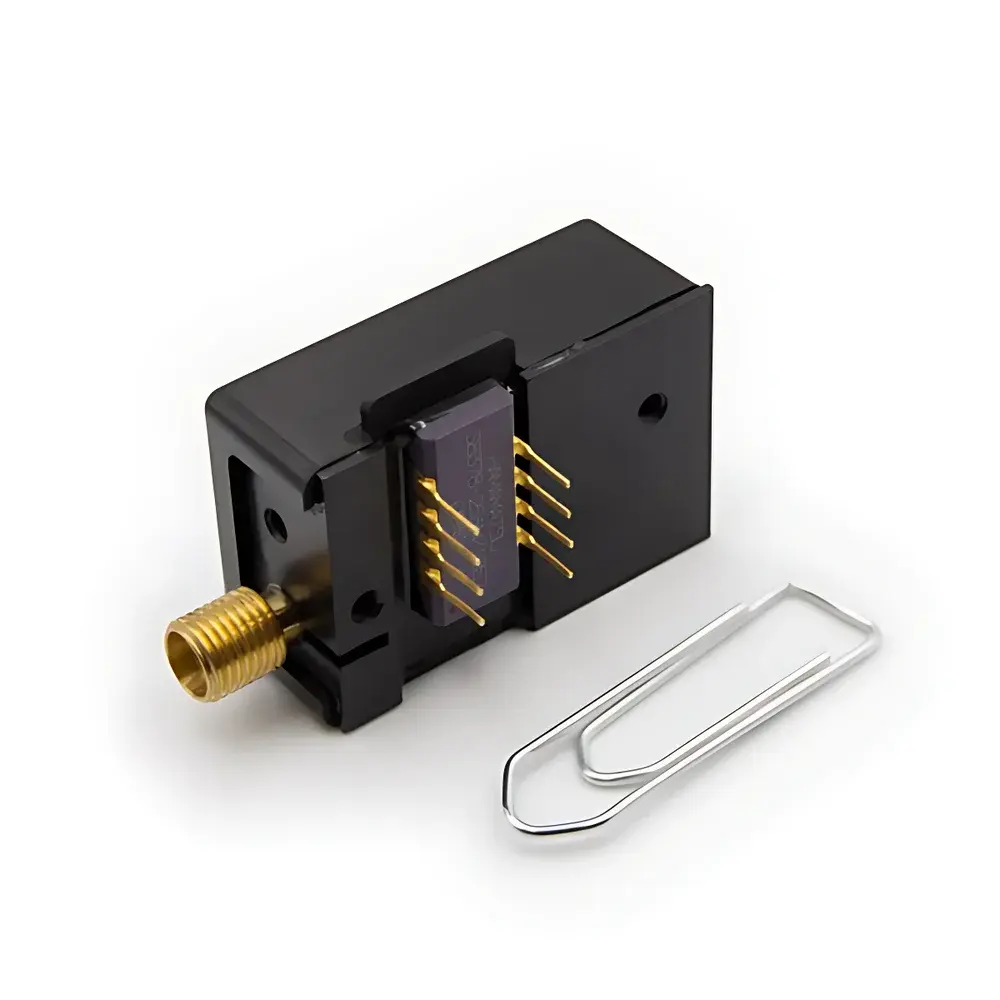
HORIBA VS20 Series Fiber Optic UV-Vis Spectrometer
| Brand | HORIBA |
|---|---|
| Origin | France |
| Manufacturer Type | Original Equipment Manufacturer (OEM) |
| Import Status | Imported |
| Model Series | VS20 |
| Resolution | ≤6.5 nm (with 50 µm slit) |
| Stray Light | <0.25% @ 260 nm, <0.1% @ 400 nm, <0.2% @ 600 nm |
Overview
The HORIBA VS20 Series is an ultra-compact, fiber-coupled UV-Vis spectrometer engineered for continuous, real-time absorbance spectroscopy in demanding industrial and environmental monitoring applications. Based on a fixed-grating Czerny-Turner optical architecture with HORIBA’s proprietary aberration-corrected flat-field imaging grating, the VS20 delivers high-fidelity spectral data across the 190–850 nm range. Its core measurement principle relies on quantitative analysis of broadband absorbance spectra—enabling simultaneous multi-parameter inference without chemical reagents or sample extraction. Designed specifically for permanent installation in process streams or distributed sensor networks, the VS20 operates unattended under variable thermal and mechanical conditions, making it suitable for online water quality surveillance, bioprocess monitoring, and inline semiconductor wet bench analytics.
Key Features
- Ultra-compact form factor (≤120 × 80 × 45 mm) optimized for direct integration into flow cells, submersible probes, and OEM analytical platforms.
- Thermally stabilized optical bench with passive athermalization, ensuring wavelength calibration drift < ±0.05 nm/°C over operational range (5–40 °C).
- Aberration-corrected flat-field imaging grating enabling uniform spectral resolution and pixel-to-wavelength linearity across full detector array.
- Back-thinned CCD detector with 2048-pixel linear array, offering high quantum efficiency (>60% at 254 nm) and low read noise (<15 e⁻ RMS).
- Robust mechanical design validated to IEC 60068-2-6 (vibration: 5–500 Hz, 1.5 g RMS) and IEC 60068-2-14 (thermal shock: −20 °C ↔ +60 °C, 10 cycles).
- Fiber-optic input (SMA 905, compatible with 200–600 µm core fibers) supporting flexible remote sensing configurations.
Sample Compatibility & Compliance
The VS20 is compatible with liquid-phase samples delivered via flow-through cuvettes, immersion probes, or capillary microcells. It supports aqueous matrices with turbidity up to 400 NTU and absorbance ranges from 0.005 to 3.0 AU (depending on pathlength and fiber coupling efficiency). The instrument complies with CE marking requirements per Directive 2014/30/EU (EMC) and 2014/35/EU (LVD). Its optical design meets ISO 17025-relevant traceability standards when used with NIST-traceable calibration sources. For regulated environments—including drinking water utilities operating under EPA Method 415.3 or EU Directive 2020/2184—the VS20 supports audit-ready data logging when paired with compliant software infrastructure satisfying FDA 21 CFR Part 11 and EU Annex 11 requirements for electronic records and signatures.
Software & Data Management
The VS20 interfaces via USB 2.0 or optional RS-485 industrial serial protocol. HORIBA provides the SpectraSoft™ SDK (C/C++, Python, LabVIEW APIs) for seamless integration into SCADA, DCS, or LIMS environments. Raw spectral data (16-bit intensity vs. pixel index) is acquired at up to 10 Hz with hardware-triggered synchronization. Spectral preprocessing—including dark current subtraction, pixel binning, and wavelength calibration—occurs onboard or in host software. Chemometric models (e.g., PLS regression for COD/BOD prediction) are deployed via user-loaded .cal files; model validation reports include R², RMSEP, and residual error distribution histograms. All spectral acquisitions and processing events are timestamped and logged with immutable metadata (temperature, integration time, lamp status), supporting GLP/GMP-compliant audit trails.
Applications
- Water Quality Monitoring: Real-time quantification of nitrate/nitrite (via 200–220 nm peaks), dissolved organic carbon proxies (UV254), turbidity (scattering slope), and color (400–700 nm absorbance ratio).
- Biopharmaceutical Process Analytics: In-situ monitoring of cell culture density (600 nm OD), product titer (specific absorbance bands), and media component depletion (e.g., glucose at 1630 nm via NIR extension modules).
- Foods & Beverages: Detection of adulteration (e.g., melamine in milk via UV shift), pigment concentration (anthocyanins, chlorophyll), and thermal history assessment (caramelization markers).
- Semiconductor Wet Processing: Monitoring HF/HNO₃ etchant concentrations, metal ion contamination (Cu²⁺ at 800 nm), and particle load via dynamic light scattering correlation (when coupled with optional Mie-scatter module).
- Environmental Field Networks: Low-power, solar-compatible deployment in distributed river monitoring stations with edge-based spectral compression and anomaly detection.
FAQ
What is the typical optical pathlength supported by the VS20?
The VS20 itself is a spectrometer—not a complete measurement cell—and requires external optical interfacing. Standard configurations use 1 mm to 100 mm pathlength flow cells or immersion probes; optimal pathlength depends on analyte absorption coefficient and target concentration range.
Can the VS20 operate continuously for >6 months without recalibration?
Yes—under stable thermal conditions (±2 °C) and with periodic dark-reference acquisition (e.g., every 2 hours), wavelength and photometric stability meet ISO 10012-1 verification criteria for long-term unattended operation.
Is spectral data export compatible with ASTM E131 or ISO 14783 formats?
Raw data exports as CSV (wavelength/intensity columns) and JCAMP-DX v5.1; chemometric model outputs conform to ASTM E1655 for multivariate calibration reporting.
Does HORIBA provide application-specific calibration models for water parameters?
Pre-validated PLS models for COD, BOD₅, TOC, and NO₃⁻ are available under separate licensing agreements and require site-specific transfer calibration per ISO 80601-2-61 guidelines.
What maintenance is required for field-deployed VS20 units?
No consumables or moving parts; recommended quarterly inspection includes fiber connector cleaning, reference standard verification (using NIST SRM 2036), and firmware update validation.
Related Products





