
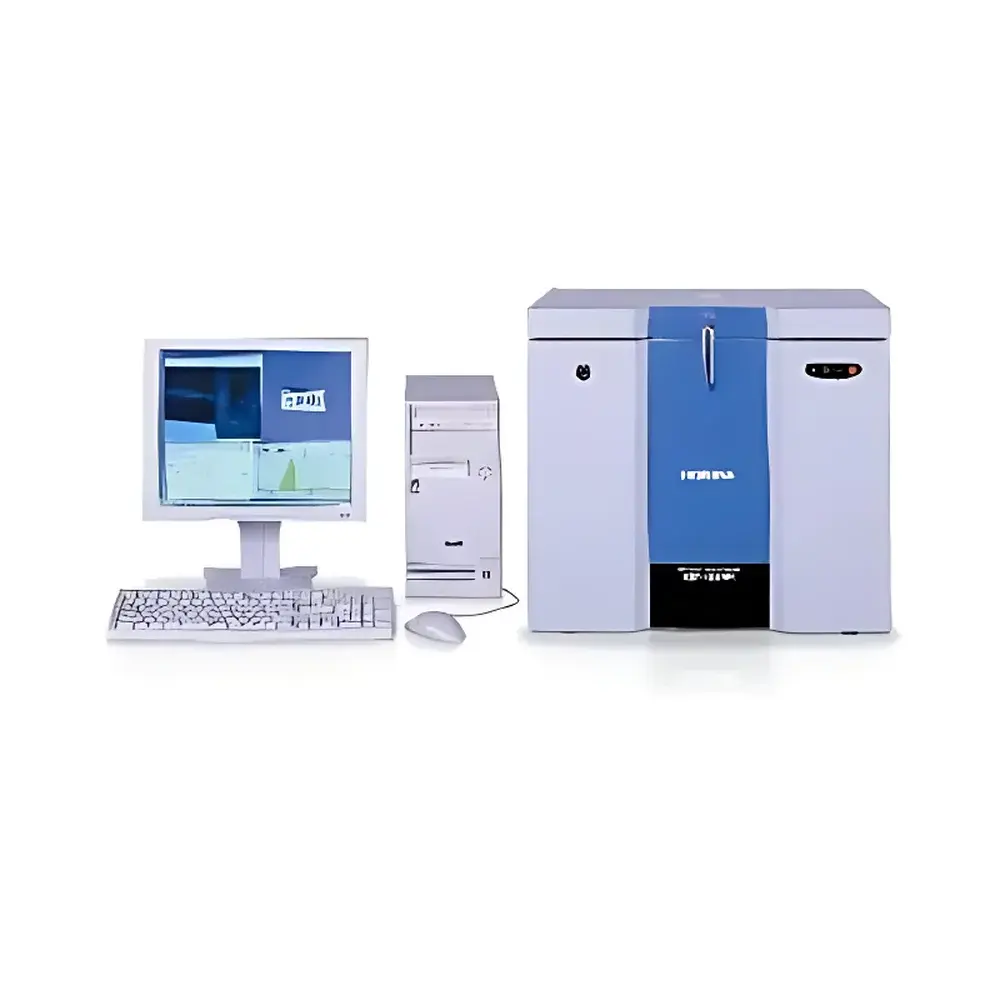
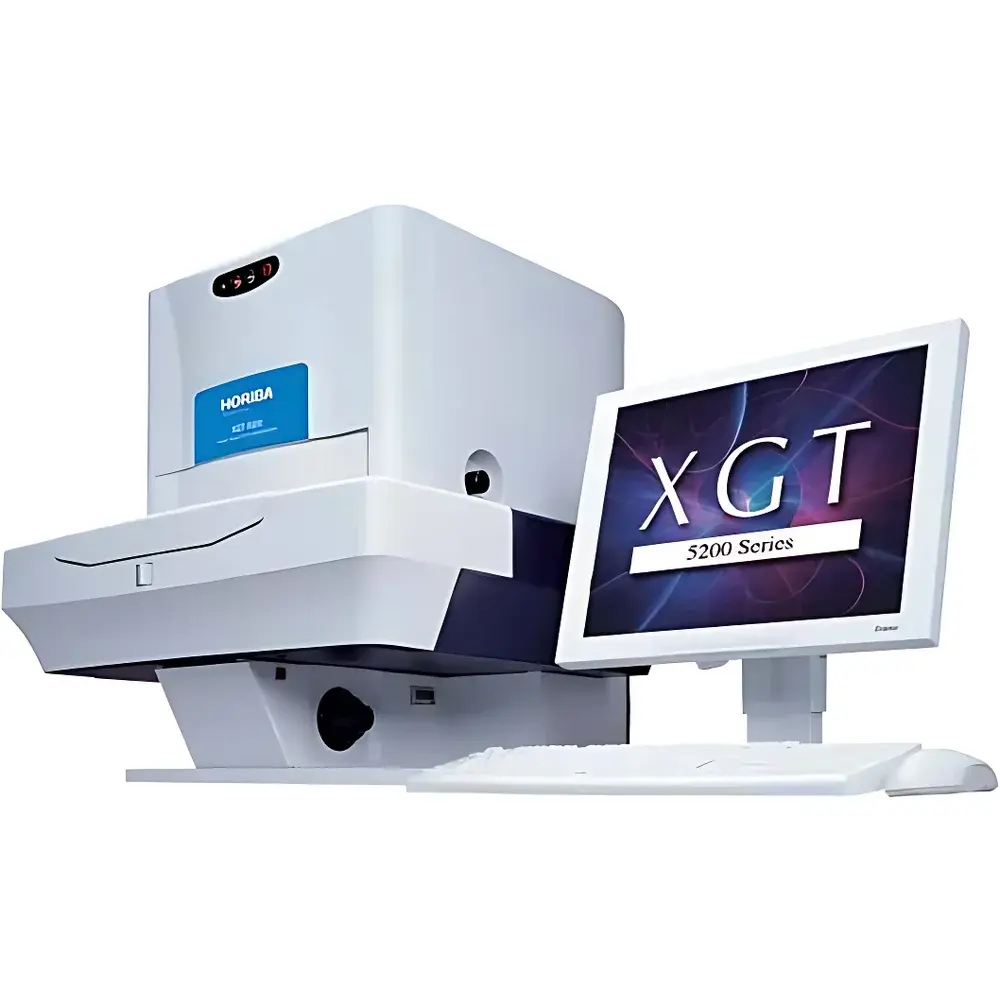
HORIBA XGT-5200WR Energy Dispersive X-Ray Fluorescence Spectrometer for RoHS/WEEE Compliance Testing
| Brand | HORIBA |
|---|---|
| Origin | Japan |
| Model | XGT-5200WR |
| Sample Environment | Air (Atmospheric) |
| Elemental Range | Na to U |
| Quantification Range | 1 ppm – 99.99% |
| Operating Conditions | 50 kV / 1 mA |
| Repeatability | ±0.1% RSD |
| Spot Size | Standard 400 µm, Optional 10 µm |
| Detector | Silicon Drift Detector (SDD), LN2-free |
| Geometry | Coaxial Optical Microscope Integration |
| Analysis Mode | Non-destructive, No Vacuum Required, No Sample Preparation |
Overview
The HORIBA XGT-5200WR is a benchtop energy dispersive X-ray fluorescence (ED-XRF) spectrometer engineered for regulatory compliance testing under international hazardous substance directives—including EU RoHS (Restriction of Hazardous Substances), WEEE (Waste Electrical and Electronic Equipment), ELV (End-of-Life Vehicles), and China RoHS. It operates on the fundamental principle of X-ray fluorescence: primary X-rays from one or two selectable microfocus X-ray tubes excite characteristic secondary (fluorescent) X-rays from elements in the sample; these emitted photons are resolved by a high-performance silicon drift detector (SDD) and quantified via fundamental parameter (FP) or empirical calibration methods. Unlike wavelength-dispersive systems, the XGT-5200WR delivers rapid, non-destructive elemental analysis without vacuum requirements or chemical digestion—enabling direct measurement of solid, coated, or heterogeneous electronic components in ambient air.
Key Features
- Dual microfocus X-ray tube architecture: Enables seamless switching between macro-beam (broad-area survey) and micro-beam (high-spatial-resolution mapping) modes—optimized for both bulk screening and localized analysis of fine features such as IC pin terminations, solder joints, or plating layers.
- Coaxial optical microscope integration: Provides parallax-free visual alignment; the optical axis coincides precisely with the X-ray beam path, ensuring that the region observed under the CCD camera is identical to the irradiated analysis spot—critical for trace-level quantification of sub-millimeter features.
- High-resolution microbeam capability: Standard 400 µm focal spot; optional 10 µm capillary optic enables spatially resolved analysis at near-micron scale—supporting failure analysis, contamination localization, and process control verification in PCBs, connectors, and semiconductor packaging.
- LN2-free SDD detection: Delivers high count-rate performance (>100,000 cps) and excellent energy resolution (<125 eV at Mn Kα), essential for resolving overlapping peaks (e.g., Cr–Fe, As–Pb, Br–Pb) in complex matrices without cryogenic maintenance overhead.
- Atmospheric operation: Eliminates vacuum pump dependency and associated cycle time delays; samples are analyzed in air—ideal for moisture-sensitive, outgassing, or large-format assemblies that cannot be evacuated.
Sample Compatibility & Compliance
The XGT-5200WR accommodates a broad range of physical forms: rigid PCBs, flexible circuits, molded plastic housings, metal casings, wire harnesses, and assembled modules up to 300 × 300 × 150 mm (W × D × H). Its open-stage design permits rapid manual loading and repositioning without fixtures. The system is validated for quantitative determination of the five RoHS-restricted elements—Pb, Cd, Hg, Cr(VI), and Br (as organobromine)—in accordance with IEC 62321-5:2013 (ED-XRF screening), ASTM F2617-22 (standard test method for RoHS screening), and GB/T 26125-2011 (China RoHS). Full audit trails, user access control, and electronic signature support align with GLP and FDA 21 CFR Part 11 requirements when configured with compliant software settings.
Software & Data Management
XGT Control Suite provides unified instrument control, real-time spectral acquisition, automated stage navigation, and integrated qualitative/quantitative analysis. Key capabilities include: point-and-click ROI selection; multi-point sequential analysis; line scans and 2D elemental mapping (XRF imaging); overlay of transmission X-ray images for structural correlation; and generation of ISO/IEC 17025-compliant reports with uncertainty estimation. All raw spectra, calibration files, and metadata are stored in a relational database with versioned backups. Export formats include CSV, PDF, and industry-standard .rpt for LIMS integration.
Applications
- Routine RoHS/WEEE screening of incoming electronic components and finished goods
- Failure investigation of non-conforming lots—localizing Pb in solder masks, Cd in pigments, or Br in flame retardants
- Process validation for lead-free reflow soldering, electroplating, and conformal coating
- Material verification of recycled plastics and metals prior to reuse in electronics manufacturing
- Research-grade elemental distribution studies in multilayer thin-film devices and heterostructured packaging substrates
FAQ
Does the XGT-5200WR require liquid nitrogen cooling?
No. It employs a thermoelectrically cooled silicon drift detector (SDD), eliminating the need for LN2 handling, storage, or refills.
Can it quantify chromium(VI) specifically?
ED-XRF measures total Cr; speciation requires complementary techniques (e.g., UV-Vis after leaching per IEC 62321-7-2). The XGT-5200WR supports total Cr screening as a pass/fail proxy in conjunction with validated extraction protocols.
What is the minimum detectable limit for lead in plastic?
Under standard atmospheric conditions and 100 s counting time, the practical detection limit for Pb in polymer matrices is ≤2 ppm (mass fraction), verified using certified reference materials (CRMs) such as BAM ERM-EC680k.
Is vacuum operation possible?
The system is optimized for air analysis; vacuum adaptation is not supported. For light-element enhancement (e.g., Na, Mg, Al), helium purge accessories may be integrated upon request.
How is calibration maintained across long-term use?
Built-in drift correction uses internal reference standards; daily verification with QC check standards (e.g., Cu/Zn alloy, Pb-doped polymer) ensures continued accuracy per ISO 17025 clause 7.7. Calibration stability is tracked via automated trend reports.






