
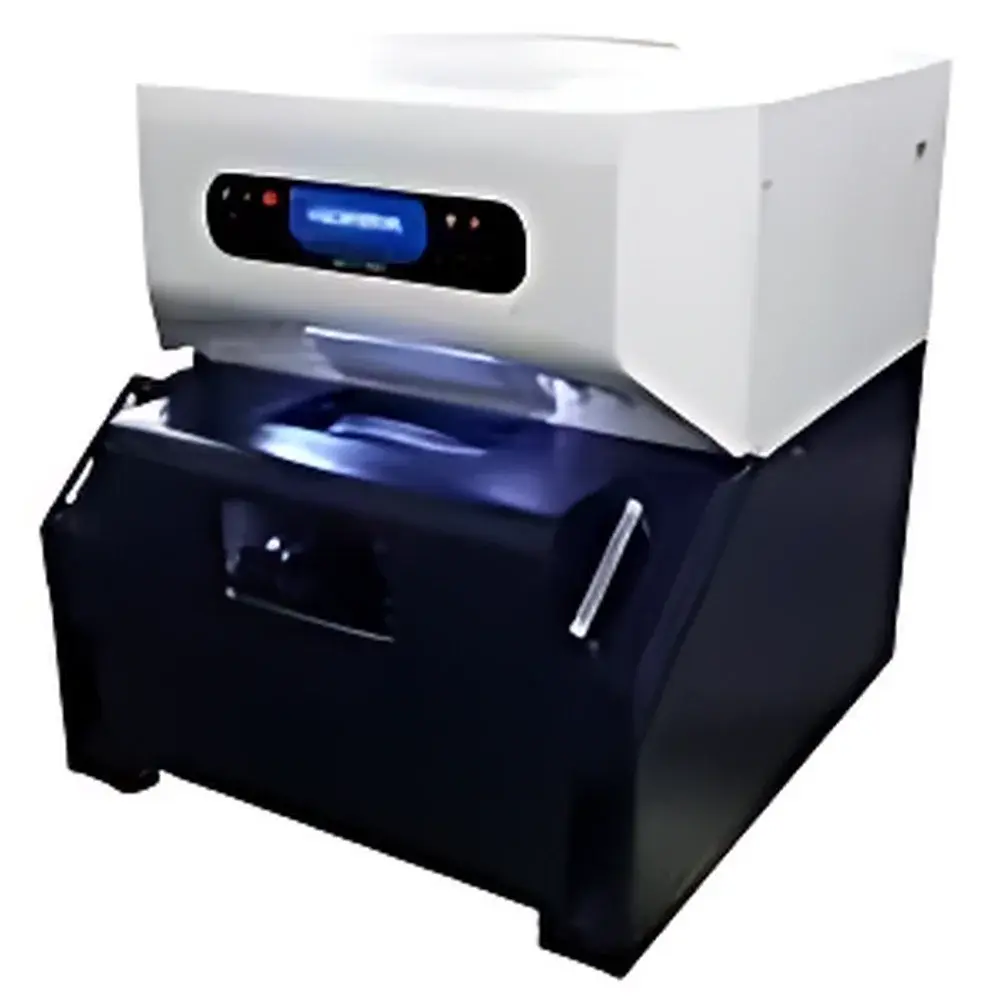
Horiba XGT-7200 Wavelength Dispersive X-Ray Fluorescence Microscope
| Origin | Japan |
|---|---|
| Manufacturer Type | Authorized Distributor |
| Origin Category | Imported |
| Model | XGT-7200 |
| Price Range | USD 42,000 – 70,000 (FOB) |
| Instrument Type | Scanning Micro-XRF |
| X-ray Tube Power | Not Applicable (Microfocus Rh Target, Fixed Excitation) |
| Elemental Range | Na (11) to U (92) |
Overview
The Horiba XGT-7200 is a high-resolution, benchtop wavelength dispersive X-ray fluorescence (WDXRF) microscope engineered for non-destructive elemental microanalysis at micrometer-scale spatial resolution. Unlike energy dispersive systems (EDXRF), the XGT-7200 integrates monochromatic X-ray excitation via a microfocus rhodium (Rh) anode tube operating at 50 kV and 1 mA, coupled with a single-capillary X-ray optic delivering a focused beam down to 10 µm diameter. Its hybrid detection architecture combines a silicon drift detector (SDD) for high-count-rate, high-energy-resolution fluorescence detection and a NaI(Tl) scintillation detector optimized for transmitted X-ray imaging—enabling simultaneous structural and compositional characterization. Designed for laboratory-based materials science, geoscience, semiconductor failure analysis, and cultural heritage studies, the system operates in full-vacuum mode (chamber: 300 × 300 × 80 mm) to enhance light-element sensitivity (down to sodium, Na, Z = 11) and minimize atmospheric absorption artifacts.
Key Features
- Micrometer-scale excitation: Single-bore polycapillary optic with selectable focal spots (10 µm or 100 µm diameter), no filter required for direct excitation
- Dual-detection capability: SDD for high-resolution XRF spectroscopy + NaI(Tl) transmission detector for real-time structural correlation
- Co-axial optical imaging: Integrated high-magnification CCD camera provides synchronized visible-light microscopy with X-ray mapping coordinates
- Precision motorized stage: 100 mm × 100 mm XY travel range with sub-micron repeatability and programmable positioning
- Full-vacuum sample chamber: Maintains ≤10⁻² Pa pressure for optimal detection of elements from Na to U without spectral interference from air attenuation
- INCA digital pulse processor: Enables real-time dead-time correction, pile-up rejection, and high-throughput spectral acquisition (≥100,000 cps)
Sample Compatibility & Compliance
The XGT-7200 accommodates solid, flat, or low-relief samples up to 30 mm in height and 100 mm in lateral dimension. Non-conductive specimens require no conductive coating due to charge-neutralizing electron flood gun integration. The system supports ISO 18115-1:2017 (surface chemical analysis), ASTM E135–22 (standard terminology for XRF), and complies with IEC 61000-6-3 (EMC emissions) and IEC 61000-6-2 (immunity). For regulated environments, data acquisition and report generation meet GLP audit-trail requirements; raw spectra and metadata are stored in vendor-neutral .spc and .xml formats compatible with third-party spectral libraries.
Software & Data Management
Controlled by Horiba’s proprietary XGT Suite v5.x, the software delivers fully integrated acquisition, processing, and reporting workflows. Quantitative analysis employs fundamental parameter (FP) methods—including standardless FP, standard-based FP, multi-layer FP, and calibration curve approaches—with uncertainty propagation per ISO 11843-7. Mapping routines support rectangular area scans (up to 5000 points), RGB false-color elemental overlays, line profiles, and spectral extraction per pixel. All results—including peak identification (K/L/M series auto-labeling), matrix corrections, and statistical summaries—are exportable to Excel® (.xlsx) or CSV. The software architecture supports concurrent operation with Horiba’s XGT-5200 platform for cross-platform method transfer and comparative analysis.
Applications
- Thin-film and multilayer stack composition profiling in photovoltaics and display manufacturing
- Inclusion analysis and phase mapping in metallurgical alloys and geological thin sections
- Contamination localization on semiconductor wafers and PCB substrates
- Elemental stratigraphy in archaeological artifacts and painted surfaces
- Quality control of coated pharmaceutical tablets (e.g., active ingredient distribution, coating uniformity)
- Forensic trace evidence analysis requiring micron-level spatial registration of elemental signatures
FAQ
Does the XGT-7200 require liquid nitrogen cooling for the SDD detector?
No—the SDD is Peltier-cooled to −20 °C, eliminating cryogen dependency while maintaining <125 eV Mn-Kα resolution.
Can the system perform depth-resolved analysis?
Not inherently; it is a surface-sensitive technique (penetration depth ~1–10 µm depending on matrix and element). Depth profiling requires variable-angle incidence or sequential ion milling, which are external to the instrument.
Is vacuum pumping time configurable?
Yes—vacuum ramp rate and hold pressure are user-defined; typical pump-down to operational pressure takes <8 minutes for a dry, ambient-condition sample.
What spectral library formats are supported for peak matching?
NIST SRD 126 (X-ray Transition Energies), IUPAC X-ray Line Database, and user-imported .csv or .txt libraries with binding energy and transition assignments.
Does the system comply with FDA 21 CFR Part 11 for electronic records?
Audit trail logging, electronic signature support, and role-based access control are available as optional modules validated per GxP requirements.
Related Products





