
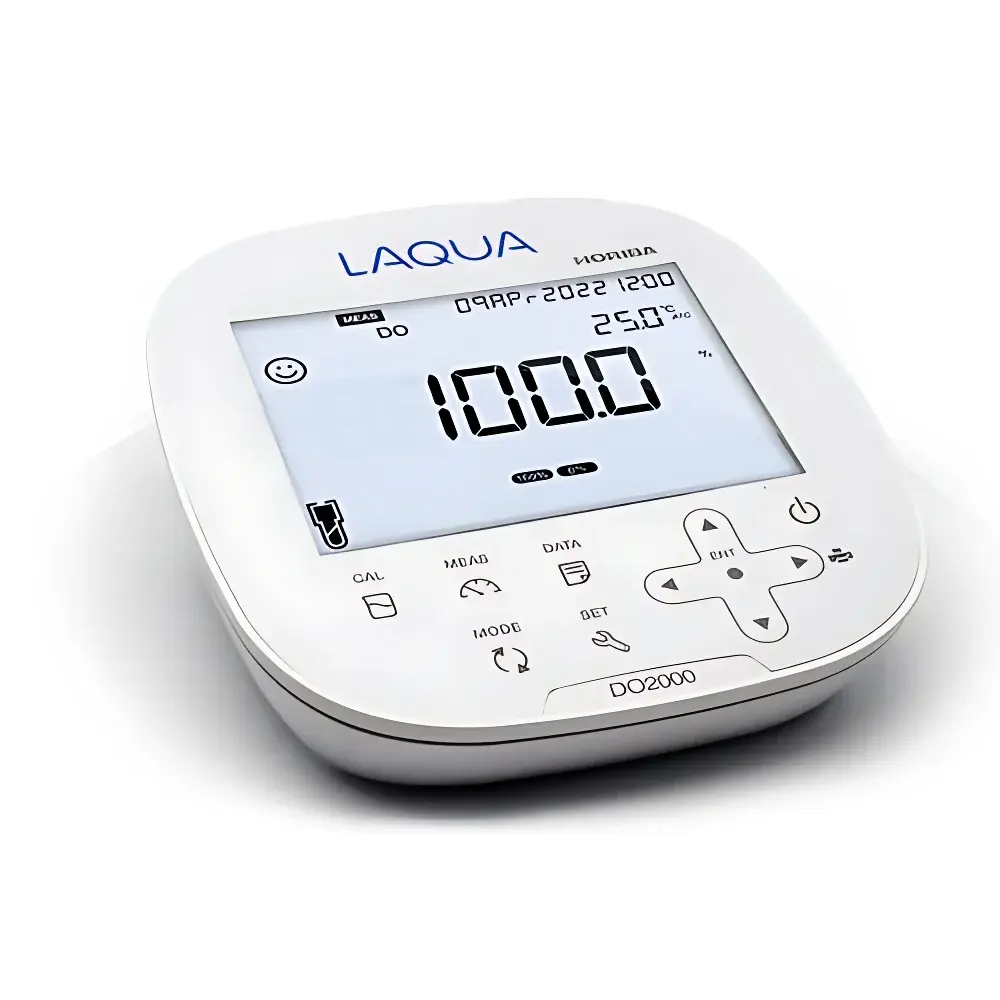
HORIBA LAQUA DO2000 Benchtop Dissolved Oxygen and BOD Meter
| Brand | HORIBA |
|---|---|
| Origin | Japan |
| Model | DO2000 |
| Instrument Type | Benchtop Laboratory Meter |
| Measurement Principle | Galvanic Cell (Electrochemical) |
| DO Range | 0.0 to 60.00 mg/L |
| DO Accuracy | ±0.1 mg/L |
| Temperature Range | −30.0 to 130.0 °C |
| Temperature Accuracy | ±0.5 °C |
| Salt Compensation | 0.0–40.0 ppt |
| Pressure Compensation | 10.0–200.0 kPa |
| BOD Method | Standard 5-Day with Seed Correction |
| Memory Capacity | 2,000 Data Sets with Timestamp |
| Communication | USB (DAS20 Software), RS-232C (Printer) |
| Display | 5-inch Backlit LCD (320-segment) |
| Power | AC Adapter (100–240 V, 50–60 Hz) |
| Dimensions | 155 × 150 × 67 mm |
| Weight | 765 g |
Overview
The HORIBA LAQUA DO2000 is a high-precision benchtop dissolved oxygen (DO) and biochemical oxygen demand (BOD) meter engineered for rigorous water quality analysis in environmental laboratories, wastewater treatment facilities, and academic research settings. It employs a galvanic cell-based electrochemical sensor—distinct from optical (luminescence-based) or polarographic principles—to deliver stable, low-maintenance DO measurements across a wide dynamic range (0.0 to 60.00 mg/L). Its integrated temperature sensor and real-time compensation algorithms correct for salinity (0.0–40.0 ppt), atmospheric pressure (10.0–200.0 kPa), and temperature (−30.0 to 130.0 °C), ensuring traceable accuracy per ISO 5814:2012 and ASTM D888-22 guidelines for DO determination in natural and treated waters. Designed explicitly for compliance-driven workflows, the DO2000 supports GLP/GMP-aligned data integrity through timestamped storage, audit-ready calibration logs, and password-protected configuration access.
Key Features
- Galvanic DO sensor with built-in ATC (Automatic Temperature Compensation) and factory-calibrated stability for minimal drift over extended operation
- Dual-parameter capability: simultaneous DO (mg/L and % saturation) and temperature measurement with independent resolution (0.01 mg/L, 0.1 °C)
- Pre-programmed 5-day BOD protocol compliant with ISO 5815-1:2019 and APHA Standard Methods 5210B, including optional seed correction for low-BOD or nitrifying samples
- Two-point DO calibration with user-selectable standards (e.g., air-saturated water and zero-oxygen solution) and electrode diagnostics displayed in real time
- Three operational modes: Auto-Stabilize (locks reading at ±0.02 mg/L stability), Auto-Hold (captures final stabilized value), and Real-Time (continuous streaming at 1 Hz)
- Large 5-inch backlit LCD with 320-segment display—optimized for readability under variable lab lighting and glove use
- Integrated electrode holder and compact footprint (155 × 150 × 67 mm) designed for space-constrained analytical benches
Sample Compatibility & Compliance
The DO2000 is validated for aqueous matrices including freshwater, seawater, wastewater effluents, drinking water, and biological reactor samples. Its galvanic sensor exhibits minimal interference from common ions (Cl⁻, NO₃⁻, SO₄²⁻) and is insensitive to hydrogen sulfide up to 1 mg/L—critical for anaerobic digestion monitoring. All calibration and measurement data adhere to ISO/IEC 17025:2017 documentation requirements, with full traceability to NIST-traceable reference standards. The instrument’s firmware implements secure, non-volatile memory storage meeting FDA 21 CFR Part 11 criteria for electronic records: each of the 2,000 stored entries includes immutable date/time stamps, operator ID (via password login), and sensor status flags (e.g., membrane integrity, electrolyte level).
Software & Data Management
Data acquisition and reporting are managed via HORIBA’s DAS20 software (Windows-compatible), accessible through USB interface. DAS20 enables batch export to CSV or Excel, customizable report templates (including QA/QC summary tables), and graphical trend analysis with overlay of multiple DO/temperature/BOD datasets. RS-232C output supports direct printing to serial-compatible thermal printers for hard-copy audit trails. Firmware updates are delivered via signed binary packages, preserving cryptographic integrity. All communication protocols are encrypted at transport layer, and the system maintains full audit trail of configuration changes—including calibration history, password modifications, and auto-shutdown timeout adjustments (configurable from 1 to 30 minutes).
Applications
- Regulatory compliance testing for EPA Method 360.1 and ISO 5814 in municipal and industrial wastewater discharge monitoring
- BOD₅ assessment in environmental impact assessments (EIAs) and NPDES permit renewal submissions
- Process control in activated sludge systems, membrane bioreactors (MBRs), and denitrification basins
- Research-grade DO profiling in limnology, marine ecology, and biogeochemical cycling studies
- Calibration verification and inter-laboratory comparison exercises under ILAC-G8:2022 guidelines
FAQ
What DO measurement principle does the DO2000 employ?
It uses a galvanic cell sensor with a noble metal cathode and zinc or lead anode, generating current proportional to oxygen partial pressure—requiring no external polarization voltage.
Is the instrument suitable for seawater analysis?
Yes; its programmable salinity compensation (0.0–40.0 ppt) and pressure compensation (10.0–200.0 kPa) ensure accurate DO quantification across estuarine and coastal sampling conditions.
Can BOD measurements be performed without seeding?
The DO2000 supports both seeded and unseeded BOD protocols; the seed correction algorithm is optional and configurable per sample matrix requirements.
How is data integrity ensured during long-term deployments?
All measurements include hardware-timestamped metadata; memory retains full context (sensor ID, calibration date, operator credentials), and USB exports retain SHA-256 checksums for forensic verification.
Does the DO2000 meet GLP requirements for pharmaceutical water testing?
While optimized for environmental applications, it satisfies core GLP elements (audit trail, calibration traceability, electronic signature support); however, users must validate against USP and EP 2.2.43 for purified water specifications.







