
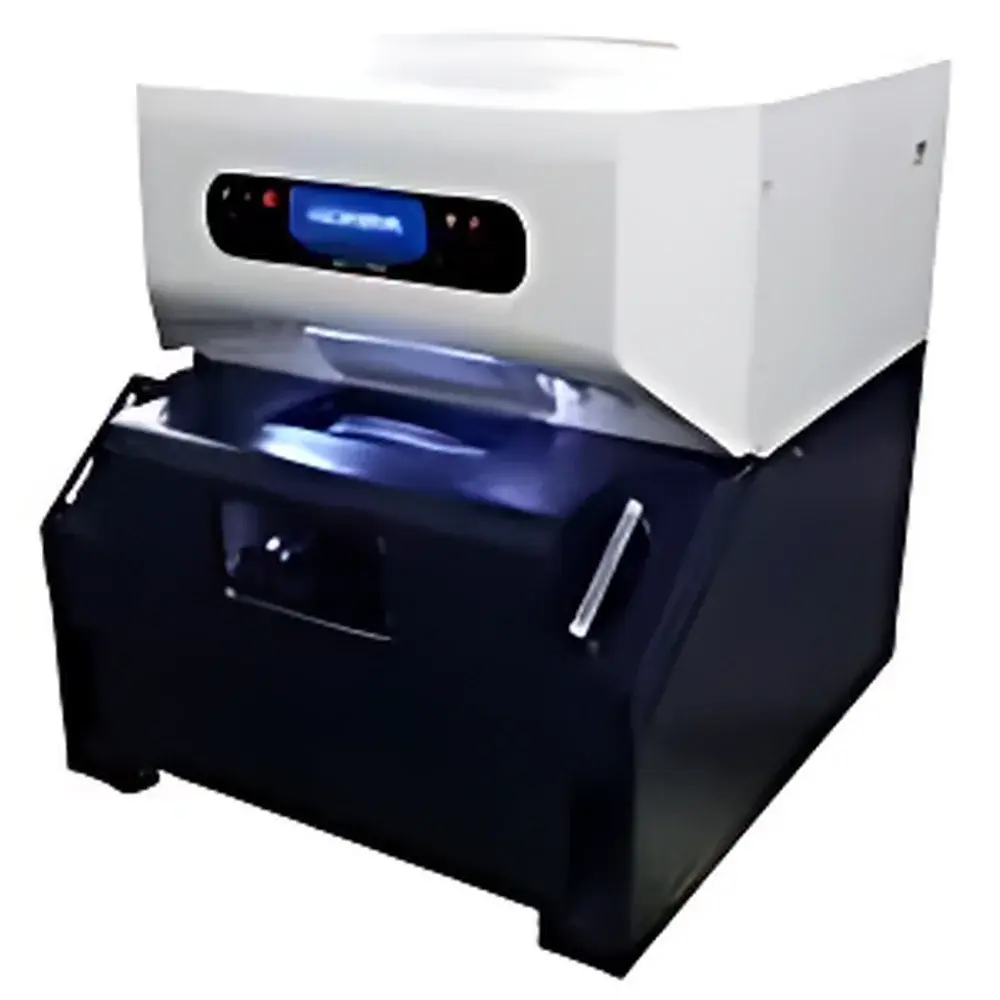
HORIBA XGT-7200WR Energy Dispersive X-Ray Fluorescence Microscope
| Brand | HORIBA |
|---|---|
| Origin | Japan |
| Model | XGT-7200WR |
| Detection Principle | Energy Dispersive X-Ray Fluorescence (ED-XRF) |
| Spot Size Range | 10 µm to 1.2 mm |
| Detector Type | Silicon Drift Detector (SDD), Liquid-Nitrogen-Free |
| Maximum Scan Area | 10 cm × 10 cm |
| Optical-Element Image Co-Registration | Yes |
| Elemental Mapping Resolution | ≤10 µm |
| Compliance | ASTM E1621, ISO 8256, IEC 62321-5 (RoHS), USP <232>/<233>, GLP/GMP-ready data audit trail |
Overview
The HORIBA XGT-7200WR is a high-performance energy dispersive X-ray fluorescence (ED-XRF) microscope engineered for non-destructive, spatially resolved elemental analysis at microscale resolution. Unlike conventional benchtop ED-XRF systems, the XGT-7200WR integrates X-ray optics, real-time optical microscopy, and SDD-based detection into a single platform—enabling simultaneous acquisition of high-fidelity optical images and quantitative elemental distribution maps. Its core innovation lies in the patented X-ray focusing capillary optic (XGT technology), which exploits total external reflection to concentrate polychromatic X-rays into a sub-10 µm beam without compromising photon flux or spectral integrity. This enables true micro-XRF analysis with lateral resolution comparable to electron microprobe techniques—yet without vacuum chamber constraints or sample charging artifacts. The instrument operates across three ambient modes: ambient air, local vacuum (for hydrated or volatile samples), and full vacuum (optimized for light element detection down to sodium). This tri-mode flexibility ensures consistent analytical performance across diverse sample classes—from printed circuit boards and metallurgical cross-sections to biological tissues and geological thin sections.
Key Features
- Patented X-ray focusing capillary optic delivering a minimum spot size of 10 µm with stable intensity and minimal divergence
- Silicon drift detector (SDD) with >125 eV Mn-Kα energy resolution at 100,000 cps count rate—operating without liquid nitrogen cryogen
- Co-axial high-resolution CCD camera enabling precise ROI selection and real-time optical–XRF image overlay
- Motorized X-ray beam collimation system: automatic switching between 10 µm and 1.2 mm apertures under software control
- Programmable stage with ±0.5 µm positional repeatability; supports automated raster scanning up to 100 mm × 100 mm
- Dual-vacuum architecture: rapid (<5 s) transition between atmospheric, localized, and full vacuum environments
- Integrated X-ray transmission imaging mode for internal structural visualization alongside fluorescence mapping
Sample Compatibility & Compliance
The XGT-7200WR accommodates solid, powder, liquid, and semi-solid specimens—including moisture-rich biological tissues, polymer composites, and corrosion-sensitive metal alloys—without mandatory coating or sectioning. Its local vacuum mode maintains partial pressure control over the sample surface while preserving native hydration state, critical for accurate quantification of Cl, K, Ca, and other biologically relevant elements. Full vacuum operation enhances sensitivity for elements from Na (Z=11) to Mg (Z=12) by minimizing atmospheric absorption of low-energy X-rays. The system complies with international regulatory frameworks governing material safety and elemental screening: IEC 62321-5 for RoHS compliance testing, ASTM E1621 for quantitative ED-XRF calibration, ISO 8256 for industrial coating thickness validation, and USP / for elemental impurity profiling in pharmaceutical excipients. Audit-trail-enabled software supports 21 CFR Part 11 compliance for GxP laboratories.
Software & Data Management
Acquisition and analysis are managed via HORIBA’s proprietary XGT Suite v4.x—a modular, scriptable platform supporting method-driven workflows and multi-user permission tiers. The software provides real-time spectral deconvolution using fundamental parameter (FP) algorithms with matrix correction, layer-stack modeling for coated substrates, and automated peak identification against NIST SRM reference libraries. Quantitative results include certified uncertainty estimates per ISO/IEC 17025 guidelines. Elemental maps are exportable as TIFF, CSV, or HDF5 formats with embedded metadata (stage coordinates, acquisition time, tube voltage/current, detector live time). All raw spectra, processed maps, and report files are stored in a relational database with timestamped revision history, electronic signatures, and configurable retention policies—fully traceable for GLP/GMP audits.
Applications
- Electronics: Pb-free solder joint verification, intermetallic compound (IMC) thickness mapping, halogen screening in PCB laminates
- Automotive: Engine wear debris analysis on oil filters, catalyst coating uniformity assessment on exhaust substrates
- Geosciences: Trace element zoning in mineral grains, fluid inclusion chemistry, soil heavy metal speciation
- Forensics: Gunshot residue (GSR) particle morphology + elemental fingerprinting, paint chip layer stratigraphy
- Cultural heritage: Pigment identification in historical manuscripts, corrosion product mapping on bronze artifacts
- Pharmaceuticals: Catalyst residue detection in active pharmaceutical ingredients (APIs), elemental impurity profiling per ICH Q3D
- Life sciences: Metalloprotein localization in tissue sections, nanoparticle biodistribution studies in frozen-hydrated samples
FAQ
What is the smallest measurable feature size achievable with the XGT-7200WR?
The system achieves a nominal X-ray beam diameter of 10 µm under optimized vacuum and collimation conditions—validated using NIST SRM 2197 line-pair test patterns.
Can the instrument analyze liquids or gels directly?
Yes—via sealed sample cups under local vacuum mode, which prevents evaporation while maintaining detection sensitivity for mid-Z elements (e.g., Fe, Cu, Zn).
Is spectral calibration traceable to national standards?
All factory calibrations are referenced to NIST-traceable multielement standards (e.g., NIST SRM 1832/1833), with certificate-of-analysis documentation provided per installation.
Does the software support automated pass/fail reporting for RoHS screening?
Yes—the Rule-Based Screening module applies IEC 62321-5 thresholds and generates compliant PDF reports with embedded spectral evidence and uncertainty statements.
How is detector stability maintained over extended acquisition sessions?
The SDD incorporates real-time temperature stabilization (±0.1°C) and pulse processing algorithms that compensate for gain drift, ensuring <0.5% peak position variation over 8-hour continuous operation.




