
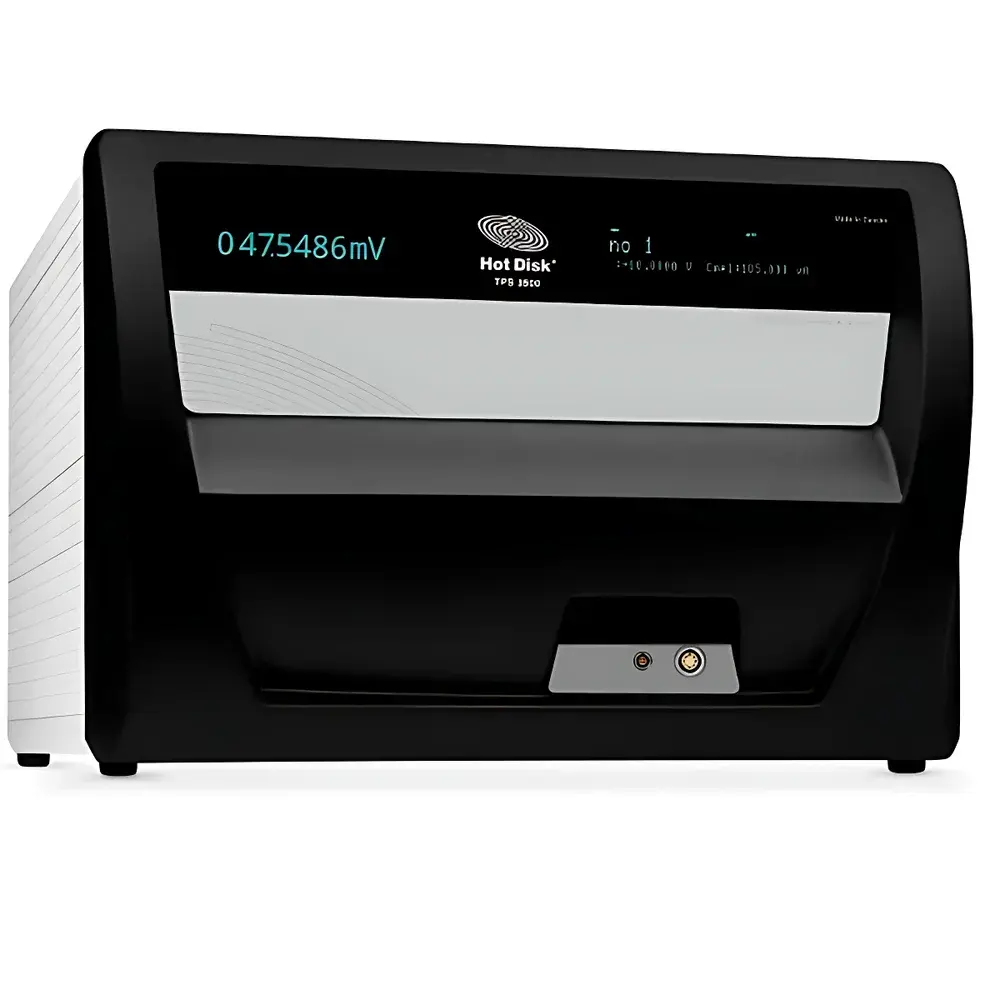
Hot Disk TPS3500 Transient Plane Source Thermal Constants Analyzer
| Brand | Hot Disk |
|---|---|
| Origin | Sweden |
| Model | TPS3500 |
| Measurement Principle | Transient Plane Source (TPS) Method |
| Thermal Conductivity Range | 0.005–2000 W/(m·K) |
| Thermal Diffusivity Range | 0.01–1200 mm²/s |
| Volumetric Heat Capacity Range | up to 5 MJ/(m³·K) |
| Temperature Range | 30 K to 1000 °C |
| Minimum Test Duration | 0.1 s |
| Accuracy | < 3% |
| Repeatability | < 1% |
| Sample Forms | Solids, Liquids, Powders, Pastes, Thin Films, Coatings, Anisotropic & Composite Materials |
| Test Atmosphere | Air, Vacuum, or Inert Gas |
| Sample Dimensions (Min) | 2 mm diameter × 0.5 mm thickness (bulk), 8 mm diameter × 0.1 mm thickness (thin films) |
| Dimensions (L×W×H) | 600 × 460 × 330 mm |
| Compliance | ISO 22007-2:2008 |
Overview
The Hot Disk TPS3500 is a high-precision transient plane source (TPS) thermal constants analyzer engineered for the simultaneous determination of thermal conductivity, thermal diffusivity, and volumetric heat capacity across an exceptionally broad material class. Unlike steady-state or laser-flash methods, the TPS technique employs a symmetric, double-sided sensor that acts both as a heat source and a resistance thermometer. A short-duration DC current pulse generates a controlled thermal transient in the sample; the resulting temperature rise is recorded with microsecond resolution. By solving the analytical solution to the three-dimensional heat conduction equation under transient conditions, the instrument extracts intrinsic thermal properties without requiring assumptions about boundary conditions or contact resistance—provided proper sensor embedding or sandwiching is applied. This physics-based approach delivers high reproducibility and eliminates calibration drift associated with reference standards. The TPS3500 was introduced in 2015 to address evolving demands in advanced materials R&D, particularly for nanocomposites, 2D materials (e.g., graphene, CNT films), ultra-thin coatings, and high-conductivity substrates where conventional probe geometries and minimum sample requirements were limiting.
Key Features
- Ultra-fast measurement capability down to 0.1 seconds—enabling reliable characterization of low-viscosity liquids (e.g., water, solvents) without convective interference
- Extended thermal conductivity range from 0.005 to 2000 W/(m·K), covering insulating polymers, aerogels, ceramics, metals, and highly conductive carbon-based thin films
- Modular design compatible with the full suite of Hot Disk sensors—including single-sided, double-sided, flexible, and high-temperature probes—allowing method adaptation to sample geometry and thermal constraints
- Integrated cryogenic-to-high-temperature stage support (30 K to 1000 °C) with optional vacuum or inert gas enclosures for controlled-atmosphere testing
- Minimal sample volume requirement: as small as 2 mm diameter × 0.5 mm thickness for bulk solids; 8 mm diameter × 0.1 mm thickness for thin-film and layered structures
- Compliance with ISO 22007-2:2008, the internationally recognized standard for thermal conductivity and thermal diffusivity measurements using the transient plane source method
Sample Compatibility & Compliance
The TPS3500 accommodates heterogeneous and anisotropic samples without geometric simplification. Its non-destructive, contact-based methodology supports direct testing of as-received materials—including irregular powders, viscous pastes, suspended nanoparticles, polymer melts, biological gels, and multi-layered composites. For thin films and coatings, the instrument enables interfacial thermal resistance (Rth) estimation when used in conjunction with substrate reference measurements. All test configurations adhere to GLP-aligned documentation practices, and raw data files include embedded metadata (timestamp, ambient pressure, sensor ID, excitation parameters) required for audit readiness under FDA 21 CFR Part 11 and ISO/IEC 17025 frameworks. Traceability to NIST-traceable reference materials (e.g., SRM 1470a, Pyroceram 9606) is maintained via periodic verification protocols included in the software suite.
Software & Data Management
Control and analysis are executed through the proprietary Hot Disk Thermal Analyser Software (v7.x), which provides real-time visualization of voltage decay curves, automatic baseline correction, and iterative curve-fitting using Levenberg–Marquardt optimization. Each measurement session generates a structured .hdp binary file containing raw thermistor response, environmental logs, and computed property values with uncertainty estimates derived from signal-to-noise ratio and parameter sensitivity analysis. Export options include CSV, Excel, and XML formats compliant with LIMS integration. Audit trails record all user actions—including parameter edits, reprocessing events, and report generation—with time-stamped digital signatures. Optional modules support batch processing, DOE-driven experimental planning, and automated compliance reporting aligned with ISO 17025 clause 7.7 (Results Reporting).
Applications
- Thermal interface material (TIM) development for power electronics and EV battery modules
- Quality control of ceramic matrix composites in aerospace turbine components
- Structure–property correlation studies of phase-change materials (PCMs) for thermal energy storage
- In-process monitoring of additive manufacturing powder beds and sintered layers
- Thermal characterization of biomedical hydrogels and tissue-engineered scaffolds
- Validation of multiscale simulation models (e.g., molecular dynamics, finite element analysis) for nanomaterials
FAQ
What distinguishes the TPS3500 from earlier Hot Disk models such as the TPS2500S?
The TPS3500 features enhanced electronics enabling sub-100-ms test durations, improved signal-to-noise ratio at low thermal effusivity, and expanded compatibility with ultra-thin (<0.2 mm) and high-aspect-ratio samples—without sacrificing accuracy or dynamic range.
Can the TPS3500 measure anisotropic thermal conductivity?
Yes—by orienting the sensor relative to crystallographic or structural axes and performing orthogonal measurements, directional thermal conductivity tensors can be reconstructed for unidirectional fibers, layered perovskites, or aligned nanocomposites.
Is vacuum-compatible operation validated per ISO 22007-2?
Yes—the vacuum chamber configuration (optional accessory) maintains thermal symmetry and minimizes radiative error across the full 30 K–1000 °C range, satisfying Clause 6.3 (Environmental Conditions) of ISO 22007-2:2008.
How is probe calibration performed?
Hot Disk probes are factory-calibrated against certified reference materials; users perform routine verification using supplied Pyroceram or graphite standards. No field recalibration is required unless mechanical damage occurs.
Does the system support automated temperature ramping during sequential measurements?
Yes—when paired with programmable temperature stages (e.g., Linkam LTS420 or Antylab HTS1000), the software executes synchronized thermal ramps with user-defined dwell times and measurement intervals.



