
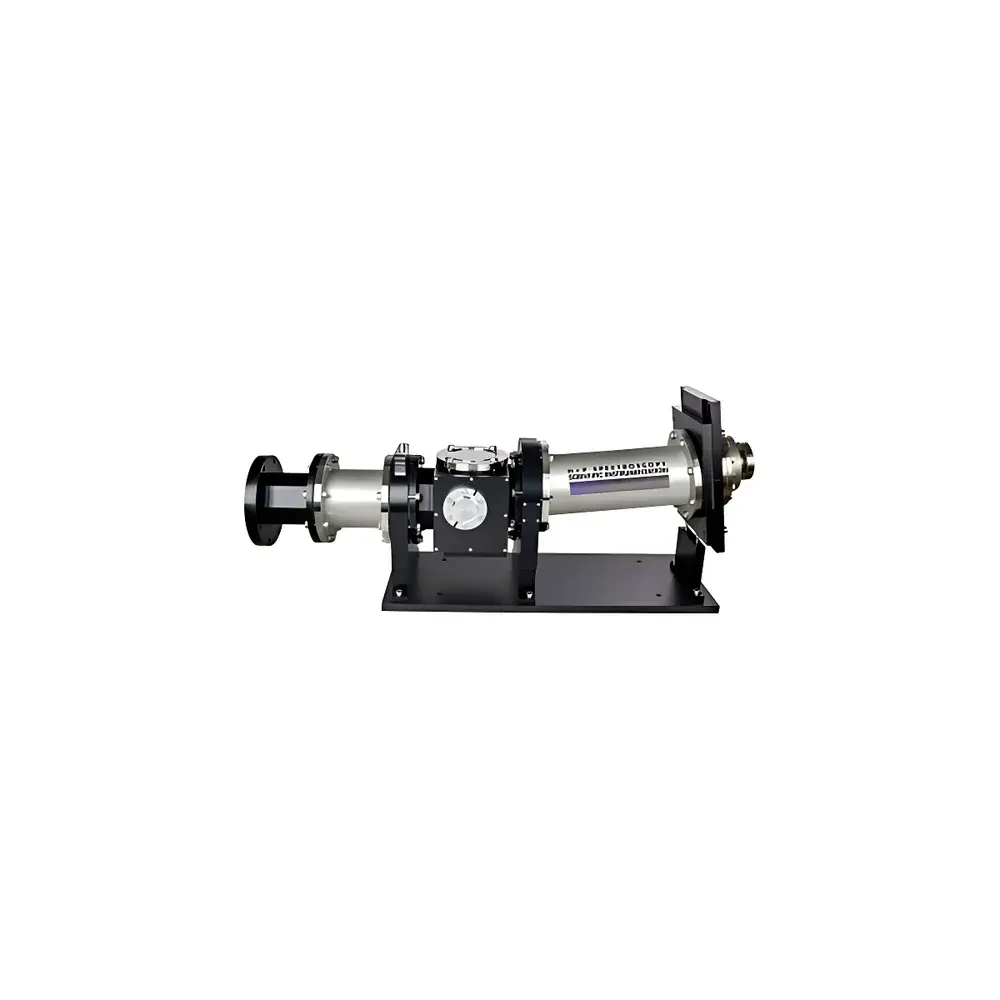
HP Spectroscopy highLIGHT High-Resolution Flat-Field XUV Spectrometer
| Brand | HP Spectroscopy |
|---|---|
| Origin | Germany |
| Manufacturer Type | Authorized Distributor |
| Origin Category | Imported |
| Model | highLIGHT High-Resolution Flat-Field XUV Spectrometer |
| Wavelength Range | 1–100 nm |
| Topology | Aberration-Corrected Flat-Field Spectrometer |
| Slitless Operation | Yes (slit optional) |
| Grating Positioning | Closed-Loop Motorized Stage |
| Filter Insertion | Integrated with USB/Ethernet Control Interface |
| Detector Compatibility | nXUV CCD, MCP/CMOS |
| Vacuum Compatibility | <10⁻⁶ mbar (UHV version available on request) |
| Dispersion | 0.06 nm/mm (SXR), 0.1–0.2 nm/mm (SXRXUV), 0.2–0.7 nm/mm (XUV) |
| Resolution | <0.001 nm @ 3 nm |
| Customization Options | Non-magnetic design, rotational geometry, spectral band optimization |
Overview
The HP Spectroscopy highLIGHT is an aberration-corrected, flat-field extreme ultraviolet (XUV) spectrometer engineered for high-resolution, high-throughput spectral analysis in the 1–100 nm wavelength range. It operates on the principle of grazing-incidence spectroscopy, leveraging optimized optical design to eliminate off-axis aberrations while maintaining uniform spectral focus across the detector plane. Unlike conventional Czerny–Turner or Rowland-circle instruments, the highLIGHT employs a slitless, direct-imaging architecture—where the source is imaged onto the detector without an entrance slit—enabling up to 20× higher photon throughput compared to slit-based systems. This architecture preserves both spectral fidelity and signal intensity, making it especially suited for low-flux sources such as high-harmonic generation (HHG) beams, laser-produced plasmas, synchrotron beamlines, and tabletop EUV/XUV sources. Its flat-field correction ensures minimal spatial distortion across the full spectral range, supporting quantitative line-profile analysis and precise energy calibration traceable to NIST-standard emission lines.
Key Features
- Aberration-corrected flat-field optics delivering uniform spectral resolution and imaging fidelity from 1 nm to 100 nm
- Slitless operation with optional motorized slit assembly—enabling rapid switching between high-throughput and high-resolution acquisition modes
- Closed-loop motorized grating stage with sub-microradian angular repeatability for precise, reproducible wavelength scanning
- Integrated filter insertion mechanism with programmable control via USB or Ethernet interfaces
- Modular detector compatibility: supports nXUV back-illuminated CCDs (for high dynamic range and sub-pixel resolution), as well as gated MCP/CMOS detectors (for time-resolved or intensity-gated measurements)
- Ultra-high vacuum (UHV)-compatible mechanical design (<10⁻⁶ mbar base pressure); UHV-optimized variants available with non-magnetic materials and bake-out rated components
- Configurable spectral bands: SXR (1–5 nm), SXRXUV (1–20 nm), and XUV (5–100 nm) variants with tailored dispersion characteristics (0.06–0.7 nm/mm)
Sample Compatibility & Compliance
The highLIGHT spectrometer is compatible with a broad range of pulsed and continuous XUV sources—including HHG systems (e.g., Yb-fiber lasers at 334 kHz repetition rate), laser-produced plasmas (LPP), discharge plasmas, and synchrotron bending magnet or undulator beamlines. Its optical path accommodates variable source distances and flexible experimental geometries (e.g., normal-incidence or grazing-incidence alignment). All mechanical and electronic subsystems comply with CE marking requirements for laboratory instrumentation. The vacuum interface conforms to ISO-KF and CF standards; electrical interfaces meet IEC 61000-6-3 (EMC) and IEC 61010-1 (safety). For regulated environments, the system supports audit-ready metadata logging when integrated with LabVIEW or custom software adhering to FDA 21 CFR Part 11 guidelines (electronic signatures, data integrity, and change control).
Software & Data Management
The highLIGHT includes a native Windows-based GUI for instrument control, spectral acquisition, real-time calibration, and basic line-fitting. A comprehensive SDK is provided for LabVIEW, VB.NET, C, and C++ development—enabling seamless integration into automated test benches or multi-instrument synchronization frameworks (e.g., with delay stages, pulse pickers, or streak cameras). Calibration files include wavelength maps, pixel-to-energy conversion tables, and detector quantum efficiency curves traceable to PTB (Physikalisch-Technische Bundesanstalt) reference data. Raw frame data are saved in HDF5 format with embedded metadata (exposure time, grating angle, filter ID, vacuum pressure), ensuring FAIR (Findable, Accessible, Interoperable, Reusable) data practices. Optional plugins support spectral deconvolution using Richardson–Lucy algorithms and Doppler-broadening correction for plasma diagnostics.
Applications
- High-harmonic spectroscopy: Resolving individual harmonic orders (e.g., 9th and 11th harmonics at ~33.4 nm and ~27.3 nm) with ΔE/E ≈ 7.5 × 10⁻⁴ bandwidth fidelity
- Atomic and ionic emission spectroscopy: Measuring fine-structure splitting and lifetime-broadened lines (e.g., nitrogen Kα at 2.88 nm, resolving power R = 1890–3290)
- Plasma diagnostics: Time-resolved XUV emission mapping for electron temperature and density estimation in laser-irradiated targets
- EUV lithography source characterization: Spectral purity assessment and out-of-band radiation quantification below 13.5 nm
- Attosecond science: Supporting pump–probe experiments requiring sub-meV energy resolution and shot-to-shot spectral stability
- Beamline end-station instrumentation: As a compact, turnkey monochromator alternative for soft X-ray absorption spectroscopy (XAS) and resonant inelastic scattering (RIXS)
FAQ
Is the highLIGHT spectrometer compatible with ultrafast laser sources?
Yes—the slitless design and high collection efficiency make it ideal for low-duty-cycle, high-peak-power sources such as femtosecond HHG systems. Gated MCP/CMOS detectors enable synchronization with laser pulses down to <100 ps temporal resolution.
Can the instrument be operated under atmospheric conditions?
No—optical performance requires vacuum operation (<10⁻⁶ mbar) due to strong XUV absorption by air. Standard configurations include DN40CF vacuum flanges and integrated pressure monitoring.
What level of spectral calibration accuracy is achievable?
Wavelength calibration uncertainty is ±0.2 pm (k = 2) when referenced to known atomic transitions (e.g., He II at 30.38 nm or Ne I at 11.42 nm), verified using PTB-traceable spectral lamps.
Is remote operation supported?
Yes—Ethernet-enabled control allows full instrument orchestration over LAN/WAN, including grating positioning, filter selection, exposure triggering, and live spectrum streaming.
Are OEM integration services available?
HP Spectroscopy offers engineering support for custom mechanical interfaces, vacuum feedthrough adaptations, magnetic shielding, and co-aligned multi-spectrometer configurations for multi-angle scattering setups.
Related Products





